Wonderland Dungeon
Cinnamon BunWonderland Dungeon is the dungeon that turns Wonderland imagery into a lethal, rule-governed environment and then becomes one of the book’s clearest examples of dungeon instability. It first appears as a newly entered adventure site, a place of prompts, quests, bosses, and class-related rewards; it ends with its core destroyed, its ley-line connections snapping apart, and the surrounding settlement forced toward evacuation. Between those points, it functions as a progression test, a theatrical imitation of a familiar cultural story, and a physical system whose rules punish improvisation as readily as they reward it.
Identity and Setting
Wonderland Dungeon is entered through a hole in the ground. The moment Broccoli Bunch’s foot touches the ground inside it, the system announces that the character is entering the dungeon, and a quest update follows. The entrance therefore establishes the dungeon as more than an ordinary ruin: it is a recognized game-like space with an interface, formal conditions, and an implied sequence of objectives. Broccoli’s immediate association with Alice in Wonderland confirms that the dungeon deliberately presents itself through a recognizable cultural frame rather than through anonymous fantasy architecture.
Its main room is later identified as a delve room, the central room of a dungeon from which the floors can be accessed. Amaryllis explains that a delve room can allow movement between a dungeon’s floors, but it cannot be used to skip ahead; the dungeon punishes attempts to do so, while still allowing an explorer to leave when necessary. Broccoli recognizes the Wonderland Dungeon’s large room and vertical shaft as this kind of hub. That retrospective explanation gives structural meaning to the earlier descent: the dungeon’s layout is not merely scenic, but part of an enforced progression system.
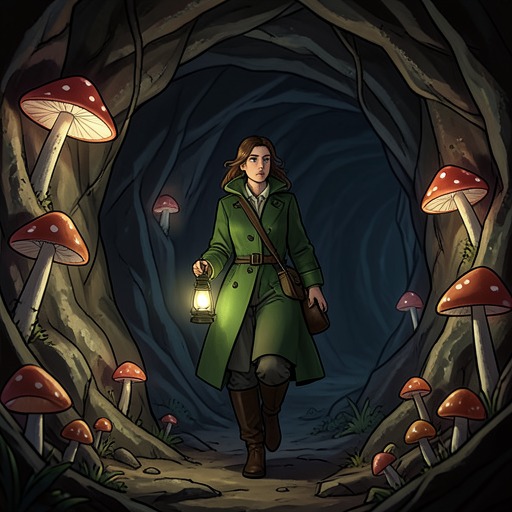
The first major interior view is a railless balcony overlooking a shaft perhaps ten or twenty meters wide. Its open top shows the bright green sky, while platforms occupy different levels and huge bulbous mushrooms grow in a spiral around the sides. The vertical arrangement makes the dungeon feel simultaneously like a natural cavern, a stage, and a puzzle built around movement. Broccoli’s jumping skill becomes materially useful in this space, allowing the character to climb the mushrooms without great difficulty when returning toward the courtroom area.
Wonderland Design and Dungeon Mechanics
The dungeon’s visual language is explicit. Clean stone floors and walls are decorated with red-and-black banners bearing the symbols of a heart, diamond, club, and spade. The orderly surfaces contrast with the dangerous spaces elsewhere, while the repeated card imagery converts the dungeon into a built version of Wonderland’s courtly and game-like iconography. The setting’s familiarity is therefore constantly unsettled: signs and symbols invite recognition, but the dungeon’s rules turn recognition into a survival problem.
The structure also adapts or changes over time. Amaryllis consults a guide whose Time of Writing is nearly a year old and warns that the dungeon may have gained at least one floor since the guide was produced. Traps may have moved as well. This information makes the Wonderland Dungeon a shifting environment rather than a fixed map. Knowledge remains useful, but it is never completely secure; an explorer can possess a route description and still confront a changed dungeon.
Broccoli’s attempt to return to the courtroom depends on whether the first-floor boss, Maddy the Hatter, must be fought again. The plan also depends on negotiating the mushroom route and on finding the correct entrance. The dungeon’s obstacles are consequently layered: physical traversal, boss recurrence, spatial memory, and uncertainty about changing conditions all shape the expedition. A plate bearing a cake marked “Eat-Me” waits where Broccoli expected time-traveling rabbits, showing how the dungeon replaces one Wonderland reference with another while preserving its logic of tempting, potentially consequential objects.
The dungeon’s system responds to actions as well as combat. Broccoli’s Cleaning class is associated with cleaning magic, and cleaning magic is used offensively against a ghost. A special action performed in line with the Cinnamon Bun class unlocks the skill Cute, linking the dungeon’s progression logic to character identity rather than limiting advancement to conventional violence. The dungeon thus measures behavior through a programmable reward structure: movement, class expression, and combat can all become advancement events.
Bosses and Escalation
The dungeon’s threats are announced through alerts and formalized through boss designations. Broccoli encounters the Zombie of Cheshire as a level-five boss. Defeating it produces multiple rewards: experience is granted for overcoming an enemy above Broccoli’s level, additional experience is awarded for defeating a dungeon boss, and the system then declares the dungeon cleared. The encounter therefore marks both a personal victory and a mechanical threshold in the dungeon’s progression.
The Zombie of Cheshire is not the only boss associated with the route. Maddy the Hatter is identified as the first-floor boss, and Broccoli’s return plan is shaped by the possibility of having to fight Maddy again. This distinction matters because the dungeon’s sequence is cumulative: a later confrontation with the Zombie of Cheshire exists within a path already defined by an earlier boss and by the risk of repeated encounters. The dungeon turns traversal into a chain of tests rather than a single isolated battle.
The danger becomes most visible after the dungeon is cleared. Broccoli reaches the Dungeon Core for the Wonderland Dungeon, but the core’s destruction initiates a collapse. Broccoli runs through the first portal as the boss room’s ground heaves beneath their feet. Sharp rocks loosen overhead and fall like spears, while monoliths tremble. The escape is not a ceremonial conclusion to victory; it is a race through a structure that has become physically unstable. The dungeon’s systems and its architecture fail together.
Destruction and Regional Consequences
The system announces that the Wonderland Dungeon Core has been destroyed. This changes the meaning of the earlier clearance: the dungeon is not simply conquered and left intact, but brought to an irreversible end. Its destruction is a direct consequence of the expedition’s climax, and the collapsing boss room supplies the immediate physical aftermath.
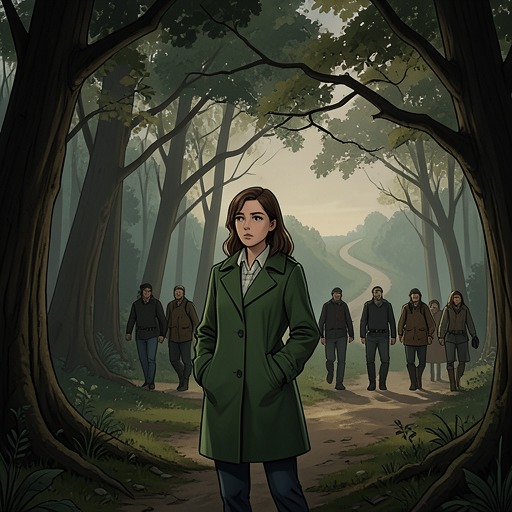
The wider implications appear in records concerning Dunwich. Local mages, including an alchemist, detect mana fluctuations, while the adventuring party sent to the Dunwich dungeon disappears from notice. A later report describes large mana shifts, possible damage to the dungeon core, and a sighting of someone in green in the forest; the guards are doubled and a scout is sent to investigate. These reports frame the dungeon from outside the adventurer’s viewpoint, replacing prompts and boss notices with uncertainty, surveillance, and emergency preparation.
The final report confirms that the Dunwich dungeon was destroyed and identifies the mana shifts as ley lines snapping apart. The mayor does not want to evacuate, but the report concludes that there is no choice because Imperials are nearby and the mana is turning unstable. The dungeon’s collapse therefore exceeds the boundaries of its rooms. It destabilizes the surrounding magical landscape, contributes to the abandonment of Dunwich, and transforms an expedition site into a regional crisis.
Narrative Significance
Wonderland Dungeon joins playful intertextual design to real mechanical danger. The green sky, card banners, mushrooms, courtroom route, “Eat-Me” cake, Maddy the Hatter, and Zombie of Cheshire all evoke Wonderland, but the references are not harmless decoration. They are embedded in a leveling system that tracks quests, class-aligned actions, boss experience, floor access, and dungeon clearance. Familiarity becomes a lure into a place whose rules must still be learned.
Its destruction also gives the dungeon a distinctive narrative arc. It begins as a threshold, announces itself through a prompt, offers routes and rewards, escalates through bosses, and ends by tearing apart the magical infrastructure that sustains it. The contrast between clean floors and falling stone, cute class rewards and lethal encounters, and recognizable story motifs and unpredictable dungeon change defines its identity. Wonderland Dungeon is significant precisely because it makes advancement inseparable from consequence: Broccoli gains progress by entering, fighting, exploring, and acting according to class, but the world records the dungeon’s end as a disaster rather than as a simple victory.