Wonderland Dungeon Entry and Exit Rules
Cinnamon BunThe Wonderland Dungeon Entry and Exit Rules define the dungeon’s access boundary through a prompt-driven choice: after entry, the system asks whether the dungeon should be sealed until exit. When the choice is refused, the instance remains unsealed, and both entry and exit are opened to any person. The rule therefore does more than describe geography; it turns dungeon access into a selectable condition with immediate consequences for party security, rescue, pursuit, and repeated travel.
Entry and the Sealing Choice
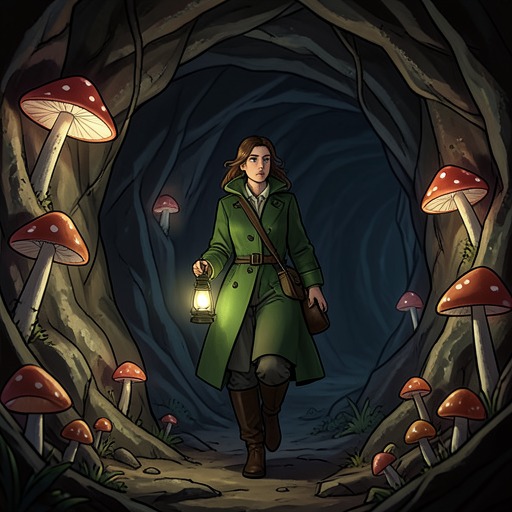
The rule is presented when the party reaches a hole leading into the Wonderland Dungeon. After the entrant’s foot touches the ground inside it, the system announces entry into the dungeon and identifies the accessible range as Dungeon Level 2–4. It also confirms that the entire party has entered the instance before presenting the decisive question, “Seal Dungeon until exit?” The sequence establishes three linked facts: entry is registered by the system, the dungeon has a stated level range, and the party’s access status can be modified at the threshold rather than being an invisible environmental property.
The sealing option is framed as a practical safety measure, but it is also a restriction on the dungeon’s social permeability. Sealing would preserve the instance for those already inside until they left; refusing it keeps the boundary open. The protagonist rejects the proposal as an awful idea, and the system records the opposite condition: “Dungeon left Unsealed.” The rule thus makes the protagonist’s judgment consequential without requiring a separate ritual, key, or guardian to enforce the decision.
Operation of an Unsealed Instance
Once the dungeon is left unsealed, the system states two symmetrical permissions: “Any Person can Enter Dungeon Instance” and “Any Person can Exit Dungeon Instance.” The wording is deliberately broad. It does not limit access to the original party, to authorized adventurers, or to people who entered through the same opening. Nor does it trap entrants inside. The result is an open instance whose boundary allows traffic in both directions.
This openness distinguishes the rule from a simple door mechanism. The dungeon remains a shared and potentially revisitable space rather than becoming a private combat arena. The same condition that permits outside parties to enter also preserves the possibility of retreat, return, assistance, pursuit, or interference. Because the rule applies to any person, its benefits and dangers are distributed equally: the party is not imprisoned, but neither is it protected from outsiders who may reach the same floors.
Relation to Dungeon Progression
The access rule operates alongside the dungeon’s layered structure. The entry announcement places the party in Dungeon Level 2–4, while later exploration reveals doors, keys, consumable traps, and bosses whose difficulty does not always conform neatly to the announced range. A poisoned shrinking potion and a poisoned cake of enlargening appear as explicit dungeon objects, and the Zombie of Cheshire is identified as a level-five boss despite the earlier level-two-to-four designation. These details make access control especially important: entering the instance is only the beginning of navigating a space whose internal threats and permissions are governed by system prompts.
The dungeon’s rules also coexist with quest logic. An earlier prompt calls upon the protagonist to save the world from a great evil and offers the binary choices to accept or refuse the quest. Inside the dungeon, another quest update directs the protagonist toward the Evil Root and states that the root cannot yet be destroyed directly; instead, the Core must be broken so that the root starves. The entry-and-exit rule belongs to this same interface culture. It converts a strategically charged decision into a visible system option, allowing the protagonist to act while also exposing the limits within which that action can occur.
Consequences and Narrative Significance
Leaving the dungeon unsealed preserves freedom of movement, but it removes exclusivity. The party can leave without being forced to complete the dungeon, and other people can enter without needing the party’s permission. That combination makes the rule a structural source of both opportunity and vulnerability. It prevents the dungeon from becoming an inescapable confinement while ensuring that control over its contents cannot be assumed merely because one group reached it first.
The wider progression system reinforces the rule’s behavioral logic. Special actions aligned with the protagonist’s Cinnamon Bun class unlock Cleaning, repeated social action unlocks Friendmaking, and successful combat against three higher-level Sentinel Ghosts grants bonus experience before the class reaches level one. These rewards teach the protagonist to read the world as a system in which choices, repetition, and risk produce formal feedback. The unsealed dungeon follows the same pattern: a spoken refusal becomes a recorded state, and that state governs who may cross the dungeon boundary.
The rule’s most important effect is therefore interpretive as well as practical. It presents danger as something that can be managed through explicit permissions rather than eliminated. The protagonist is offered a protective restriction, rejects it, and receives maximum openness instead. In the Wonderland Dungeon, freedom of entry and freedom of exit are inseparable; the same unlocked threshold that keeps escape possible also leaves the dungeon exposed to every possible entrant.