
Rationalism and Tradition at the EJ
City of GodThe Synagogue of Evolutionary Judaism's seminars put modern reason in direct conflict with the imperative of revealed religion.
increasing Bearing strength in each event
 decreasing
Bearing strength in each eventdecreasingA Congregation of Questioners
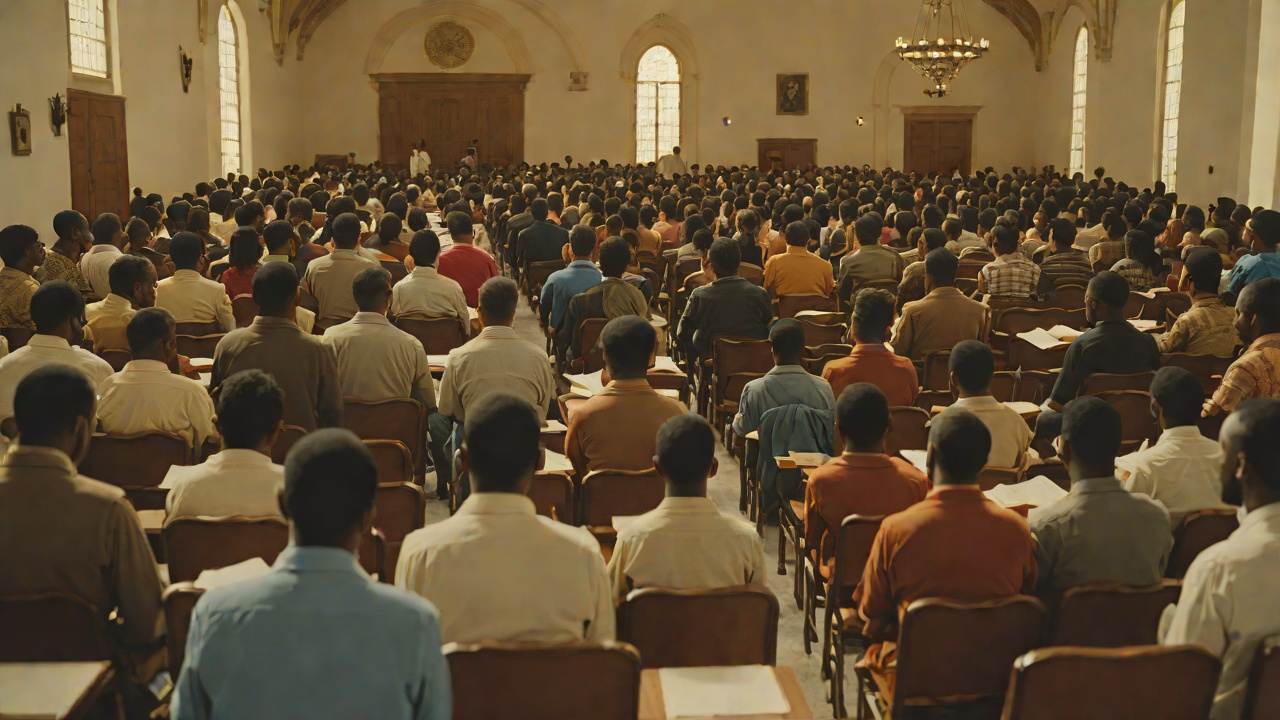
A Congregation of Questioners
Context
The small congregation gathers for services redesigned around the Shema, Kaddish, and an extended seminar. Members include professors, judges, doctors, an actress, and an elderly man carried up the stairs by his son. They study the documentary hypothesis, the historical sources of the Torah, and the ethics of the commandments.
Significance
The EJ makes questioning a liturgical act. It assumes that religious texts have human authors and multiple voices, and that piety requires intellectual honesty. The result is a community held together not by dogmatic assent but by a shared commitment to inquiry.
Consequences
The seminars attract newcomers who may be expecting more comfort. A tension develops between the founding radicals and those who want tradition.
The Elder's Challenge

The Elder's Challenge
Context
When an elderly man stands and says that epic is for the Greeks, the room laughs, and he is emboldened. He declares that some things must not be questioned: the Torah was given by the Creator, and without accepting the yoke of the Kingdom of Heaven there is no religion. Pem slumps in his chair, recognizing the moment when rationalism hits the wall.
Significance
The elder articulates the irreducible core of traditional faith. He is not stupid; he is devout. His challenge forces the EJ to answer the most difficult question of all: whether a religion can survive without revelation's authority.
Consequences
Sarah responds with Hillel and the Golden Rule, but the tension is unresolved. The service moves to Kaddish, yet the old man's words linger.
The Heavy Man's Ancestor-Worship Attack
The Heavy Man's Ancestor-Worship Attack
Context
A heavyset man rises with difficulty and says that traditionalist devotions that do not allow the light of modern knowledge are no more than ancestor worship. He argues that reverencing the words of the ancients puts something between us and God. The room goes silent.
Significance
The attack sharpens the conflict into a single antithesis: God or ancestors, revelation or reason. Everett recognizes the speaker as Murray Seligman, the Nobel Prize-winning physicist. His argument carries the authority of modern science.
Consequences
The congregation is galvanized. Sarah calls for the Kaddish, but the debate will resume in later services and in the novel's larger meditation.
Seligman's Cosmology

Seligman's Cosmology
Context
Seligman lays out the modern universe: fifteen billion years old, expanding, made of dark matter, galaxies, and quantum waves. He asks whether Lord and King are sufficient honorifics for the Creator of this cosmos. He ends by suggesting that God may be insufficiently praised by the entire inherited language of worship.
Significance
His speech is an eruption of science into theology. It reframes the EJ's mission as an effort to discover a God of the anthropic universe rather than the localized Lord of ancient Israel. For Pem it is another sign, one that hides itself in the traffic of contemporary knowledge.
Consequences
Everett is shaken to learn that the speaker was the same Murray Seligman who copied his algebra homework. The encounter connects the ordinary and the cosmic, making revelation a matter of daily coincidence.
Sarah's Evolving Answer
Sarah's Evolving Answer
Context
Sarah continues to lead the congregation through the conflicts, welcoming newcomers but finding the seminar model strained by growth. She speaks of God as Something Evolving and argues that the ethical life itself is evidence of the divine. She holds tradition and reason in a creative tension.
Significance
Sarah's theology is the novel's most balanced response to the rationalism versus tradition conflict. She refuses to choose between Hillel's Golden Rule and the cosmological Creator. The EJ itself is a structure built for that refusal.
Consequences
The congregation survives, grows, and becomes the spiritual home for Pem's conversion. The conflicts do not end, but they become part of a living tradition that can hold them.
on Friday nights in the first years of the EJ
at the service where an elderly man objects to the word epic
moments later, when a heavyset man answers the elder
at the later Friday service when Seligman speaks at length
after Seligman's speech, in Sarah's later leadership of the EJ
