Ant
City of GodIn City of God, the Ant appears as a seemingly minor creature observed during a Sunday afternoon in Central Park, yet it becomes one of the novel's most resonant figures for understanding how complex societies cohere without visible central command. The narrator, hunkering down with boys who have discovered a brown ant population in a patch of dirt under a tree, watches these infinitesimal creatures, each not an eighth of an inch long, go about their business building an underground city. From this modest scene, the novel unfolds a sustained analogy between the ant colony and the human metropolis, suggesting that both operate through an invisible organ of aggregate thought that no single member can comprehend.
The Observation in Central Park
The scene begins as a simple moment of shared curiosity: the boys find the ants, and the narrator kneels with them to watch. Two or three different trails of ants radiate from the mound, and the creatures coming and going get in each other's way, sometimes bumping. They wave their antennae about as if they had never seen another one such as themselves before, though that is clearly not the case. The narrator explains that some sort of chemical messages are being synapsed back and forth before each ant continues on its way or, sometimes, reverses itself and goes back the way it had come. The description is precise and affectionate, treating the ants not as metaphors but as actual living beings engaged in purposeful activity.
The Social Order of the Colony
The narrator reflects that ants do not look for that much out of life. They may be brainless, but nothing alive is more purposive, disciplined, or possessed of a stronger work ethic. Their lives are all work, even the queen's, perhaps especially, down there under the mound where the observers cannot see her. Lacking brains, ants make do with genetically programmed little nervous sympathies that allow them to contribute to the general welfare. Whatever their role in the society, as egg tenders, warriors, guards, or food gatherers, they are all working for the queen, preserving and protecting her as an egg-laying monarch whose fecundity determines the future of the society. Yet any given ant in its life probably never sees the queen, or more than its immediate confreres, although if it circulates more widely than that, certainly with no memory of having met any specific fellow ant before.
The Invisible Organ of Thought
The narrator's central speculation concerns the ants' invisible organ of aggregate thought. Ant by ant, body by body, and without any visible central decision-making mechanism, they seem to take instruction from one another, antenna to antenna, and are unified in their responses. The narrator compares this to parallel processors, or to the human cortical structure of neurons. Each ant comprises one cell of a group brain, unlike the human brain in being unlocatable, somewhere above and around them, an invisible organ of thought that is beyond the capacity of any one of them to understand. This image of a distributed, unlocatable intelligence becomes the novel's model for thinking about collective life, whether in the ant mound or in the human city.
The City as a Parallel System
The narrator explicitly extends the ant analogy to human beings. He notes that these are the simplest, most modest kinds of ants, domesticated Central Park ants, the house sparrows of the ant species. There are others in the jungles and rain forests and veldts of the world, big ones, that build leaf bridges in trees, cultivate crops, float across rivers on rafts of their own devising, march, make war, eat meat, and bite like hell. These are ants that have a patriotic sense of their anthood, if not a degree of self-esteem. The narrator then speculates that if, in a city park of broad reaches, winding paths, roadways, and lakes, one could imagine seeing on a warm and sunny Sunday afternoon the random and unpredictable movement of great numbers of human beings in the same way, one might watch one person, one couple, one family, a child, and assure oneself of the integrity of the individual will while being unable to divine what the next moment would bring. But when the masses are celebrating a beautiful day, the same invisible organizing principle seems to apply.
The Ant and the Urban Over-Brain
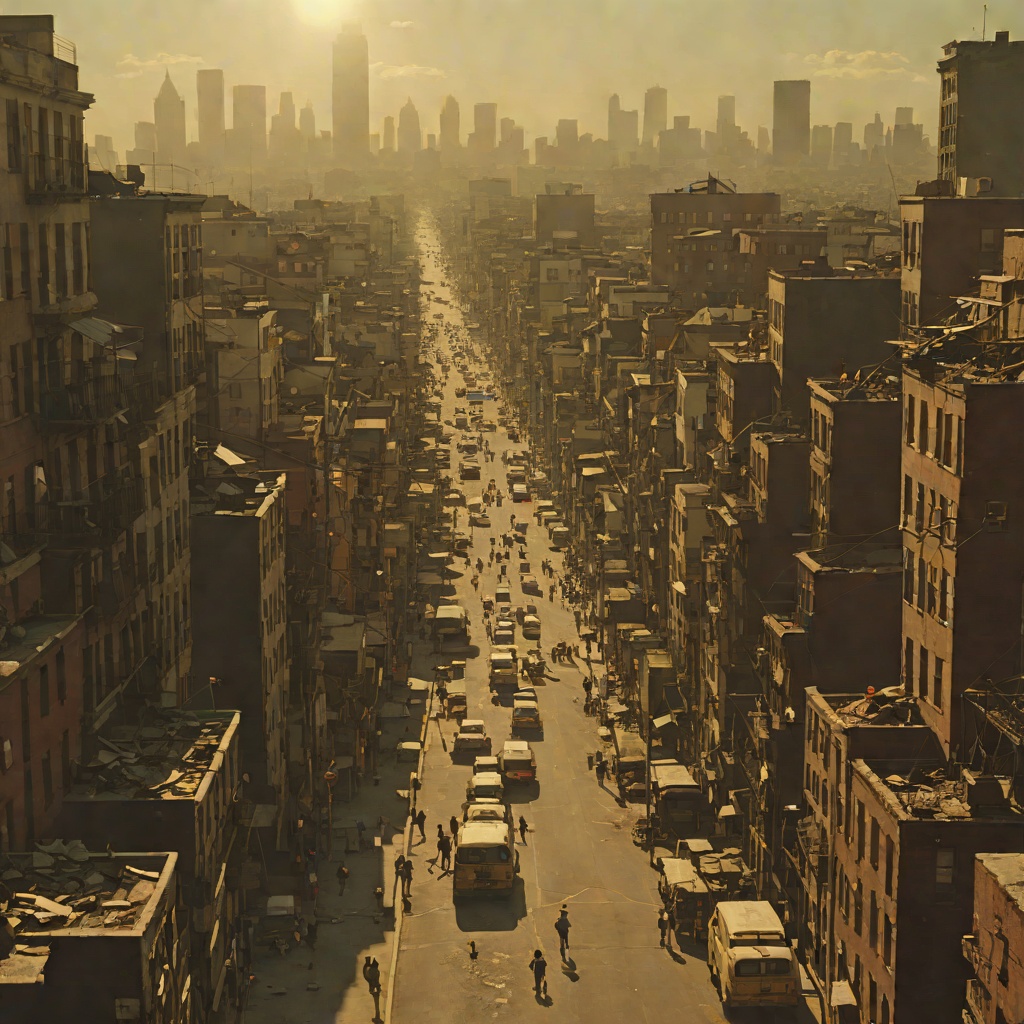
The Ant thus connects to the novel's broader vision of New York City as a living system. The narrator elsewhere describes stopping on any corner at the intersection of two busy streets and seeing thousands of lives headed in all four directions, uptown, downtown, east and west, on foot, on bikes, on in-line skates, in buses, strollers, cars, and trucks, with the subway rumble underneath. He speaks of a primatial over-soul, a species recognition never acknowledged, and reflects that the city may begin from a marketplace, a trading post, or the confluence of waters, but it secretly depends on the human need to walk among strangers. The ant colony, with its unlocatable group brain, offers a natural template for this urban over-brain, the invisible organ of thought that emerges from the aggregate movements of millions of individuals who never consciously coordinate with one another.
Significance in the Novel's Ecology
The Ant belongs to a constellation of animal images in City of God that includes the birds of Valdemingomez, the great urban aviary at a garbage dump north of Madrid where over a hundred thirty species of storks, hawks, egrets, linnets, kites, jackdaws, ravens, condors, and turkey buzzards circle and nest in old Big Mac containers and TV cabinets. Where the birds represent the wild and the exotic thriving on human waste, the ants represent the modest, the domestic, and the foundational. The narrator's explanation to the children, and the adults coming over to see what they were looking at and enjoying the rap, turns the ant mound into a site of informal education and communal wonder. The Ant ultimately serves as the novel's most concrete demonstration that purposive, disciplined, unified action need not require a visible leader or a central decision-making mechanism, a principle that resonates through the novel's explorations of faith, community, and the mysterious coherence of urban life.