Big Bang
City of GodThe Big Bang is the book’s central expression for an origin that is at once scientific hypothesis, verbal problem, and substitute creation story. It describes the universe’s expansion from a singular point while opening questions that physics cannot finally contain: what existed before space, what “into” can mean when space itself is born, and whether consciousness is accidental or somehow anticipated by the structure of matter. The expression therefore links cosmology to theology, narrative, and the persistence of wonder.
Definition and Cosmic Beginning
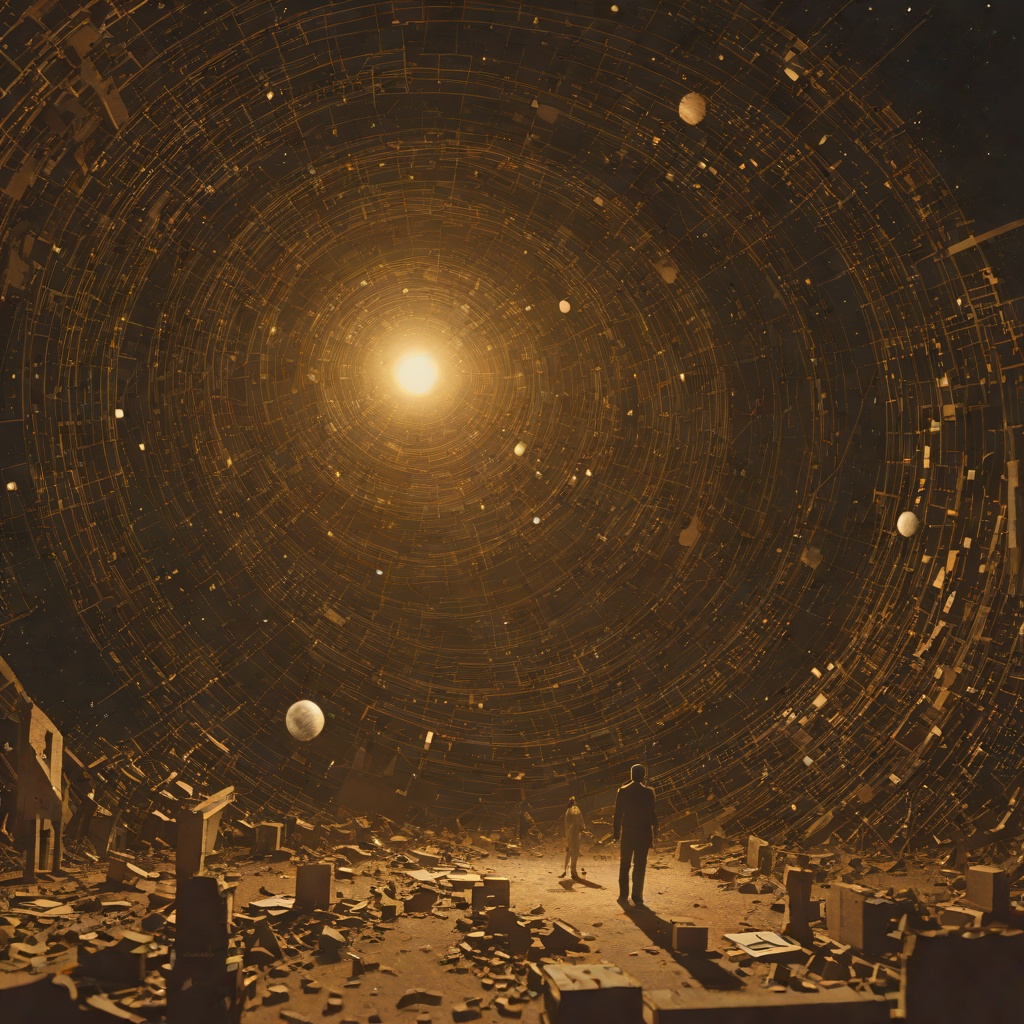
The Big Bang theory is presented as an exponential expansion from a singular space-time point: an original particulate event or quantum occurrence whose scale makes the word “explosion” inadequate. The crucial distinction is that the universe did not burst into already available space. Space itself expanded, carrying gas, matter, darkness, and light outward in what the narrator imagines as a silent, instantaneous flowering from nothing into the volume and chronology of space-time. This formulation makes the Big Bang less a detonation inside a container than the appearance of the container along with everything it contains.
The theory also supplies a history of continuing transformation. After the initial event, star matter evolves through elemental dust, nebulae, burning, glowing, and pulsing; galaxies and stars move away from one another across roughly fifteen billion years. Yet the account immediately generates a conceptual disturbance. If the original singularity contained all space and all time, the universe’s present expansion seems to require an answer to the question of what it is filling. The Big Bang thus explains cosmic development while preserving an abyss at the center of explanation.
Scientific Language and Its Limits
The expression is surrounded by the playful terminology of cosmology. Possible cosmic futures are named the Big Crunch, in which gravity draws the universe back into itself, and the Big Chill, in which insufficient density allows expansion to continue. Dark matter is discussed through the acronyms WIMPs and MACHOs. The narrator treats this vocabulary as both charming and troubling, wondering whether scientists are mocking themselves or practicing a form of bravery under metaphysical fire. The names make the unknown manageable, but their cuteness also exposes the distance between technical mastery and existential understanding.
The same tension appears in the account of neutrinos. Physicists build enormous heavy-water tanks deep underground, beneath seas, lakes, mountains, tunnels, and Antarctic ice, hoping to detect the tiny voltage produced when neutrinos pass through the darkness. Their nearly frictionless passage through the earth becomes a bodily image of invisibility made briefly perceptible. The narrator then reassigns the particle’s discovery to a remembered episode at Bronx High School of Science, where Seligman claimed to have proved the existence of a subatomic particle with no physical properties. The anecdote folds advanced physics into adolescent rivalry and makes scientific discovery inseparable from memory, exaggeration, and personal storytelling.
Creation, God, and Consciousness
The Big Bang becomes a challenge to both atheistic accident and conventional religious certainty. The narrator considers it more absurd to imagine that the universe and human consciousness arose through mere happenstance than to posit a Creator. Albert Einstein’s ability to live with the idea of a creator becomes a model for a less doctrinaire theology. Einstein’s name for God, the Old One, emphasizes age, singularity, comprehensiveness, and freedom from gender. The phrase does not produce a conventional revelation, but it offers a precise language for a divinity encountered through the order of the cosmos rather than through petition or intervention.
That divinity remains deliberately incomplete. The narrator imagines Einstein tracking God in gravity, in the weak and strong nuclear forces, or in light moving at 186,000 miles per second, while acknowledging that this is not the concerned God to whom people pray. The Big Bang therefore does not prove a personal deity. Instead, it creates a field in which scientific description and religious intuition can meet without either one fully absorbing the other. Cosmic origin becomes a pressure placed on every available explanation.
Near the book’s end, this pressure is reformulated through the anthropic principle. The universe expands at an inflationary rate, remains opaque under gases for billions of years, and becomes illuminated when photons move through space and stellar furnaces form. Out of that sequence come the elements that make human life possible. The principle does not simply claim that people exist; it asks why the universe’s composition permits consciousness at all. Seligman’s explanation turns cosmic history into a conditional statement about human possibility: whatever the universe is made of has made humanity possible.
Recurrence and Narrative Significance
The Big Bang’s final recurrence shifts the expression from cosmology to artistic transmission. Movies no longer require physical film; they can be recorded and held in digital suspension as ones and zeroes. When the last remaining piece of the world has been filmed, the narrator imagines another Big Bang in which those digital multitudes scatter through the universe as particles behaving like waves. Under future winds, solar flares, or other celestial signals, they could assemble into brilliant colored constellations on a remote planet.
In that imagined future, an unrecognizable form of life looks upward and sees the faces of Randolph Scott, Gail Russell, George Brent, and Linda Darnell among the stars. The image makes cinema a second creation event: not the birth of matter, but the dispersal and possible reassembly of human images. The Big Bang thus gathers the book’s major concerns into one expression. It names physical origin, marks the limits of explanation, permits a nontraditional encounter with God, frames the emergence of consciousness, and finally becomes a metaphor for how stories and faces might outlast their makers by entering the universe as matter-like signals.