Big Chill
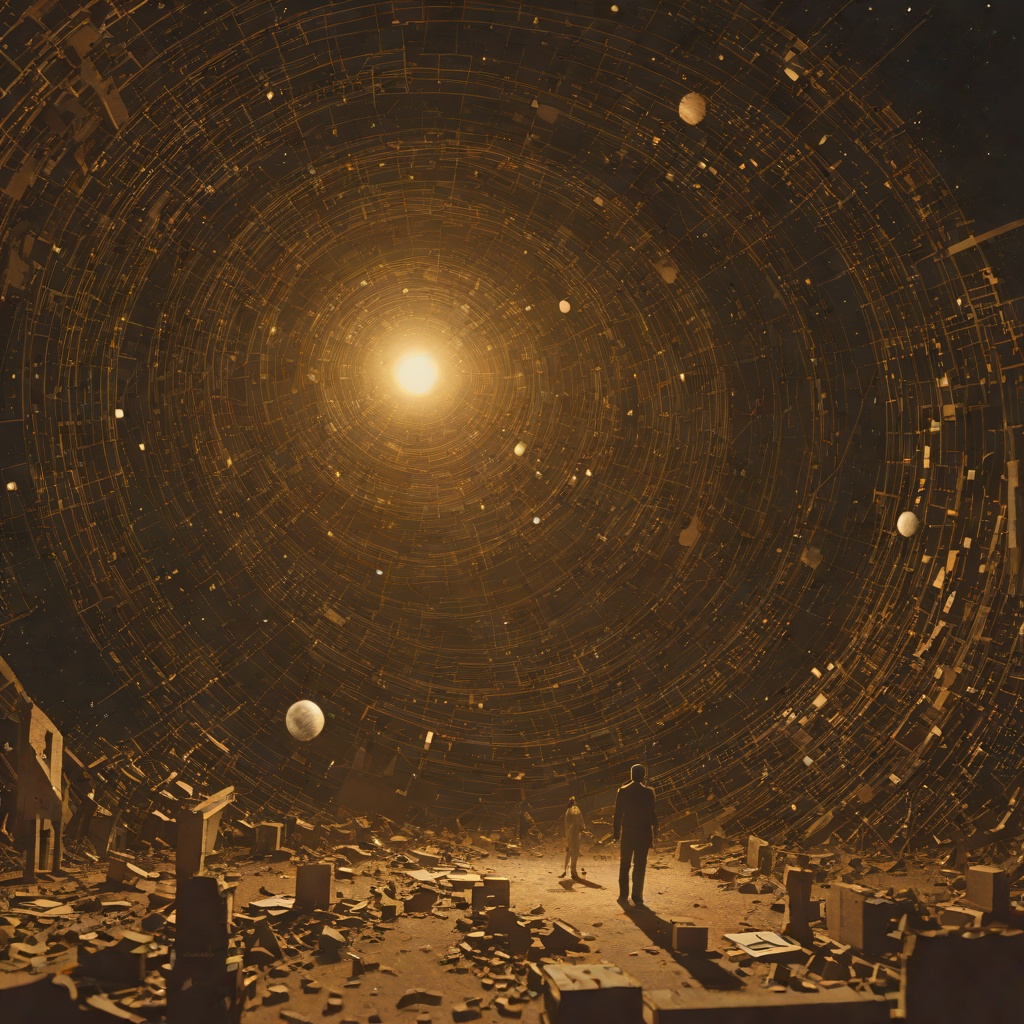
City of GodThe Big Chill is one of the three hypothetical terminal fates of the universe that the narrator of City of God contemplates in the novel's opening cosmological meditation. It names the scenario in which the universe, lacking sufficient density to collapse back on itself, continues expanding forever until it cools into a state of diffuse, lifeless equilibrium. Within the novel's theological argument, the Big Chill functions as a counterpoint to the Big Bang and the Big Crunch, part of a taxonomy of cosmic endings that the narrator finds both scientifically suggestive and philosophically troubling.
The Cosmological Taxonomy
The Big Chill appears in the narrator's survey of the names that cosmologists and astronomers have given to the possible fates of the universe. The narrator observes that the scientific mind is "by its nature childish, capable through life of a child's wonder and excitements, but lacking real discernment, lacking sadness, too easily delighted by its own intellect." This judgment frames the entire taxonomy: the Big Bang, the Big Crunch, and the Big Chill are all presented as examples of the "cute names" that scientists give to their universe. The narrator notes that if the universe cannot overcome its own gravity, it will "fly back into itself, and that will be the Big Crunch," but "in the event of a lack of density, it will continue to expand, and that will be the Big Chill." The Big Chill thus stands as the expansionist alternative to the gravitational collapse of the Big Crunch, the two terminal scenarios bracketing the present moment of cosmic expansion.
The narrator's catalog extends beyond these three fates to include the vocabulary of dark matter research: the neutrino or weakly interacting massive particles, known as WIMPs, and the massive compact halo objects, or MACHOs, that form the darkmattered halos around galaxies. The narrator wonders whether these names represent "American trade humor" practiced out of modesty, as the English practice self-denigration in their small talk, or whether they constitute "bravery under fire, that studied carelessness in the trenches while the metaphysical rounds come in." The Big Chill, in this reading, is not merely a scientific hypothesis but a rhetorical gesture, a way of naming the unnameable end of all things with a shrug.
The Expanding Universe
The Big Chill presupposes the account of cosmic origins that the narrator lays out at the very opening of the novel. The theory holds that the universe expanded exponentially from a singular space/time point, "some original particulate event or quantum substantive happenstance," to such an extent that the word explosion is inadequate, though the theory is known as the Big Bang. The narrator emphasizes that the universe did not burst out into pre-existent available space; rather, "it was the space that blew out, taking everything with it in a great expansive flowering, a silent flash into being in a second or two of the entire outrushing universe of gas and matter and darkness-light." This was "a cosmic floop of nothing into the volume and chronology of spacetime."
Universal history since has seen "a kind of evolution of star matter, of elemental dust, nebulae, burning, glowing, pulsing, everything flying away from everything else for the last fifteen or so billion years." The Big Chill is the logical terminus of this ongoing expansion: if the universe lacks sufficient density, it will simply keep flying apart, cooling as it goes. The narrator presses on the strangeness of this picture, asking what it means to say that space itself is what expanded, stretched, flowered, and into what. The universe, "expanding even now its galaxies of burning suns, dying stars, metallic monuments of stone, clouds of cosmic dust, must be filling . . . something." The Big Chill is the name for the end of that filling, the moment when expansion has done all it can and the universe settles into a cold, diffuse stillness.
The Anthropic Principle and the Question of Purpose
The Big Chill gains its theological weight through its connection to the anthropic principle, which the narrator explains late in the novel. The universe, having exploded into existence at an inflationary rate and spent billions of years swathed in an opacity of gases before photons brought light into space and everything cooled, eventually produced "just those elements" that allowed for the appearance of human life. "Whatever the universe is composed of seems to have made us possible." The narrator credits Seligman with this insight, and it stands in tension with the terminal scenarios: if the universe was somehow composed to make human life possible, what does it mean that its ultimate fate is a cold, lifeless expansion?
The narrator's skepticism about the scientific character of mind runs throughout. The scientists who name the Big Chill are, in the narrator's view, "too easily delighted by their own intellect," lacking the moral gravity that the narrator finds in the physicist Steven Weinberg, "who has the moral gravity you would want from a scientist." The Big Chill, as a name, participates in this delight, converting the death of the universe into a witticism. Yet the narrator's own engagement with the concept is anything but casual; the meditation on cosmic endings is continuous with the novel's larger search for a God who can survive the death of the cosmos.
The narrator's alternative to the scientists' cuteness is the figure of the Old One, Einstein's name for God. Einstein "was not a stylish writer, Albert, but he chose words for their precision," and the Old One is "really very exact": old because archaeologists discovered a Neanderthal skull buried within a circle of stones on the Tyrrhenian coast, the cranium severed and used for a drinking bowl, and one because God is "by definition not only unduplicable and all-encompassing but also without gender." Einstein thought of his work in physics as tracking God, "as if God lived in gravity, or shuttled between the weak nuclear force and the strong nuclear force, or could be seen now and then indolently moving along at one hundred eighty-six thousand miles per second." This is "not exactly the concerned God people pray to or petition, but, hell, it's a start."
The Big Chill, in this context, is the fate that even the Old One must confront. The narrator's cosmology is one in which the universe is not guaranteed to end in meaning; it may simply cool. The narrator's own position, expressed in the novel's closing reflections, is a rejection of "the secular disdain" in favor of a glad heart: "I like birds, I like women, I like language. These foolish things gladden the heart." The Big Chill is the cosmic backdrop against which these foolish things matter all the more, the cold end that makes the warmth of the present moment precious. The narrator's meditation on the Big Chill thus serves as a kind of negative theology, defining by contrast the God who is not the concerned God of petition but the Old One who lives in the very physics that predicts the universe's slow cooling into nothing.