Big Crunch
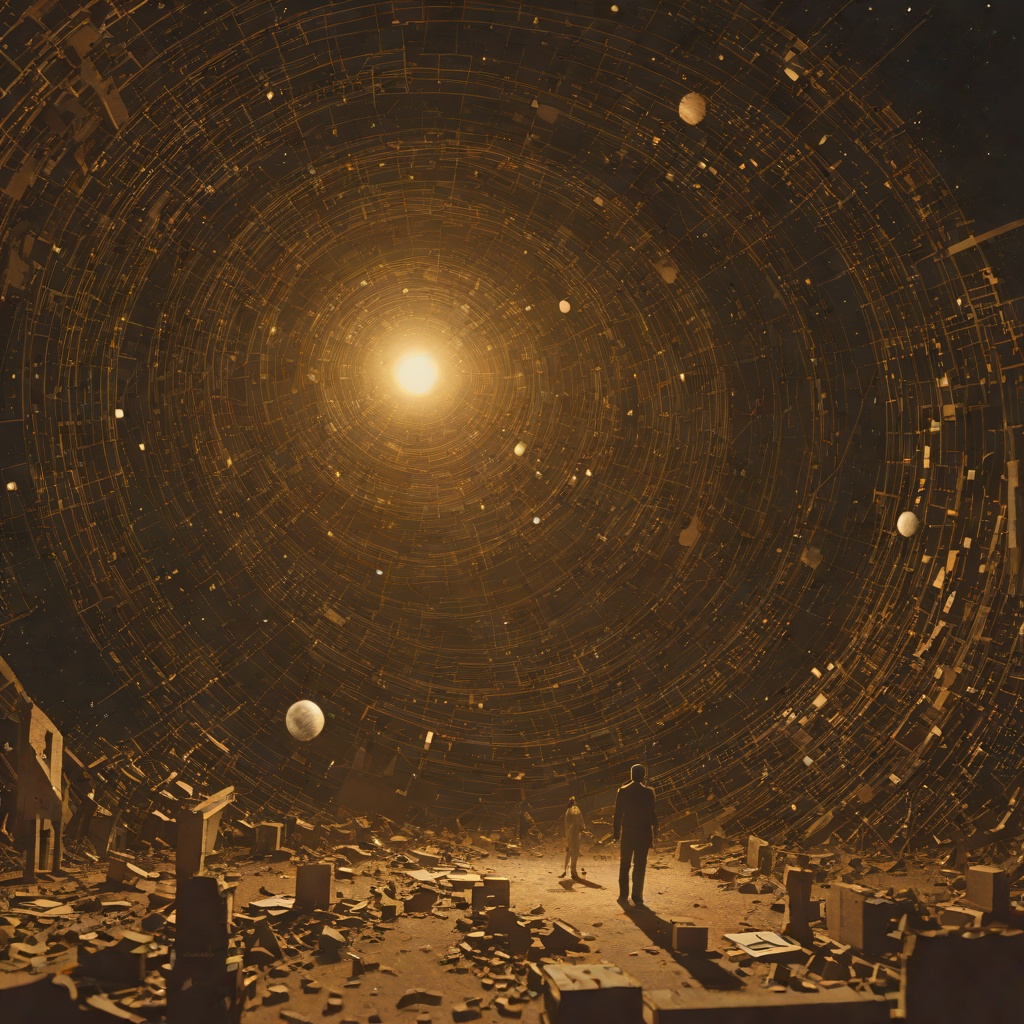
City of GodThe Big Crunch is one of the three cosmological scenarios that frame the opening meditations of E. L. Doctorow's City of God, a novel that begins not with character or plot but with a long, speculative inquiry into the nature of the universe's origin and its possible ends. The concept names the hypothetical event in which the universe, having expanded outward since its explosive beginning, eventually overcomes its own momentum and collapses back into itself. In the novel's telling, this is the fate that awaits the cosmos "in the event it cannot overcome its own gravity." The Big Crunch thus stands as the inverse of the Big Bang, the mirror-image ending to the universe's beginning, and one of the two principal ways the novel imagines the cosmos concluding its history.
Cosmological Context and the Naming of the Universe
The Big Crunch appears within a broader critique of the whimsical nomenclature that cosmologists and astronomers have devised for the universe's grandest phenomena. The novel's narrator observes that the scientific mind, "by its nature childish," is "too easily delighted by its own intellect," and wonders why the professionals who study the cosmos are "so given to cute names for their universe." The Big Bang, the Big Crunch, and the Big Chill are all cited as examples of this tendency. The narrator speculates about the motives behind such naming, asking whether these scientists are "clever fellows mocking themselves," whether it is "a kind of American trade humor they practice out of modesty," or whether it is "bravery under fire, that studied carelessness in the trenches while the metaphysical rounds come in." The Big Crunch, in this reading, is not merely a physical hypothesis but a rhetorical gesture, a way of domesticating the terrifying scale of cosmic destiny through colloquial language.
The novel's opening description of the Big Bang establishes the conceptual framework within which the Big Crunch must be understood. The universe, according to the theory, "expanded exponentially from a point, a singular space/time point," to such an extent that "the word explosion is inadequate." Crucially, the universe did not burst into pre-existent space; rather, "it was the space that blew out, taking everything with it in a great expansive flowering." This was "a cosmic floop of nothing into the volume and chronology of spacetime," a silent flash into being that occurred "in a second or two." For the last fifteen billion years or so, everything has been flying away from everything else. The Big Crunch is the logical terminus of this process, the moment when the outward flight reverses and the universe, in the novel's phrase, "will fly back into itself."
The Big Crunch and the Question of Creation
The cosmological scenarios, including the Big Crunch, serve in the novel as a way of approaching the question of whether the universe's existence requires a Creator. The narrator notes that the idea that the universe "would come into being by some fluke happenstance," that "this dark universe of incalculable magnitude has been accidentally self-generated," is "even more absurd than the idea of a Creator." The Big Crunch, as the universe's potential end, is part of this larger argument about cosmic meaning. If the universe is destined to collapse back into itself, then its entire history, including the emergence of consciousness, would be a temporary phenomenon within a larger cycle of expansion and contraction. The novel uses this prospect to deepen its inquiry into whether the cosmos is governed by accident or by purpose.
This cosmological meditation is connected to the figure of Albert Einstein, who "lived quite easily with the concept of a Creator" and habitually called God "the Old One." The novel reflects on the precision of this name: God is "very old," as evidenced by the discovery of a Neanderthal skull buried within a circle of stones on the Tyrrhenian coast, the cranium severed and used for a drinking bowl, and God is "One" because the divine is "by definition not only unduplicable and all-encompassing but also without gender." Einstein thought of his work in physics as "tracking God," as if God "lived in gravity, or shuttled between the weak nuclear force and the strong nuclear force." The Big Crunch, as a hypothesis about the universe's end, participates in this same project of tracking the divine through the behavior of the cosmos.
The Anthropic Principle and the Universe's Purpose
The Big Crunch is also implicitly connected to the novel's discussion of the anthropic principle, which the narrator explains as the idea that the universe, "having exploded into existence at an inflationary rate, and spent billions of years swathed in an opacity of gases before photons brought light into space," was composed of just those elements that "allowed for the appearance of human life." The narrator attributes this explanation to Seligman, a figure who also appears in the novel's account of the neutrino's discovery at the Bronx High School of Science. The anthropic principle suggests that "whatever the universe is composed of seems to have made us possible." The Big Crunch, as the universe's potential end, stands in tension with this principle: if the universe is destined to collapse, then the conditions that made human life possible are themselves temporary, and the cosmic hospitality toward consciousness is only a phase within a larger process of expansion and contraction.
The novel's treatment of the Big Crunch is thus part of a sustained meditation on the relationship between scientific cosmology and religious meaning. The concept appears not as a plot event but as a recurring intellectual reference point, one of the ways the novel explores whether the universe's vastness and its apparent indifference to human concerns can be reconciled with the idea of a Creator. The Big Crunch, like the Big Bang and the Big Chill, is a name for the universe's ultimate fate, and the novel's narrator wonders whether such names are a form of modesty, a form of humor, or a form of courage in the face of the metaphysical questions that cosmology raises. In this way, the Big Crunch becomes more than a physical hypothesis; it is a figure for the human attempt to comprehend, and to name, the forces that govern existence itself.