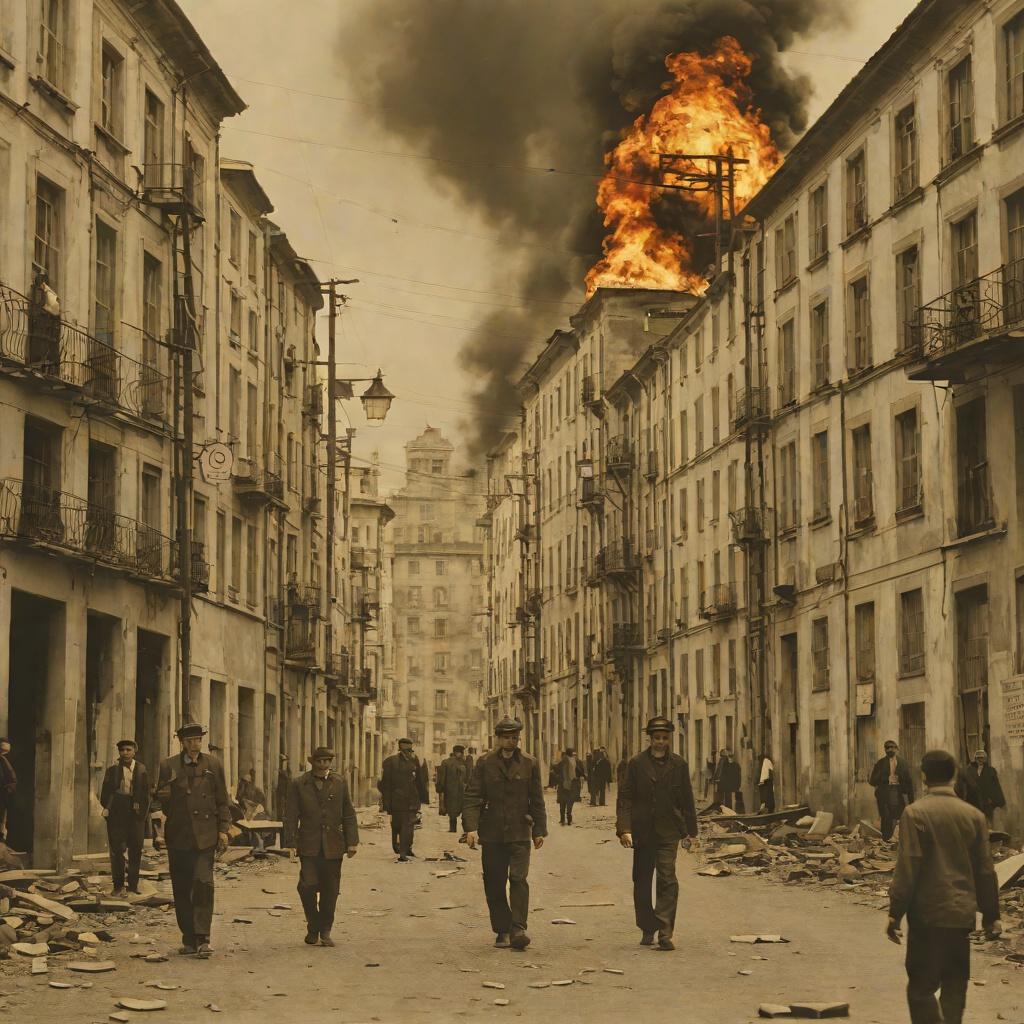
Burning of the Kovno Ghetto Hospital
City of GodThe Burning of the Kovno Ghetto Hospital stands as one of the most harrowing and formative events in E. L. Doctorow's City of God, a mass murder that the novel reconstructs through the childhood memory of Yehoshua, the father of Sarah Blumenthal. The Germans surrounded the ghetto's makeshift hospital, boarded up its doors and windows, and set the structure on fire with more than sixty-five people trapped inside, including twenty-three children. The numbers became indelible in Yehoshua's mind—sixty-five, twenty-three—and the event functions as a rupture in his childhood, a moment when the illusion of safety and even of privilege collapsed before the reality of systematic extermination. The fire is not merely a historical atrocity but the emotional and moral center from which the novel's concerns with testimony, archival resistance, and the failure of justice all radiate outward.
The Hospital and the Horror of the Fire
The hospital was not a modern facility but a cluster of houses that had been refashioned by opening walls and tying the buildings together with lumber, creating three wards of bunk beds—one for men, one for women, one for children—along with examining rooms, a small ill-equipped operating room, and a dispensary. The Germans surrounded the building, boarded up the doors and windows, and set it ablaze with over sixty-five people inside, including twenty-three children. Some of the patients were ill with typhus, and the Germans feared the contagion and the decimation of the labor supply; their solution was to burn everyone alive, including the staff. All the next day smoke rose over the town, lingering like fog in unnaturally warm, overcast weather. Yehoshua's eyes smarted and he coughed, imagining—perhaps accurately—that he had inhaled the smoke of the dead. At dawn, everyone had to go off to work as usual, a detail that underscores the brutal normalization of atrocity within the ghetto's daily rhythms.
Yehoshua's Childhood and the Shattering of Illusion
Before the fire, Yehoshua had lived in a strange and perverted illusion of military pride. As one of seven boys who served as runners for the Kovno Ghetto Council, he wore a special cap with a military brim and a star sewn on his jacket, and he felt privileged that his star was not like all the other stars but some indication of rank. Mr. Barbanel, the chief assistant to the community leader Dr. Koenig, called him his best runner, choosing him for the most important matters. Yehoshua thought of himself as the star runner, secretly even admiring the uniforms of the enemies. He was only ten years old, and he knew full well what was happening even while living in this illusion. The night of the fire, he was awakened by what he thought was the wind whistling through cracks in the attic boards, but it was screaming. He knelt at his window and saw the sky alight with flame, the color reflected on his nightshirt. His mother led him back to bed, telling him they were not on fire and he was safe, and he wrapped himself in his covers, folded the pillow over his ears, and hummed to himself so as not to hear the screams. He fell asleep imagining the screams turning back into the wind, as if drawn up by God, rising to heaven. In the morning, the word came that the Germans had burned down the hospital.
The Father's Resignation and the Council's Futility
The fire was not the first of the so-called actions by the Germans, who had conducted sudden, unannounced sweeps of the houses, trucking people to the old fort on the river west of the city to be murdered. But with this particular horror, Yehoshua's father resigned from his role with the council, finding his complicity in a life of helpless subjugation no longer endurable. There was a secret meeting of the council the next night after the fire, and when he came back, Yehoshua was upstairs, supposedly asleep but as awake and alert as he could be. A silence fell while his mother put bread and soup before him, and he pushed the dish away. He told her that the council would make a formal protest at the monthly meeting with the Germans, applying moral suasion to these ungovernable forces of terror, but his voice was uncharacteristically leaden and toneless. The futility of the council's response is palpable; the formal protest could do nothing against the Germans' bouts of efficiency.
The Archive and the Duty to Document
The fire and its aftermath are inseparable from the novel's central concern with documentation as an act of resistance. Mr. Barbanel, the chief aide to Dr. Koenig, kept a diary in which he reported everything that happened, along with relevant documentation, the latest regulations, execution orders, deaths, minutes of council meetings, orders signed by the infamous Commandant Schmitz, proscriptions, dicta, and identity papers for work details. He used whatever paper he had on hand—unused student exercise books, for example—and wrote in a neat Yiddish, like stitches sewn into the page, the characters very small, the words flying off his pen line after line in his passion to say what happened each day of their lives as captives. His doing this was illegal; the Germans forbade unauthorized writings or photographs and had confiscated all cameras. But as the chief aide to Dr. Koenig, Barbanel had always to be writing something, and it was relatively easy for him to enfold this within his formal duties. When Yehoshua asked him one day if he was by profession a historian, Barbanel smiled and shook his head, saying, "You are one smart kid, Yehoshua. Yes, I'm a historian, by necessity. But you wouldn't tell anyone, would you." They shook hands on it. Barbanel's diary, by the time Yehoshua was aware of it, must have run into thousands of pages, volumes, a whole trunk full of material, and since neither he nor Greta Margolin was to survive the destruction of the ghetto, those papers remained hidden in the earth of Eastern Europe, in its rubble and dust.
The Recovery of the Archive and the Pursuit of Justice
Decades later, the archive's recovery becomes the novel's central quest. The chest containing the materials is impounded at JFK Airport until, at Pem's request, he can get in touch with the Justice Department and have one of their attorneys present when it is cracked open, as customs has insisted it must be. If the archive includes documentary proof of the identity of the ghetto commander, S.S. Major Schmitz, it will have to resist a challenge in court, and so the circumstances of the unsealing have to be irreproachable. Pem and Sarah ride out to JFK in a taxi on a late weekday morning in the rain, and Sarah watches as an inspector takes up a hammer and chisel and goes to work on the chest, which is larger than she had imagined, hammered together with big heavy nails and metallic corner pieces, painted white with raw lumber where the paint has flaked off. The sound of the splitting wood makes her wince, as if her father's history is seeping into the room. The inspectors carefully lift out packages of various sizes wrapped in oilskin, with an oilskin lining against the inner sides of the chest, the fierce preservation of the materials unmistakable and, to Sarah, itself an urgent message that brings a sob to her throat. They unwrap the packages to find sheaves of paper bound in twine, booklets, manuals, folders, rolled-up blueprints, diagrams, stapled documents, and envelopes of various sizes, each labeled in a small, neat Yiddish script. After running their hands along the inner walls, the inspectors agree there is nothing of interest to them and excuse themselves. Pem and the attorney dive in, finding a diary in one increasingly familiar hand covering a period of three years, from 1941 to the date in 1944 when the ghetto is dismantled, along with reams of documentation, rules and regulations issued by the Germans, and innumerable orders with the signature of Commandant Schmitz, confiscating all domestic animals, then all wagons.
The Photograph and the Transmission of Trauma
Among the materials Pem hands Sarah is an envelope of forbidden little black-and-white photos: a line of men and women marching to work behind barbed wire, a husband and wife and their child on a bench having their picture taken with cloth stars sewn to their coats, a woman on her knees in the vegetable garden, the members of the council posing in business suits with stars, a body in a business suit hanging from a gallows with the head awry staring heavenward, winter snow on the ground, and seven little boys in front of a wood cabin, standing at their idea of attention on the steps, wearing military-school caps and stars on their breasts that might possibly be imagined as insignia of their office as runners for the council. They are unsmiling little boys, one with shoulders hunched up in the instinctive posture of self-protection, all underdressed, with short pants and sweaters and jackets they have outgrown, each at attention, feet together, arms pressed against his sides, looking into the camera in the full knowledge of death. Sarah finds her father in the first row. The photograph collapses the distance between the historical atrocity and the present moment, transmitting the trauma across generations and making the reader confront the child who witnessed the burning hospital.
The Failure of Justice and the Unfinished Reckoning
The pursuit of justice for the hospital fire and the broader atrocities ultimately fails. The rabbi has faxed Sarah her father's file, which includes his letters to the Justice Department, their bureaucratic replies, and two 1977 articles from the Times about a deportation hearing. Three people testify that the man in question is the ghetto commandant, Schmitz, but his lawyer shoots down their testimony, arguing they were elderly and easily befuddled. The defendant testifies he is Helmut Preissen, an ex-corporal who only did guard duty in the ghetto for three months before being shipped to fight on the Russian front, the same ID he presented to the immigration authorities after the war. The judge finds in his favor. Letters to and from the Simon Wiesenthal Center show a functionary agreeing with Sarah's father that Preissen is almost certainly Schmitz, but short of convincing documentation, the ID cannot be made that will justify reopening the case, although their file is being kept open. The Justice Department lawyer is somewhat defensive about his handling of the case. At the end of the novel, Pem reports that they found out the son of a bitch died two months ago—Schmid, Schmitz, whatever his name was, the Nazi who ran the ghetto, died in his sleep in a home in Yonkers. "We had him good and nailed, too. Damn!" Pem exclaims, lamenting that the man never had to stand up in court and let the world take a look at him for what he was. The burning of the hospital, with its sixty-five dead and twenty-three children, thus remains an atrocity for which no legal reckoning is ever achieved, its memory preserved only through the testimony of a ten-year-old boy and the archive that survived in the earth.