Crisis of Faith
City of GodCrisis of Faith is the defining state of Thomas Pemberton’s inner and professional life: a condition in which inherited religious certainty has become impossible, yet the desire for God, ethical meaning, and spiritual attachment remains undiminished. Pemberton’s crisis is not presented as private collapse but as an intellectual and moral investigation, conducted through sermons, urban wandering, detective work, historical memory, and his increasingly intimate relation to the Synagogue of Evolutionary Judaism. Its decisive question is whether faith can survive once its consolations, habits, rituals, and claims to exclusive authority have been subjected to doubt.
Definition and First Questions
The crisis first takes the form of an argument against submission disguised as salvation. Pemberton reflects that people are desperate to be unburdened and may therefore embrace Christianity or any other claim of divine authority. In his view, God’s authority can reduce human beings, regardless of tradition, to beggarly submission. Ecumenism does not resolve the difficulty, because treating all faiths as valid can make the choice of Jesus seem merely aesthetic, while asserting one true path immediately raises the problem of identifying the elect and condemning everyone else. The stories communities cherish become the practical means by which they distinguish truth from falsity, and Pemberton therefore presses toward the unsettling possibility that God is, at least in human possession, a story about God rather than an uncontested presence.
This questioning is directed at faith’s pure center rather than at its external supports. Pemberton distinguishes the heart of belief from its consolations, habits, ritual, and sacraments, asking whether anyone can still believe that God is contained by the story told about Him. The crisis consequently attacks not only doctrine but the human impulse to convert uncertainty into authority. Faith remains emotionally powerful, but its power is no longer accepted as proof of its truth.
Pemberton later insists before the bishop’s examiners that his condition is not a spiritual crisis in the ordinary sense. He denies that he has broken down, cracked up, burned out, or caved in, even while admitting that his personal life is in ruins, his church resembles a war ruin, and he feels isolated. His chronic despair has led him to walk the streets of Manhattan for years, but he presents the ideas emerging from that despair as substantive propositions rather than symptoms of psychological decline. The denial is revealing: he rejects the institutional language that would contain his doubts as illness, while acknowledging the loneliness and disorder through which those doubts have developed.
The Cross and the Detective Method
The stolen brass cross makes Pemberton’s crisis material. Searching St. Timothy’s Episcopal Church with a small flashlight, he sees a shadow where the large brass cross should be and discovers the unfaded painted shadow of the crucifix behind the altar. The absence turns the cross from a familiar instrument of worship into a conspicuous thing, a missing object whose shape persists as residue and accusation. A police detective tells him that thieves would more likely target a handwritten Torah because it might bring thousands of dollars, whereas the cross has no meaningful street value and would be treated as scrap metal. This practical explanation intensifies rather than settles the mystery: the theft is irrational according to ordinary commerce, and its irrationality becomes the opening through which theological interpretation enters.
Pemberton responds by borrowing the procedures of detective fiction. He buys used paperback detective novels and imagines that their dependable punishments offer more order than God’s world. He then accepts a voice-mail request from Rabbi Joshua Gruen of the Synagogue of Evolutionary Judaism and decides that, if he is to understand the cross, he must investigate. The meeting is arranged without explanation, and Joshua refuses to answer questions by telephone, preserving the atmosphere of a case whose facts are distributed through guarded encounters rather than delivered as doctrine.
On the roof of the synagogue, Joshua reveals the missing object. The eight-foot hollow brass cross from St. Timothy’s lies flat on the black tarred roof, its transverse parallel to the building’s frontage and its upright pressed against the granite pediment. Pemberton experiences the roof as a place of exhilaration and vertigo, but the physical shock is also interpretive: the Christian emblem has been displaced onto a Jewish institution, where it becomes a sign whose intention cannot be read from its placement alone. Pemberton recognizes that the arrangement is an affront whoever created it, yet even that judgment remains provisional. The cross can be theft, insult, warning, joke, ritual gesture, or communication, and no single explanation commands belief.
The mystery therefore changes the form of the crisis. Pemberton is no longer merely asking whether God exists or whether doctrine is true; he is asking how a person should behave when confronted with a sign that appears meaningful but refuses to reveal its meaning. His detective identity becomes a discipline of attention. The investigation does not promise the restoration of certainty. Instead, it teaches him to remain patient, observant, and accountable in the presence of ambiguity.
Sacrifice, History, and the Failure of Easy Redemption
Pemberton’s theological questioning reaches the doctrine of sacrifice. Drawing on the work of Walter Burkert, he considers the biological image of an animal abandoning part of itself to escape a predator: the lizard leaves its tail, the fox chews off its foot, and the sacrificed portion allows the whole to survive. Ancient myths, in this account, repeatedly imagine human beings escaping monsters by surrendering pieces of themselves. Sacrifice is thus not automatically proof of divine love or moral redemption; it can arise from an older pattern of programmed survival, where one part is given up to delay destruction.
This framework alters the meaning of the cross. The cross may be read as an emblem of atonement, but Pemberton’s reflection places atonement beside bodily terror, instinct, loss, and the coercive logic of saving a whole by destroying a part. Theological language does not transcend violence simply by naming it sacred. The cross’s displacement onto the synagogue roof consequently exposes the unstable traffic between Christian symbolism and Jewish historical memory, between ritual meaning and the brutal material histories that religious symbols can conceal.
The crisis becomes most severe when Pemberton addresses the mass violence of the twentieth century. He speaks of slavery, genocidal murder, war, and the anonymous obliteration of tens of millions, emphasizing that the dead cannot be resurrected even in the imagination of Christian believers. He refuses to resolve these catastrophes through an argument about omniscience, but he does insist that relentless cruelty has brought God into disrepute. Human beings use God for murderous purposes, while God appears not to resist being claimed by anyone for any foul reason. The result is not a neat atheistic conclusion but a suspicion that God may be part of the problem whenever divine authority is made available to violence.
Community, Scholarship, and Love
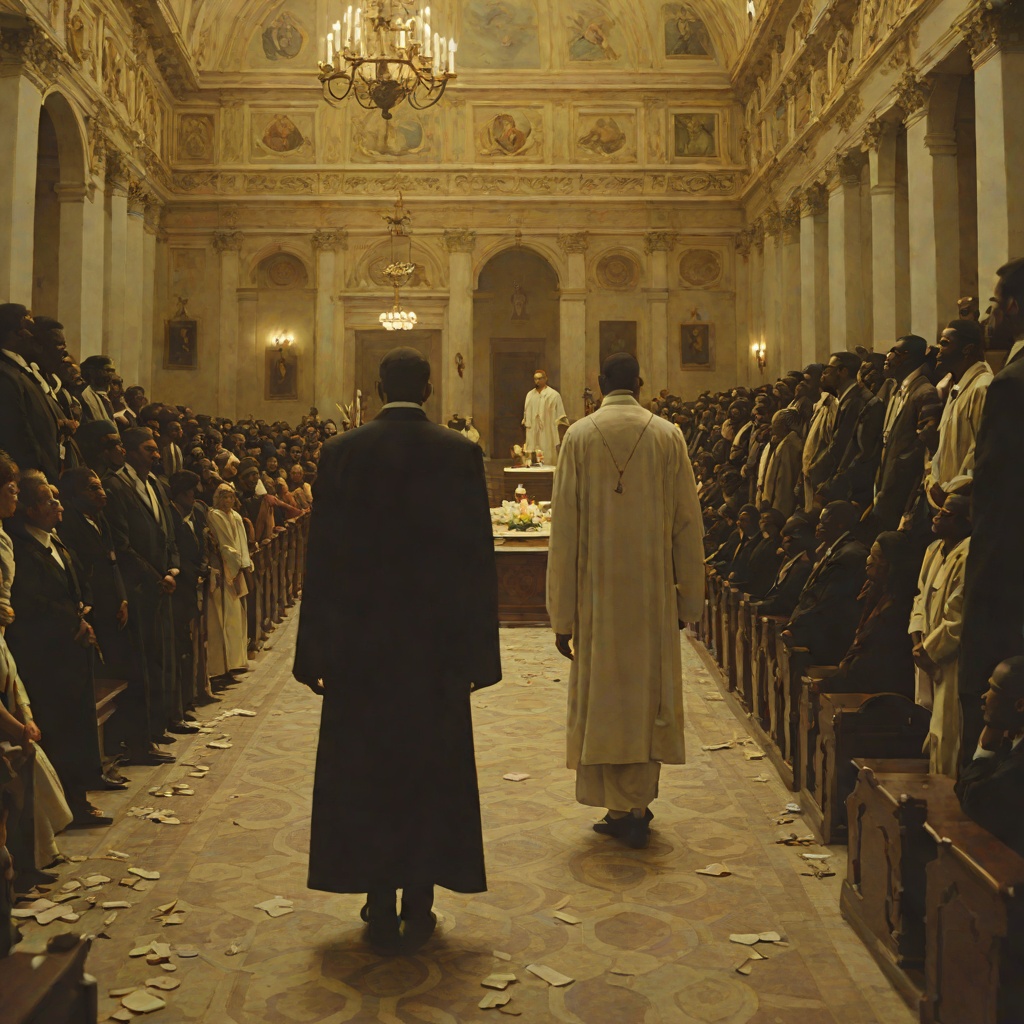
The Synagogue of Evolutionary Judaism gives Pemberton a setting in which faith can be examined without being immediately discarded. Its congregation includes a Columbia professor of Comparative Religion, a State Supreme Court judge, an Actors Studio student, two physicians, a Barnard junior, and an elderly man whose son carries him up the brownstone stairs. Pemberton, coming from divinity studies and Christian ministry, finds the gatherings both familiar and newly strange. The community’s religious life is structured around study, reflection, prayer for the dead, and the eventual restructuring of services according to an evolved faith, allowing religious practice to persist without pretending that its texts are untouched by history.
The group’s discussion of the Torah’s sources is especially important to Pemberton’s crisis. The first five books are treated as collected texts associated with J, E, P, and D rather than as a seamless original revelation. The biblical language, written without vowels or punctuation, is understood as enigmatic from the beginning, while later scholars, priests, and sages interpreted contradictions, disturbing passages, and morally troubling acts through metaphor, symbolism, allegory, punctuation, syntax, and revision. Scripture thus appears as a layered human history of reading and repair. This does not make the Torah meaningless; it makes meaning inseparable from interpretation, preserving religious inquiry while dislodging claims of simple textual transparency.
Sarah Blumenthal embodies the possibility that love and intellectual doubt can coexist. She is Joshua Gruen’s wife, a rabbi, and an assistant rabbi at Temple Emanuel. Pemberton is drawn to her from their first meeting, imagining what it would mean for Trish to wear the collar and celebrate the Eucharist with him, but his attraction is not merely a diversion from theology. Sarah’s religious progressivism and the synagogue’s practice of critical study offer him a lived alternative to the rigid opposition between Christian certainty and unbelief.
Pemberton’s conversion studies remain incomplete when he and Sarah decide to marry, with Sarah meeting him halfway rather than demanding that his uncertainty be resolved first. He tells Joshua that he has never felt so completely Christian as he does while studying to be a Jew. The paradox captures the crisis’s movement: conversion does not erase his former identity but makes its deepest elements newly visible through displacement. His statement also risks misunderstanding, and he is warned to consider whether he has the right perspective. The warning preserves the crisis as an unfinished process rather than turning interreligious love into a final theological answer.
Doubt as Ethical Discipline
Sarah later argues that doubt has been the great civilizing force of the twentieth century. For her, theological uncertainty, constantly debated and balanced against skeptical, rueful, or grieving hesitation, can hold people to ethical behavior, while true believers of many kinds have committed murder. The religious impulse to excommunicate, demonize, eradicate, and ethnically cleanse becomes, in this analysis, a political use of certainty. Suspending firm convictions about God or the afterlife may paradoxically enable people to walk in God’s spirit more responsibly than those who claim to possess historic guarantees.
This position gives Pemberton’s crisis a positive ethical function. Doubt is not simply the loss of comfort; it is a restraint on the human wish to make God an instrument of domination. Sarah trusts religious people who turn toward symbolic comfort rather than reaffirming absolute guarantees, including professionals who remain uneasy with their institutions, customs, and doctrinal pronouncements. Their faith is compromised, but that compromise is precisely what makes self-knowledge possible. A faith aware of its own limits may be less dangerous than certainty that mistakes possession of a story for possession of God.
The displaced cross remains central because it refuses to settle whether religious symbols heal, accuse, or provoke. Joshua senses that its appearance announces something momentous, yet he fears that speaking of the sign may make it lose its light. He recognizes it without knowing what it instructs him to do, and keeps his own counsel even from Sarah. The sign turns him into a detective whose task is a humble, dogged act of detection, while Pemberton’s own crisis follows the same discipline. Meaning may be evolving slowly, perhaps even through the moans of the dying, but it cannot be forced into a doctrine on demand.
Crisis of Faith therefore ends not in recovered orthodoxy or triumphant disbelief but in a more demanding uncertainty. Pemberton’s movement toward Judaism, his continued sense of Christianity, his study of historically layered scripture, his response to the cross, and his confrontation with genocide all resist a single explanatory framework. The crisis preserves the religious question by denying that any institution, text, symbol, or believer can possess it completely. Its lasting significance lies in converting doubt from an embarrassment to a form of vigilance: a way of remaining open to transcendence while refusing to surrender moral judgment to anyone who claims to speak for God.