Dancing in the Dark
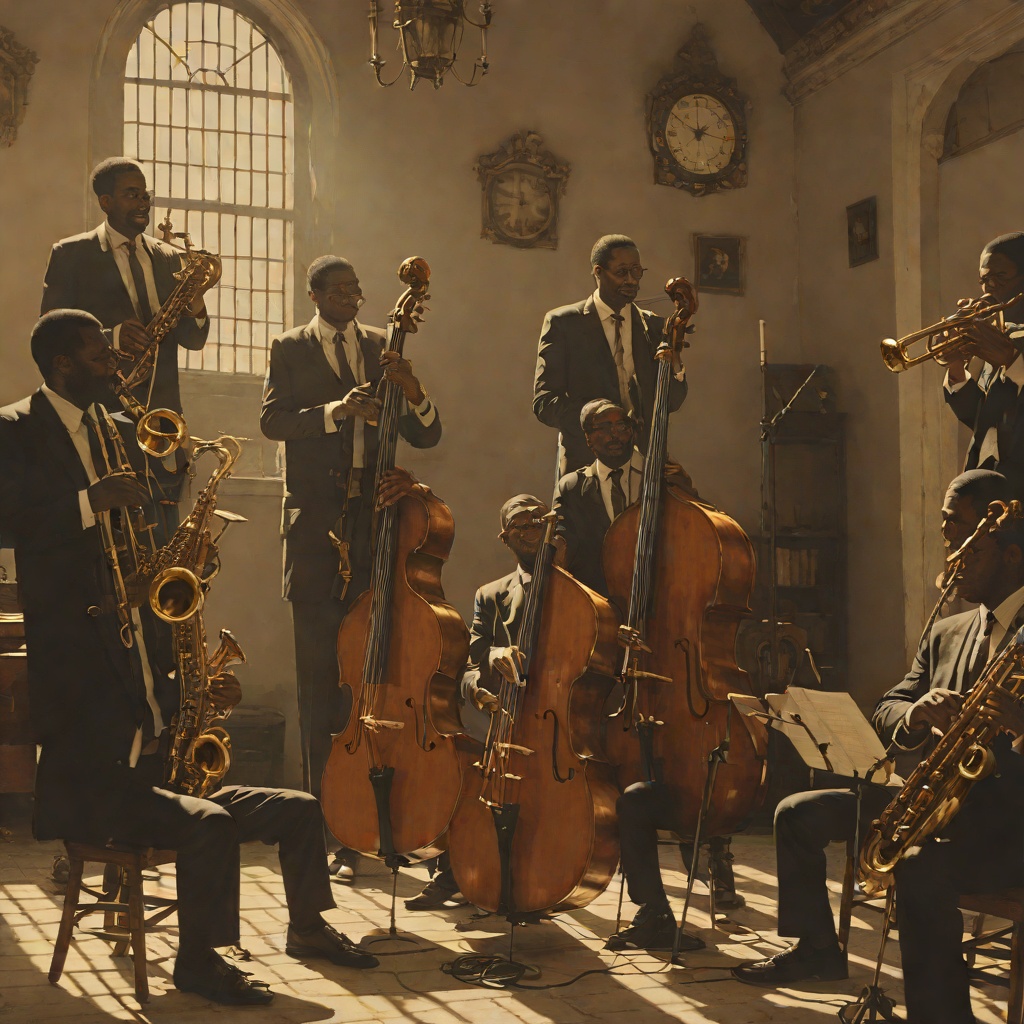
City of God“Dancing in the Dark” functions in City of God as both a song and a compact philosophy of existence. Introduced through the performance of The Midrash Jazz Quartet, it gives musical form to a world in which faith, knowledge, love, and mortality remain only partly visible. The refrain does not promise that the darkness will lift. Instead, it makes movement within darkness the condition of life itself.
Performance and First Appearance
The expression first appears as the title of a number performed by The Midrash Jazz Quartet. The presentation is theatrical and communal: applause marks the performance, and the song is allowed to unfold through its musical ending before its larger meaning is made explicit. Its first force therefore comes from rhythm and participation rather than from abstract explanation. The audience receives a familiar standard, but the surrounding work places that standard inside an inquiry into belief and uncertainty.
The song belongs to a sequence in which music is not ornamental background. The Midrash Jazz Quartet’s standards provide a recurring language for experiences that ordinary explanation cannot settle. “Dancing in the Dark” can be heard alongside the book’s questions about whether faith must be blind and whether belief arises from human need. The song does not answer those questions doctrinally; it translates them into a bodily image of continuing to move when certainty is unavailable.
The Dance as a Model of Life
The song’s defining lines describe dancing in darkness until the tune ends and waltzing in wonder. The image binds limitation and astonishment together. Darkness suggests ignorance, danger, or the absence of reliable consolation, while the dance supplies balance, rhythm, touch, and temporary direction. Wonder is not presented as the opposite of darkness. It is what can occur within it.
The book later makes the metaphor direct: the dance is identified with life, and the dark becomes the space in which life must be danced. This formulation shifts the expression from entertainment to existential principle. The dancer cannot wait for a complete map of reality, nor can the dancer guarantee how long the music will continue. Action is nevertheless possible because rhythm creates a provisional order. The song’s refrain thus holds together mortality and vitality: the tune will end, but its ending does not cancel the significance of the movement before it.
Recurrence, Memory, and Narrative Form
The expression recurs rather than appearing as an isolated lyric. Its repetition gives the novel a return point, allowing a performed standard to gather philosophical weight each time it is recalled. A song has a different temporality from a single statement: it can be heard, remembered, repeated, and reinterpreted. “Dancing in the Dark” consequently becomes a formal counterpart to the book’s movement among sermons, memories, performances, and reflections.
This recurrence also makes the reader participate in the work of interpretation. The lyric offers a schematic situation rather than a complete explanation of what the darkness means. The reader must fill that indeterminacy with the surrounding pressures of the novel: crisis of faith, historical catastrophe, emotional vulnerability, and the precarious possibility of human connection. The experience of hearing the refrain again is therefore not identical to hearing it the first time. Its meaning deepens through retrospective association, while its musical identity remains stable.
Performance and Embodied Meaning
The expression’s importance is reinforced by the book’s attention to performance as an act that creates meaning. The quartet’s rendition is one such ritualized event; the song later resonates with social dancing, where bodies coordinate before every feeling has been verbally defined. In this context, “Dancing in the Dark” is not merely a metaphor imposed by an outside commentator. It is enacted through tempo, gesture, proximity, and the shared discipline of following a tune.
That embodied quality distinguishes the song’s consolation from a promise of certainty. A sermon may ask listeners to trust, while the song makes uncertainty physically inhabitable. The dancer does not possess the darkness or explain it away. The dancer negotiates it through repeated steps, attention to another body, and responsiveness to a beat that is both structured and temporary. The result is a form of knowledge grounded less in mastery than in practiced participation.
Contrast with Other Forms of Making
The song’s image also illuminates the novel’s broader contrast between controlled artistic construction and fragile human improvisation. Elsewhere, an installation places a medieval suit of armor on a model railroad whose train repeatedly runs off its track, forcing a young woman to kneel and reset the wheels. That scene turns repetition, failure, and repair into visible components of artistic experience. “Dancing in the Dark” offers a related but more humane figure: life proceeds through imperfect coordination rather than through permanent control.
The difference is crucial. The railroad image exposes the comedy of systems that cannot remain on their tracks, while the dance accepts instability as its starting condition. Both scenes resist the fantasy of smooth progress, but the song gives uncertainty a social rhythm. Its darkness is not simply an empty void; it is the medium in which attention, movement, and wonder become possible.
Significance
“Dancing in the Dark” condenses City of God’s attraction to forms that remain meaningful without becoming definitive. The expression neither confirms a heaven nor denies one. It preserves the unresolved space between belief and doubt, but prevents that space from becoming mere paralysis. Its decisive claim is practical and aesthetic: when the world is not fully legible, existence still has a rhythm, and human beings can answer it together.
The song’s ending is therefore also its ethical pressure. Because the tune ends, every step is finite; because the dancers continue until then, finitude does not make movement pointless. “Dancing in the Dark” names a way of inhabiting uncertainty with alertness, physical presence, and wonder rather than with the false comfort of complete explanation.