Deconsecration of St. Timothy's
City of GodThe Deconsecration of St. Timothy's is the ecclesiastical act that formally dissolves the Episcopal parish where Thomas Pemberton served as priest, stripping the building of its sacred status and leaving Pem, as he is known, unassigned within the diocese. The event is the institutional counterpart to Pem's personal crisis of faith, the moment when his long theological struggle becomes official fact. Once the church is deconsecrated, the See does not know what to do with its former rector, and Pem's first response is to assign himself to a hospice on Roosevelt Island, where he does a great deal of pastoral work among the dying. The deconsecration thus functions as the hinge between Pem's old life as a Christian minister and his eventual conversion to Judaism and marriage to Sarah Blumenthal, the rabbi who will become his wife.
The Empty Altar and the Stolen Cross
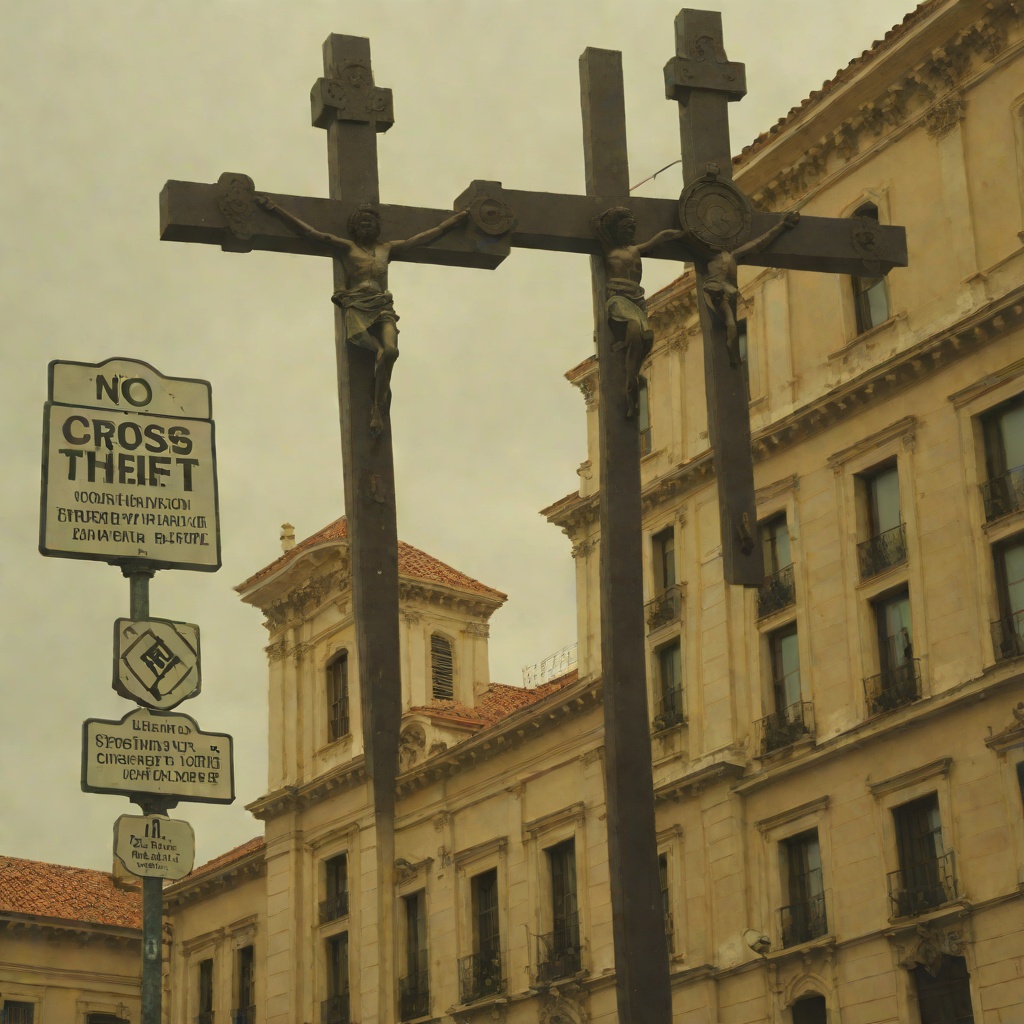
The deconsecration is preceded by the mysterious theft of the church's eight-foot hollow brass cross, an event that sets the entire narrative in motion. When Pem discovers the cross missing from behind the altar, he finds only a shadow of the crucifix in the unfaded paint of his predecessor's poor taste, a ghostly outline marking where the sacred object once hung. The detective assigned to the case offers a cynical assessment: a synagogue would be robbed for its Torah, a handwritten, non-mass-produced item worth at least five thousand dollars, whereas the book value of the cross is nothing, scrap metal on the street. The theft is never solved through ordinary police work, and the cross eventually reappears in a far more startling location, lying flat on the black tarred roof of the Synagogue of Evolutionary Judaism on Ninety-eighth Street, its transverse exactly parallel to the front of the building, its upright pressed against the granite pediment, tarnished and shining in the autumn sun. Pem, summoned to the roof by the rabbi Joshua Gruen, recognizes the object at once, bending down to examine the old nicks and dents that mark its history.
The Aftermath: Roosevelt Island and the Unassigned Priest
The deconsecration leaves Pem in a state of institutional limbo. With St. Timothy's no longer a functioning church, the See must decide what to do with its priest, and the decision is postponed indefinitely. Pem's response is characteristically self-directed: rather than wait for the diocese to assign him, he assigns himself to a hospice on Roosevelt Island, where he tends to the dying. This work is not merely a stopgap; it is a form of ministry that strips away the trappings of ecclesiastical authority and confronts Pem directly with the human realities of suffering and death that have haunted his theology. The hospice becomes the crucible in which his remaining Christian faith is tested and ultimately transformed, preparing him for the radical step of conversion.
The Theater of St. Tim's
The physical building of St. Timothy's does not remain empty for long. The church, with its piously aspiring brownstone steeple that was probably the tallest thing in the neighborhood when it was built, is converted into a theater company. The few gravestones in the patchy grass have sagged over the years like shoulders bowed in grief, and all of it, including the graves, now belongs to a theater company. Gothic lettering over the doors announces the Theater of St. Tim's, and the company is playing Chekhov's The Seagull. Pem himself reflects on the irony with a kind of wry acceptance, noting that drama was born from religion, that the exit of the gods brought in ordinary Greeks, and that over the long haul, humanity has probably done better with Sophocles. The transformation of the sacred space into a secular stage is thus not a desecration in Pem's eyes but a return to origins, a recognition that the theatrical impulse and the religious impulse share a common root.
The Wedding Prayer and the Final Act
The deconsecration culminates not in the church but in the wedding of Pem and Sarah Blumenthal, where Pem delivers what he calls his final act as a Christian and an ex-Christian priest. Standing before the assembled guests, his double-breasted blazer hanging open, his tie loosened, his forehead triumphantly cowlicked, he grasps the cordless microphone and speaks directly to God in one of the intonative systems of clicks and grunts, glottal stops and trills. He catalogues the monstrously evil mortifiers of humanity in the historic generations of every adult in the room, the enslavement and horrible death of many tens of millions of human beings, the exponential murder of souls in wars and genocides, the masses of the violently dead consigned by their very numbers to the lists of anonymous oblivion. He declares that they are not resurrectable, that they cannot and will not resurrect even in the imagination of the Christian faithful. He refuses to address the question of how a supposedly omniscient God could allow such catastrophes, but he insists that the genocidal cruelties of the age have brought God into disrepute, that even among those clinging to a love of God there is a risen suspicion that God is part of the problem, bought and embraced like the lowest, most pathetic streetwalker by anyone who wants Him for any foul, murderous reason. The prayer is Pem's theological farewell, the articulation of everything his crisis of faith has taught him, and it is spoken not in a church but at a wedding, not as a priest but as a man about to become a Jew.
The Significance of the Deconsecration
The deconsecration of St. Timothy's is more than a bureaucratic procedure; it is the symbolic death of Pem's old identity and the precondition for his new one. The empty altar, the stolen cross, the theater company performing Chekhov, the hospice on Roosevelt Island, and the wedding prayer all trace the arc of a man who has lost his faith in the institution but not his longing for the sacred. The cross that was stolen from St. Timothy's and placed on the roof of the synagogue becomes the emblem of this passage, an object that moves from one sacred context to another, carrying with it the unresolved questions of sacrifice, atonement, and the nature of God that Pem has wrestled with throughout his ministry. The deconsecration thus marks the moment when Pem stops being a Christian priest and begins the journey that will make him a Jew, a husband, and finally a man at peace with the mystery he could never resolve within the walls of his former church.