Meeting with the Jewish Partisans in the Kovno Ghetto
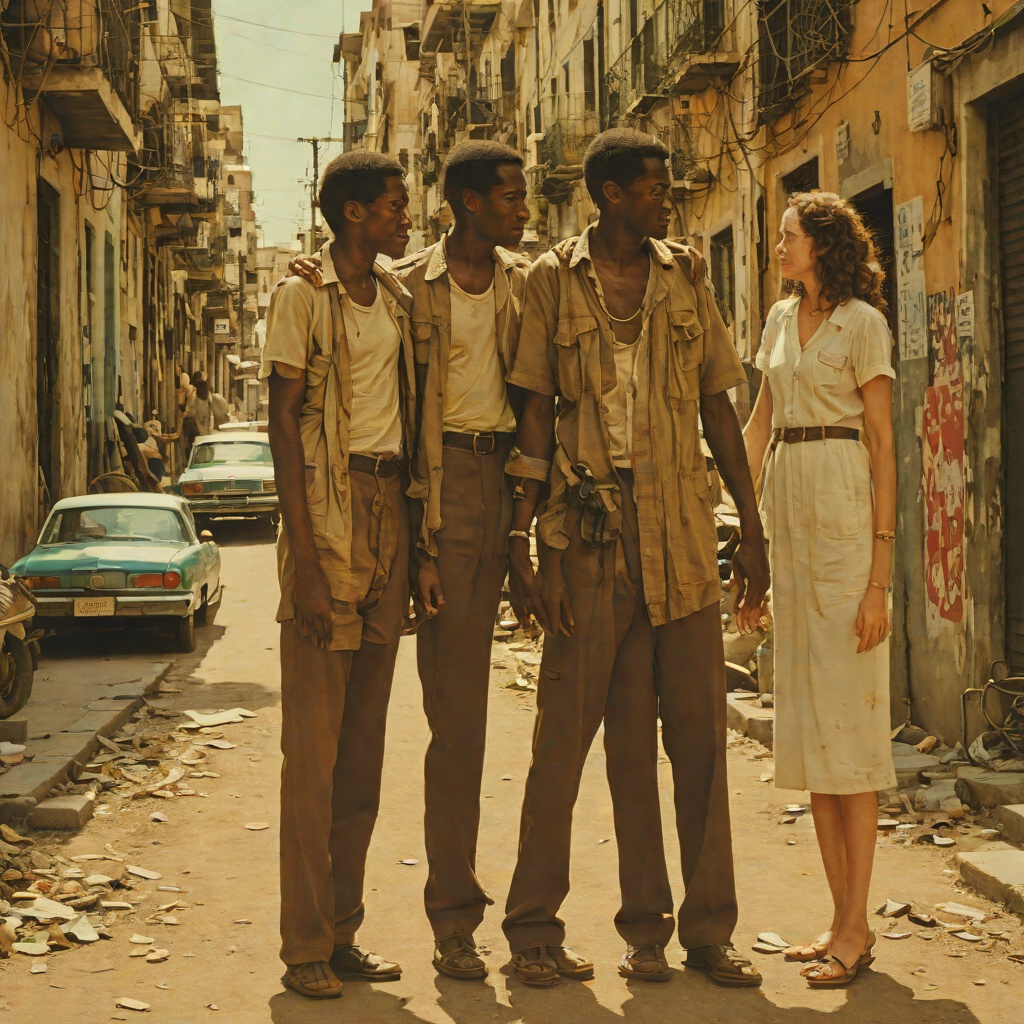
City of GodIn the deep stillness of early morning, in a cabin used to store paint supplies, sand bins, and carpentry tools—no more than a block from the ghetto's perimeter—a delegation of Jewish partisans rose through a trapdoor to meet secretly with the Kovno Ghetto Council. The signal came as soft taps, once, and then again; a desk was moved aside, and from underneath, three figures emerged into the room, bringing with them the cold and the darkness they had come from. To the ten-year-old Yehoshua, who had been made present at the meeting, their emergence was like birth: first the head, then the shoulders—but then the rifle. The partisans were two men and a woman, their faces and hands blackened with dirt, their rifles identical to those carried by the guards on the bridge, a detail that thrilled the boy because he knew each weapon had to have been taken from a German. They waved off any assistance, hoisting themselves into sitting position on the floor and then standing to face the room, their every gesture disdainful, their eyes cold and impatient—even the woman's, though when she caught sight of the child she betrayed a momentary softening, the compassion of an older sister, an unwitting disclosure of worry for a boy in this place, under the direction of old men.
The Partisans and the Council
The three partisans were known to no one except Dr. Koenig, whose prewar practice had taken him everywhere in the district; possibly he had delivered at least one of them, the young man who spoke for them, Benno, on whose eyeglasses the candles shone when he averted his head and allowed the doctor to grasp his shoulders in greeting. "Look, how strong!" Dr. Koenig whispered, in the first and last of the amenities of the evening. The other two took up positions by the windows, peeking through the drawn sack curtains before turning to face the room. Benno sat on a table and, holding his rifle loosely across his knees, addressed the council in a hushed, fluent Yiddish that sounded to the boy like a brook running over rocks. He was young—no more than twenty or twenty-one—with a round-rimmed glasses that gave him, incongruously, a yeshiva bocher's appearance; his companion had a broad Slavic face and wide shoulders, the sort of oaf Yehoshua would have stayed away from in the old days at school. The third council member present was Rabbi Pomeranz, a very thin, slight, middle-aged man who wore an old battered homburg and whose beard had turned white; he sat in a chair against the wall holding a closed siddur on his lap, his finger keeping the place, silently davening while attending to the matters at hand, his head nodding and his lips moving as he uttered to himself the prayers he knew without the book, but his eyes fixed on the partisan who spoke.
The Warning and the Argument
Benno's message was blunt and without consolation. The Russian army was within a hundred twenty miles, he said, and as the front moved west, the ghetto would be dismantled and its inhabitants with it. "You will dig the graves you will lie in," he told them. "It is just a matter of time." Dr. Koenig countered that the Germans were already trying to destroy evidence of their murders, that they were frightened of criminal prosecution after the war. Benno dismissed this as self-delusion: if the Germans did not slaughter the Jews here, they would move them somewhere else and slaughter them. The partisans were proposing to take people out—as many as wanted to come. They could move thirty or forty a night, Benno said. Three partisan units, one Jewish and two Russian, held militarily secure areas behind German lines; his own group consisted of a hundred and fifty armed Jewish men and women and another two hundred people whom they took care of. The argument grew sharper when the question of who should be taken arose. Someone insisted that the council could not impose its authority in the matter, that people must choose for themselves—and that if the council did impose its authority, it would be as bad as the Nazis. The words lodged in Yehoshua's memory with the force of scripture: "Oh my Sarah, I remember these words as if they were uttered yesterday."
The Departure and the Rabbi's Defiance
The meeting ended as it had begun, through the trapdoor. The thickset one who had said nothing and the woman descended and disappeared first. Before following them, Benno took Dr. Koenig aside and, the boy assumed, instructed him on how to make further contact. Then, before lowering himself through the trapdoor, he addressed Rabbi Pomeranz with a parting taunt: since the rabbi's prayers were so effective and had already done so much good, he expected the rabbi would choose to remain and pray to the Lord his God to save his people. When the partisans had gone and the desk was back in place, the rabbi stood and set his battered homburg firmly on his head as he prepared to go out. "That's not why I pray to the Lord, blessed be His name," he said to no one in particular. "I pray to bring Him into being." The line—a theology of divine dependence reversed, in which human prayer does not petition an existing God but calls one into existence—stands as the meeting's most radical utterance, and it reverberates through the novel's larger meditation on a God who has been bought and embraced "like the lowest, most pathetic streetwalker" by anyone who wants Him for any foul, murderous reason.
The Underground Railroad
Once the council met in full, it decided it had no other choice than to inform people there was now a means of escape from the ghetto. But the news could be disseminated only in the most secure manner, not only because of the obvious danger of the Germans themselves, but because of the spies the Germans had installed among the Jews—pretend Jews, or simple betrayers, as some of the ghetto police had become. The procedure was painstaking, one by one, beginning with the people the council members knew personally. Yehoshua received a new assignment: the star runner in his garrison cap would find the selected people at the hours they were available and summon them, in secrecy, to the council offices. In due course the underground railroad was put into place. The partisans had very easily infiltrated the city; as Benno had said, they really knew what they were doing. It was surprisingly effective. The boy was never sure how it was done, what the actual means of escape was—perhaps it changed from night to night. He thought as many as two hundred fifty people got out before it all ended. The council gave priority to those most fit to endure the difficulties of living in the open, and when people left, their registration and work cards were bestowed upon people of the same age and gender who didn't have them, in the hope of keeping the Germans from realizing that the ghetto's numbers were decreasing. The painstaking method was characteristic of the council, and Yehoshua reflected that perhaps if it had not been so painstaking, more people could have been freed.
The Meeting's Afterlife in Memory and Archive
The meeting and its consequences became part of the testimony that survived the ghetto's destruction. Yehoshua, who would grow up to be Sarah Blumenthal's father, carried the memory of that night into his old age, and his daughter would later recognize that his account, however accurate or inaccurate in its details, had caught her father's voice. The archive that Josef Barbanel kept—the diary in which he reported everything that happened, along with the relevant documentation, the latest regulations, the execution orders, the deaths, minutes of the council meetings, orders signed by the infamous Commandant Schmitz—was smuggled out of the ghetto and hidden in the earth of Eastern Europe, in its rubble, in the wreckage and ruination and dust of its Christian tradition, where it remained until its recovery decades later. When the chest was finally opened in a small office in the International Arrivals Building at JFK Airport, the inspectors found packages of various sizes wrapped in oilskin, sheaves of paper bound in twine, booklets, manuals, folders, rolled-up blueprints, diagrams, stapled documents, envelopes of various sizes, each labeled in a small, neat Yiddish script—and among the photographs, a picture of seven little boys in front of a wood cabin, standing at their idea of attention on the steps, wearing military-school caps and stars on their breasts that might possibly be imagined as insignia of their office as runners for the council, unsmiling little boys, underdressed, with short pants and sweaters and jackets they had outgrown, each of them at attention, feet together, arms pressed against his sides, looking into the camera in the full knowledge of death. Sarah found her father in the first row. The meeting with the partisans, which had given the boy his most dangerous assignment and his most vivid memory, was thus preserved not only in his testimony but in the archive's photographic record—a single night's clandestine encounter that set in motion the escape of hundreds and left its trace in the face of a ten-year-old runner staring into the camera with the full knowledge of death.