Murray Seligman's Speech at the EJ Synagogue
City of GodMurray Seligman's Speech at the EJ Synagogue becomes the decisive intellectual interruption in the congregation's effort to define a modern religious practice. Delivered amid a seminar-like Sabbath service at the Synagogue of Evolutionary Judaism, it places the language of creation under the pressure of contemporary physics, then exposes the emotional and social limits of rationalism through the reactions of Pem, Sarah, and an elderly congregant. The speech matters not because it settles whether God exists, but because it makes the gap between scholarly inquiry and religious allegiance impossible to ignore.
Setting and Religious Method
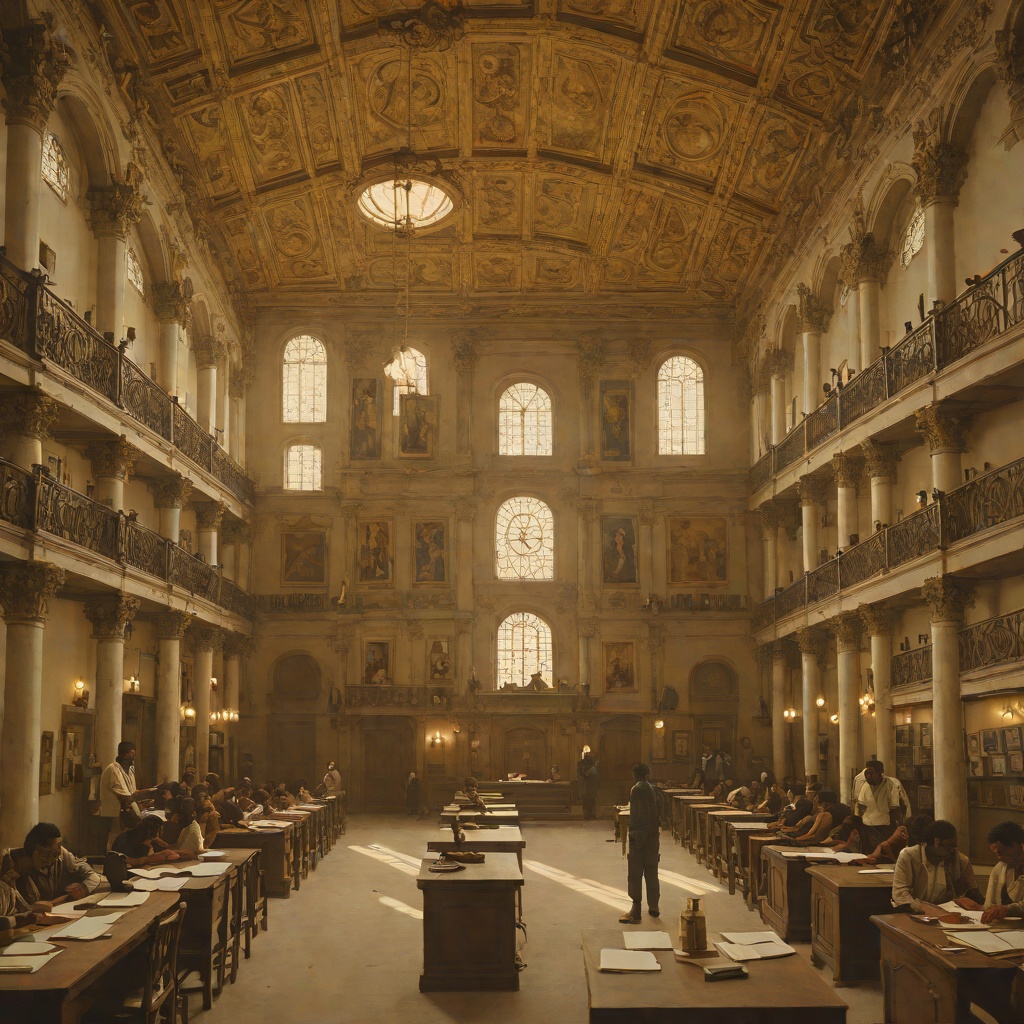
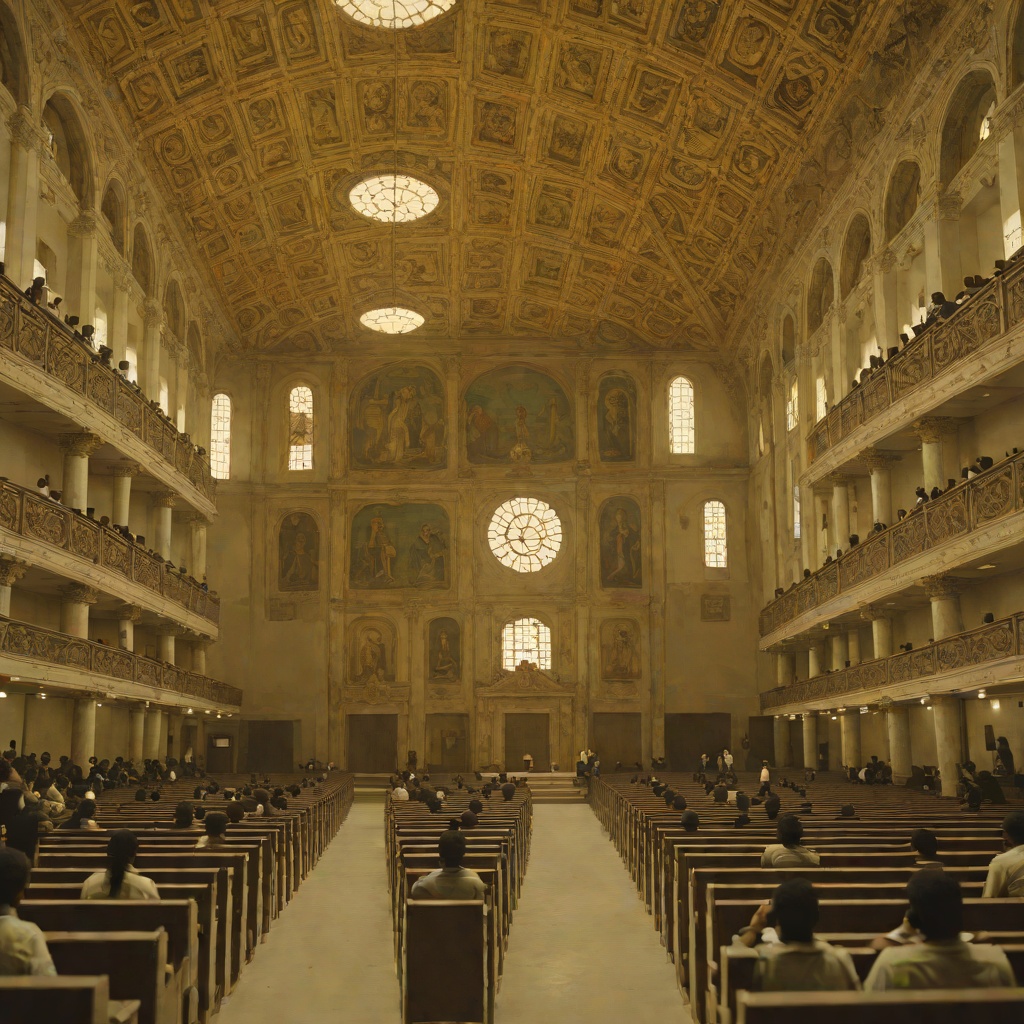
The speech takes place within the distinctive format of the Synagogue of Evolutionary Judaism. Its services retain a traditional liturgical beginning and ending, conducted in English, but devote their middle to extended examination directed by the rabbi rather than to a conventional sermon. Friday evening services ordinarily receive a replay on Saturday morning, while holidays provide further occasions for topical inquiry. The congregation therefore treats worship as a recurring encounter between inherited forms and modern investigation.
That method is supported by reading lists and a small congregational library, giving the synagogue the character of a continuing-education yeshiva. Its members include a Columbia professor of Comparative Religion, a State Supreme Court judge, a young woman studying at the Actors Studio, two physicians, a Barnard junior, and an elderly man whose son carries him up the brownstone stairs and returns for him at the end of the evening. The range of bodies, professions, ages, and intellectual positions makes the service a social experiment as well as a theological one. Murray's intervention enters a room already organized to test religious claims against scholarship.
The immediate intellectual background is the documentary hypothesis. The congregation's study of the Torah distinguishes the historical sources conventionally identified as J, E, P, and D, and examines how the biblical text came into its received form rather than treating it as a transparent transcript of original revelation. The same inquiry separates what Jewish teaching and practice may have inherited from particular historical circumstances from what remains ethically or intellectually defining. Murray's speech extends this source-critical impulse from the history of scripture to the scale of the universe itself.
The Speech and Its Cosmological Scale
Murray begins from the limited historical world of ancient Israel. He describes its Hebrews as conceiving a magnificent single God of the universe, yet naturally understanding that cosmic God through their land, crops, tribal wars, and changing relationship with the people. In that setting, the titles Lord and King are intelligible: they localize the Creator through the political and agricultural vocabulary available to the community that worships him.
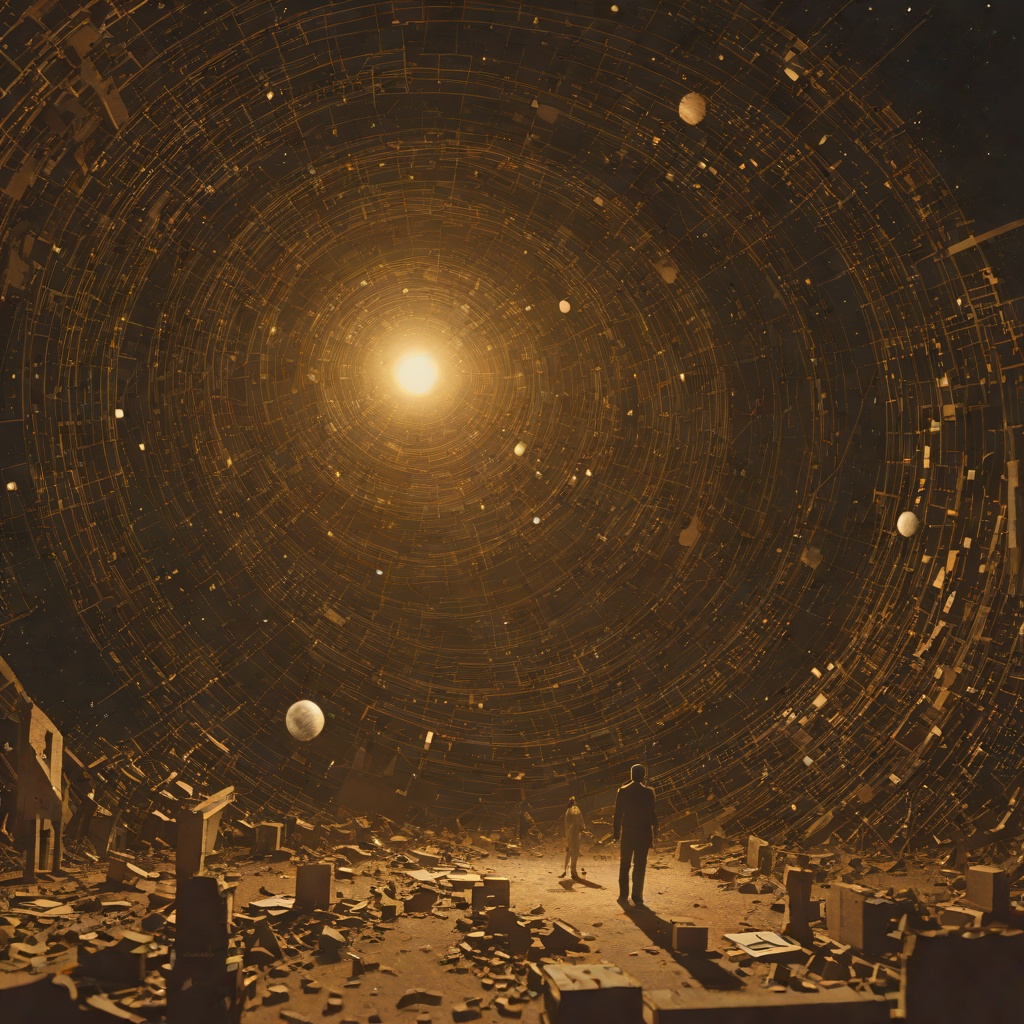
He then enlarges the frame with modern scientific knowledge. The universe, he says, is roughly fifteen billion years old; it suddenly inflated and has continued expanding. Space and time are inseparable, gravity can bend space, and another force counteracts gravity so that the universe does not collapse into itself. Galaxies contain millions of stars, clusters of galaxies are themselves arranged in larger clusters, and dark matter remains unexplained. The speech thus moves from the small, historically situated world of ancient Israel to a universe whose dimensions strain every inherited human metaphor.
Murray's argument does not simply reject the Creator. Instead, it asks what kind of Creator could originate such a reality, perhaps even more than one universe when human perception can disclose only this one. The larger the cosmos becomes, the less adequate ordinary images of a localized ruler appear. His cosmology makes divine grandeur more difficult to imagine in conventional terms, but it also makes the word Creator carry a more overwhelming, less anthropomorphic force.
Congregational Conflict Over Questioning
The speech follows a public challenge from an elderly congregant who is broadly sympathetic to the rabbi's modern approach but fears that inquiry may dissolve religion altogether. The man recalls discovering the synagogue during a walk, liking its young rabbi, its intellectual discussions, and its modest service, though he had needed time to adjust to a co-ed minyan. He values the small congregation because nobody puts on airs and nobody solicits him for a building fund. His support for the community is therefore practical and personal, not merely doctrinal.
Yet he insists that some propositions must not be questioned. Among them is the belief that the Torah was given by the Creator and the acceptance of the yoke of the Kingdom of Heaven. Without such commitments, he argues, there may be tradition but no religion. His intervention identifies the boundary that the seminar format risks crossing: historical criticism can explain how sacred texts were composed, but for him the loss of divine origin would remove the ground on which religious identity stands.
Murray's cosmological account answers that anxiety indirectly. It does not restore an unquestioned Torah or offer a simple creed. It replaces a familiar human scale with an almost incomprehensible one, implying that any Creator worthy of the universe would exceed the political and familial images through which ancient worshippers approached divinity. The resulting tension is not between science and a fully abandoned faith; it is between a faith that survives by rethinking its language and a faith that regards certain questions as destructive.
Recognition and Retrospective Reversal
The event also changes meaning through Pem's recognition of the speaker. During the service, Pem suddenly asks who the large man is. The narrator identifies him as Seligman, noting that he is bigger and heavier and now combs his hair. Pem is startled and relieved that Seligman did not see him. His first recollection is not of intellectual greatness but of a schoolmate who was a shlub, landed on people, lacked enough lunch money, ignored lessons, and needed the plot of Macbeth explained to him. He remembers Seligman's untied shoelaces and green teeth.
The reversal comes when Pem realizes that this is Murray Seligman, the Nobelist in physics. Seligman's present authority does not erase the physical and social awkwardness of the remembered boy; it makes the contrast sharper. The speech is heard simultaneously as a serious intervention in theology and as the unexpected performance of someone whom Pem had once placed at the bottom of his schoolroom hierarchy. The old image of the inadequate child and the new image of the eminent physicist remain superimposed.
This recognition changes the social temperature of the scene. The congregation has been discussing how modern scholarship can revise religious understanding, but the revelation that the speaker is a Nobel laureate gives the scientific voice a newly visible status. Pem's widening smile registers astonishment rather than doctrinal agreement. Murray's authority arrives through both his ideas and the shock of his identity, showing how intellectual arguments are received through memory, class judgment, bodily impression, and old shame as much as through their formal content.
Consequences and Narrative Significance
For Pem, the speech dramatizes the moment when rationalism reaches its limit. He slumps in his chair and holds his head in his hands while the elderly man receives appreciative remarks from nearby listeners. The gesture does not indicate that the scientific case has failed; it shows that explanation alone cannot settle the desire for a religious foundation. At the same moment, the narrator wonders whether Sarah Blumenthal's expression contains a longing for Joshua Gruen's resurrection and whether Sarah had relied on Joshua for her theology strongly enough to make carrying his ideas forward difficult.
The rabbi finally clears her throat and suggests moving to the Kaddish. That transition places mourning beside cosmology and debate beside ritual. The service does not conclude with a philosophical resolution. Instead, the congregation returns to a traditional prayer for the dead after confronting the universe's age, expansion, forces, galaxies, and unknown matter. The juxtaposition preserves the EJ method in its most difficult form: inquiry can unsettle inherited belief without eliminating the practices through which grief, memory, and communal identity are expressed.
Murray Seligman's Speech at the EJ Synagogue therefore functions as both a theological argument and a test of the synagogue's intellectual project. It demonstrates the power of the documentary and scientific perspectives to dislocate human-centered religious language, while also revealing that religious life is sustained by more than propositions. The speech enlarges creation until ordinary metaphors fail, and the return to Kaddish shows what remains when certainty has been interrogated: a community still speaking, remembering, and deciding what forms of tradition can survive knowledge.