New York City
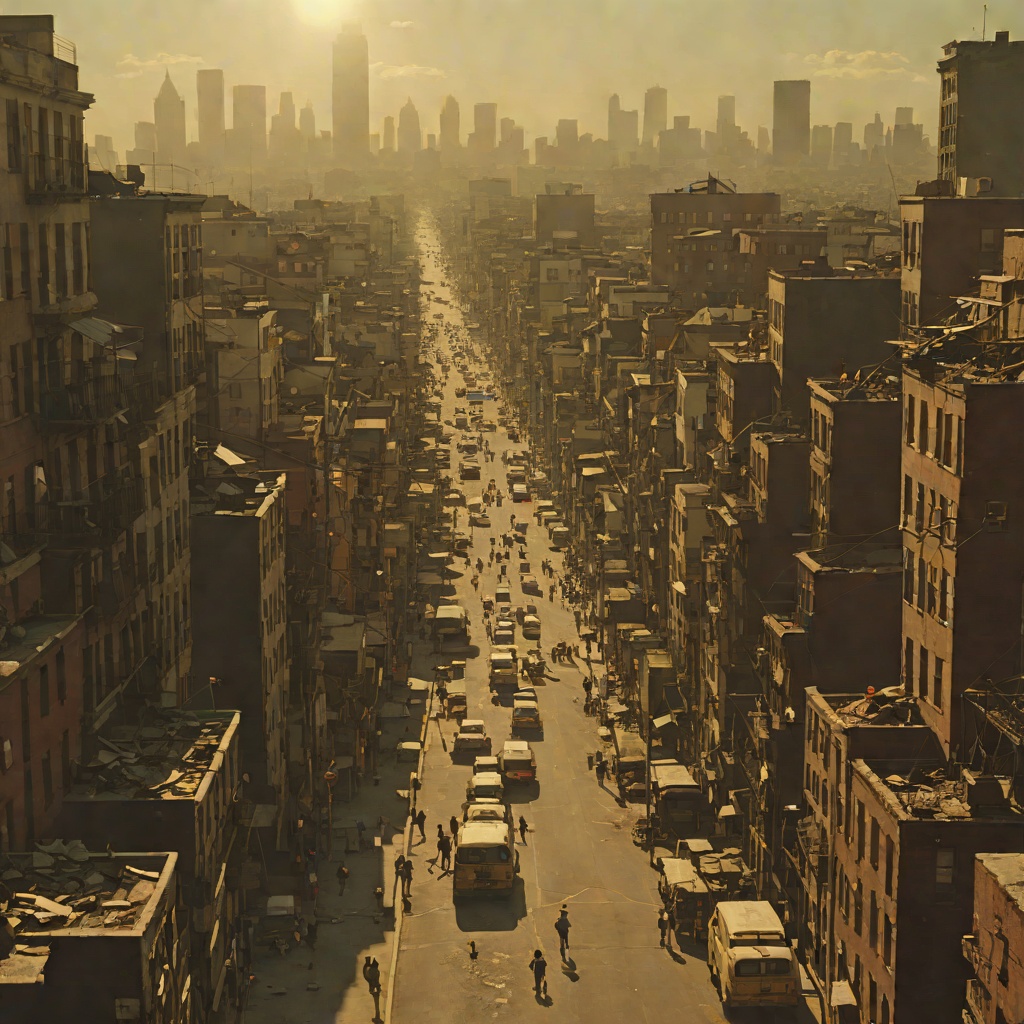
City of GodNew York City is the novel's true protagonist, a sprawling, self-contradictory organism that the narrator renders with the obsessive attention of a location scout and the wonder of a philosopher. It is the stage for the intertwined stories of Thomas Pemberton, Sarah Blumenthal, and the Synagogue of Evolutionary Judaism, but it is also a subject of inquiry in its own right, a living system whose streets, parks, and garbage dumps become the novel's central metaphor for the human condition. The city is presented as the capital of everything at once: literature, the arts, social pretension, people who make immense amounts of money without working, and people who work all their lives and end up broke and gray. It is the capital of all music and of exhausted trees, a place where the migrant wretched of the world believe that if they can just get here, they can get a foothold, running a newsstand, a bodega, driving a cab, peddling, whatever it takes. The narrator's ambivalence is palpable: he wants to tell them this is no place for poor people, even as he acknowledges that the racial fault line going through the heartland goes through the city's heart. The city grid was laid out in the 1840s, so that despite everything, its inhabitants still live with the decisions of the dead, walking streets where generations have trod. The city is a hypershock of fire sirens, police-car hoots, ritual pneumatic drilling, runners in their running shorts, Rollerblades, messengers, hissing bus doors, and sidewalk pileups for the stars at their screenings, all of it punctuated by the daily violence of cop crime, building facades falling into the streets, and bursting water mains. Yet at the intersection of two busy streets, the narrator can stop and see thousands of lives headed in all four directions, and know himself to be momentarily part of the most spectacular phenomenon in the unnatural world, a primatial over-soul, a species recognition that is never acknowledged. The city may begin from a marketplace, a trading post, the confluence of waters, but it secretly depends on the human need to walk among strangers, and each passerby, every scruffy, oversize, undersize, weird, fat, or bony or limping or muttering or foreign-looking person, is a New Yorker, as native to this diaspora as the narrator, part of a great sputtering experiment in a universalist society proposing a world without nations where anyone can be anything and the ID is planetary. The narrator's warning, "Not that you shouldn't watch your pocketbook, lady," undercuts the idealism with a wink of streetwise pragmatism. The city is also the site of the novel's most intimate and transformative moments. It is where the narrator, drifting around town picking locations like the art director of a movie, places St. Timothy's Episcopal Church in the East Village, off Second Avenue around the corner from the Ukrainian hall and restaurant, a typical New York Brownstone Ecclesiastic, little brother of the grander Church of the Ascension on lower Fifth Avenue. The neighborhood around St. Tim's is populated by people just getting by: a young T-shirted girl running in place with her Walkman, a gray-haired over-the-hill bohemian rummy affecting a ponytail, a squat short Latina, a stooped old man in house slippers with a Yankees cap and filthy pants held up by a rope, a young black man crossing against the traffic, glaring, imperious, making his statement. It is in this city that the narrator follows the father's walking routes, beginning at Union Square Park, where rat-poison skull-and-crossbones warnings are planted in the grass, and moving through the farmers' market with its banks of potted flowers and truck farm produce from New Jersey, the brilliant color fields of pears and apples, spinach, kale, carrots in the sunlight, the brisk, unsentimental exchanges between buyer and seller rehashing the first act of civilization. The walk continues west along Fourteenth, past cheap clothes hanging from pipe racks on the sidewalk, big hand-crayoned sale signs in the windows, tables with hats and gloves for the coming winter, the ceilings of the stores strung with luggage, the traffic crawling by, big fumy buses, the smells of pizza and sidewalk incense free for the breathing. Down Seventh past the double-parked parameds of St. Vincent's, with distant sirens on their way tolling the truth of eternal emergency, slanting eastward along Greenwich Avenue past Mexican and Indian restaurants and coffee ritual places, the narrator observes a long-gray-haired man with a little dog on a leash, three black kids with voluminous jeans falling off their hips, a thin blond young woman kneeling to tend to a baby in a stroller, a stopped-in-traffic truck driver looking down at her, his arm dangling over his cab door. Across the street rises the towered Romanesque strawberry-red Jefferson Market Courthouse, recalling the last century when, given the great identity problem of the new world, every conceivable architecture rose from the sidewalks of New York, Romanesque, Gothic, Moorish, Belle Epoque, and Tenement. The walk ends along miserable, wretched Eighth Street, once the glory of bohemian intellect with the best bookstore in New York, now the venue of shoes and phony antique clothing, the boomboxed hatchbacks from New Jersey zooming up to the curb, and south on sedate lower Fifth to Washington Square. The city's parks and wild spaces offer a counterpoint to its human chaos. In Central Park, the narrator remembers a Sunday when the boys found a brown ant population in a patch of dirt under a tree, and he hunkered down with them to watch these infinitesimal creatures, each not an eighth of an inch long, go about their business building an underground city. The ants, brainless but purposive, disciplined, and with a stronger work ethic than anything alive, work for the queen, preserving and protecting her as an egg-laying monarch whose fecundity determines the future of the society, yet any given ant in its life probably never sees the queen. Ant by ant, body by body, without any visible central decision-making mechanism, they take instruction from one another, antenna to antenna, unified in their responses, almost like parallel processors, or the cortical structure of neurons, each comprising one cell of a group brain, an invisible organ of thought beyond the capacity of any one of them to understand. The narrator explains to the kids that these are domesticated Central Park ants, the house sparrows of the ant species, unlike the big ones in the jungles and rain forests and veldts of the world that build leaf bridges in trees, cultivate crops, float across rivers on rafts of their own devising, march, make war, eat meat, bite like hell, ants that have a patriotic sense of their anthood. He speculates that if one could watch the random and unpredictable movement of great numbers of human beings in a city park in the same way, one could assure oneself of the integrity of the individual will, but when the masses are celebrating a beautiful day, they too might form an invisible organ of aggregate thought. The city's ecological imagination extends beyond its parks to the City of Birds at Valdemingomez, an enormous garbage dump north of Madrid that the narrator describes as a great urban aviary, its population of storks, hawks, egrets, linnets, kites, jackdaws, ravens, condors, and turkey buzzards able to circle the dump and, with a boost from the trade winds, wing-whiff its miasma of sulfurous gases as far east as Rome. The birds of Valdemingomez don't migrate, why would they, with over a hundred thirty species of them, even a few accidentals from the tropics, the albatross, the blue-footed booby, come to look things over. Eggs are laid in old Big Mac containers, nests are lined with cassette tape, the songbirds flitter in and out of rusty cans, grackles huddle in TV cabinets, gulls bomb old sofas with the clamshells of paella, and when flocks of rock doves go cooing and pecking over fields of chicken bones, the bones clack like train tracks, clink like wind chimes, shiver and shirr like shuffled cards, bongo and bop, and chickuh-chick-chick like a hot marimba band, with special rates for ornithologists. The city is also the home of the Synagogue of Evolutionary Judaism, where Pem loves the Friday evening services, and the narrator finds them fascinating, the congregation including a professor of Comparative Religion at Columbia, a judge of the State Supreme Court, a young woman studying at the Actors Studio, a married couple both of whom are physicians, a Barnard junior, and, most touchingly, an elderly white-haired man whose son carries him up the brownstone stairs and retrieves him at the end of the evening. The essence of the EJ approach is to take the various aspects of Jewish teaching and practice, consider their historic sources or origins and their theological rationale and, insofar as possible, hold them up to modern scholarship and begin to separate what appears to be inessential, or intellectually untenable, or simply, blindly, customary, from what is truly crucial and defining, with every service having a traditional liturgical beginning and ending in English but an extended effort of examination as its middle, not in the form of a sermon by the rabbi but of a rabbinically directed seminar discussion. The radical EJ is, ironically, a kind of continuing-ed yeshiva. At one such service, an elderly man stood up to challenge Sarah Blumenthal, saying he was mostly on her side but asking whether there were some things that must not be questioned, for instance that the Torah was given by the Creator, blessed be His name, and that the yoke of the Kingdom of Heaven must be accepted, without which, never mind no tradition, it's no religion, nothing. The narrator saw Pem slump in his chair and hold his hands to his head, that moment when rationalism hits the wall, and wondered, not without some anger at himself, if Sarah had depended on Joshua for her theology, if she was capable of carrying his ideas forward. The city is also the setting for the novel's most personal and celebratory moments, including the wedding of Pem and Sarah, where the narrator, dancing with Sarah to "My Blue Heaven" in a lively tempo, holds her for the first time, his hand in the small of her back, connected to her animacy of being, feeling her heat, her clean herbal scent, her flushed happiness, and she puts her cheek against his and says in his ear, "You will always be our friend, Everett," before her wretched older boy, Jake, taps him on the elbow to cut in. The narrator remembers everything Pem said when he got up and grasped the cordless microphone, the band stopped playing, and he stood there swaying slightly while the room went silent, his double-breasted blazer hanging open, his tie loosened, his forehead triumphantly cowlicked, and he declared, "Friends, I will not speak of my happiness, of my prayerful thanks to the Lord, may His name be blessed, that my dear love Sarah Blumenthal has found me worthy of her attention. You can believe that I will passionately live what's left of my life to earn what she has given me. I will soon be a Jew. I will find the joy of a hallowed life." The city's galleries and cultural spaces reflect its restless creative energy, as when the narrator visits a gallery on lower Broadway where an artist has put down a model railroad track with a train going round and round, the engine welded to the visored headpiece of a suit of medieval armor, an expressionless iron face mask leading the train round and round, the train keeping running off the track and the lovely young woman in charge having to get down on her knees, with her high heels flopping and her tight-skirted and quite shapely ass presenting itself to the onlooker, to set the train wheels back on the track, the narrator wondering if she too isn't part of the artist's intention. He admires the artist who goes around the world wrapping whatever he can get his hands on, the Reichstag in Berlin looking like an unusually large package delivered by UPS, a grove of trees in a Swiss park bagged in polyester, the Pont-Neuf done in saffron silk, all rippling shimmering scrims through which light can pass, outlines revealed, and who ran miles of open umbrellas along the California coast and wants to come to Central Park and staple it with rows of steel gates flying nylon flaps of gold, the narrator urging, "Let him come, Mayor. Let him come, Commissioners," liking the idea of out-of-scale art as world occupation, planetary embrace, the inverse relations of such projects, the coolness of the years of planning, the huge amounts of money for the capricious result, the abruptly reconformed and freshly wild appropriated public space, the outrage of making ephemeral art of the city, the land. The city is also the place where the narrator's own spiritual journey unfolds, where he picks up his old paperback Augustine, City of God, every page almost totally underlined, and wonders about all those years he put in, the solemn processions, colors and collars and little charms, asking himself whether he was a broad-church Anglican or an animist, and reflecting that Augustine is a hell of a writer, with his writer's bag of tricks, all those doctrinal notions treated as if they exist, like characters in a novel. And it is from this city that Sarah Blumenthal delivers her address to the Conference of American Studies in Religion in Washington, D.C., arguing that in the twentieth century about to end, the great civilizer on earth seems to have been doubt, the constantly debated and flexible inner condition of theological uncertainty, the wish to believe in balance with rueful or nervous or grieving skepticism, which has held people in thrall to ethical behavior, while the true believers, of whatever stamp, religious or religious-statist, have done the murdering, the impulse to excommunicate, to satanize, to eradicate, to ethnically cleanse being a religious impulse, and that in the practice and politics of religion, God has always been a license to kill, but to hold in abeyance and irresolution any firm convictions of God, or of an afterlife with Him, warrants walking in His spirit, somehow. She trusts those who gravitate toward symbolic comfort rather than those who reaffirm historic guarantees, the uneasy promulgators of traditional established religion who are not in lockstep with its customs and practices, or who are chafing under doctrinal pronouncements, or losing their congregations to charismatics and stadium-filling conversion performers, the faithful who read Scripture in the way Coleridge defined the act of reading poetry or fiction, with a "willing suspension of disbelief," yet who must be true to themselves and understand theirs is a compromised faith, something more required of them, something more. New York City, in all its chaos, beauty, violence, and possibility, is the ground from which all these meditations arise, the physical and spiritual home of a novel that asks what it means to live a hallowed life in a secular age.