Pemberton–Blumenthal Wedding
City of GodThe Pemberton–Blumenthal Wedding is the novel's climactic social and theological event, where the former Episcopal priest Thomas Pemberton marries Rabbi Sarah Blumenthal in a downtown ceremony, delivers a radical wedding prayer that indicts God for the genocides of the twentieth century, and publicly announces his impending conversion to Judaism. The event crystallizes the book's central concerns: the crossing of religious boundaries, the reckoning with historical evil, and the possibility of love and renewal after profound loss. It is a wedding that is also a theological declaration, a family gathering that is also a collision of two worlds, and a celebration shadowed by the memory of Sarah's first husband, Joshua Gruen.
The Setting and the Gathering
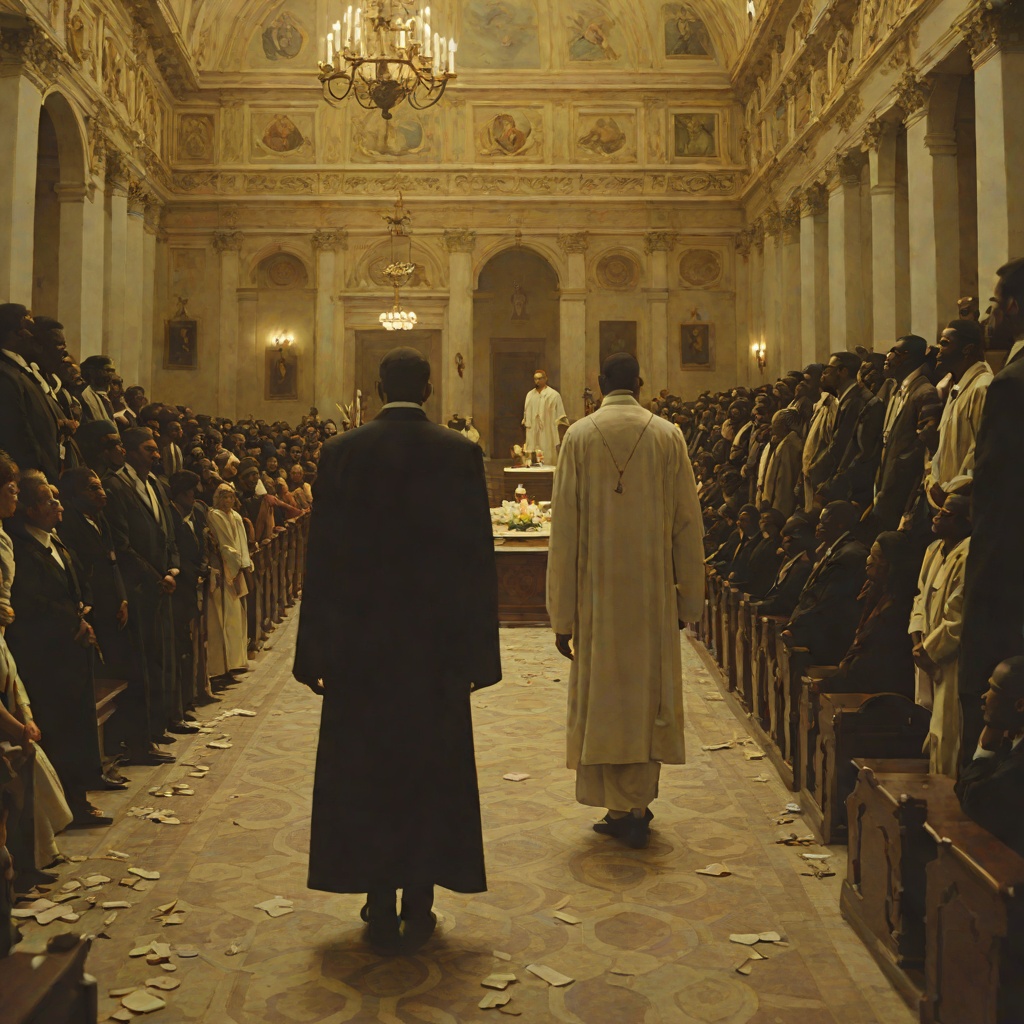
The wedding takes place downtown in the middle of the week, a deliberate departure from convention that reflects the couple's own unusual path. There is no best man; instead, there is a best woman, Joshua Gruen's sister Judy, a psychiatric social worker in her midthirties, small and dark-haired, wearing a corsage, who is described as "just a little tearful." The choice is significant: Sarah's decision to honor her late husband's sister in this role is read by the narrator as "a large, meaningful choice enacting the impeccable ethics of Sarah," an acknowledgment, in the midst of her joy, of her loss, the loss to both of them. The reception is held in the Senate Room of the Jefferson residential hotel on East Seventy-second Street, the residence of Sarah's dowager aunt, Myrna Fein, the late mother's older sister, who acts as hostess and instructs the waiters, making clear that "this is her show." The narrator is surprised on two counts: that there is any wedding reception at all, and that it is held at this stuffy hotel. Some fifty or sixty people attend, most of whom the narrator does not know, representing the extended relationships of Pem and Sarah. The gathering is visibly divided: on one side sit the Pems and on the other the Sarahs, "not a combination conducive to partying," so that when someone gets up to dance, everyone watches. The narrator reflects that on such occasions it is always a strain connecting the principals to the relatives and friends from their past, and that the wedding guests seem to be "just those people whom the bride and groom have spent their lives trying to escape."
The Couple and Their History
The wedding brings together two figures whose separate histories have been marked by loss and faith. Sarah Blumenthal, an assistant rabbi at Temple Emanuel, is described at the reception wearing an ivory suit with a bronze silk blouse that picks up the lights in her hair, her hair longer now and tied simply behind her neck in the style of an American revolutionary, her ears unadorned, and without her glasses, so nearsighted that she looks past the narrator without actually seeing him. Her first husband, Joshua Gruen, was a rabbi who ran a small synagogue on the Upper West Side, a converted parlor with an Ark at one end, a platform table for reading the Torah, shelves of prayer books, and rows of bridge chairs; he had two young sons, aged two and four, cared for by a dark Guatemalan nanny. Joshua's death and Sarah's subsequent relationship with Pem form the emotional backdrop of the wedding. The narrator wonders how Sarah has been able to keep her establishment going, speculating about Joshua's insurance, his family's money, or a mortgage on their synagogue, and notes that while Pem is broke, Sarah does not seem to be, despite her father having been a lifelong academic and the expense of nursing homes. Judy, speaking at the reception, says she is happy for Sarah, calling her "a wonderful person" and noting that she and Judy's brother "were a marriage made in heaven," but that after everything she has been through, Sarah deserves some happiness, and that the marriage is good for the kids too. Judy's husband, Al Something, who teaches English at a community college in New Jersey, is "not that convinced," stroking his pepper-and-salt beard as he watches Pem dance and chat with an elderly white-haired lady.
The Wedding Prayer
Pem's speech at the reception is the event's theological centerpiece. When he gets up and grasps the cordless microphone, the band stops playing and the room goes silent; his double-breasted blazer hangs open, his tie is loosened, his forehead "triumphantly cowlicked." He begins by saying he will not speak of his happiness or his prayerful thanks to the Lord that Sarah Blumenthal has found him worthy of her attention, promising that he will "passionately live what's left of my life to earn what she has given me," and announcing, "I will soon be a Jew. I will find the joy of a hallowed life." He then delivers what he calls his "final act as a Christian and an ex–Christian priest," a prayer addressed to God in "one of our intonative systems of clicks and grunts, glottal stops and trills." The prayer is a sweeping indictment: it recalls the "monstrously evil mortifiers of humanity" in the historic generations of every adult in the room, responsible collectively for the enslavement and horrible death of many tens of millions of human beings, an "exponential murder of souls" in wars and genocides, with the violently dead of the century consigned by their very numbers to "the lists of anonymous oblivion," and not resurrectable, "they cannot and will not resurrect even in the imagination of your Christian faithful." Pem refuses to address how an omniscient God could allow such catastrophes, noting that God's record even before this century "has not been all that commendable," but declares that the "relentless and unimaginable genocidal cruelties" of the age have brought God into disrepute, and that the degradation of the idea of life has thrown some into the despair of cursing God's name and impugning God's existence. He voices the "risen suspicion" among even those clinging to a love of God that God is "part of the problem," that men use God at will for their most hideous purposes, that God does not resist, that "anyone who wants You, and for whatever foul, murderous reason, can have You," and that God is "bought and embraced like the lowest, most pathetic streetwalker." The prayer extends beyond headline killers to the "miserable, wretched numbers of the rest of us" who inhabit the back pages and work in symbolic emulation of their spirit, living fervently to enrich themselves at the expense of others, so that even in the most advanced industrial democracies life is adversarial and the social contract breaks down continually.
The Dance and the Aftermath
The reception's lighter moments are charged with the same emotional intensity. The narrator, Everett, dances with Sarah to "My Blue Heaven" in a lively tempo, holding her for the first time beyond a handshake, his hand in the small of her back, feeling her heat and the clean herbal scent of her hair, while she laughs at his solemnized slow-time dance step to the fast-time beat. She puts her cheek against his and says in his ear, "You will always be our friend, Everett," and he is about to declare something spectacularly foolish when her older boy, Jake, taps him on the elbow to cut in. Sarah dances away with her son in his starched white shirt and red tie and unusually well combed hair, her arms outstretched, looking down on his solemnity of concentration in the healing pleasure of her serene love. The narrator reflects on the difficulty of writing a proper novel without talking about money, and observes the extended relationships of the two families. The wedding is also framed by the novel's recurring motifs: the Midrash Jazz Quartet plays the standards, with songs like "Me and My Shadow," "Stardust," "Good Night Sweetheart," and "Dancing in the Dark" serving as a kind of secular liturgy, and the narrator's thoughts drift to other performances, including an artist's installation on lower Broadway with a model railroad train led by a suit of medieval armor, and the work of an artist who wraps landmarks in fabric, suggesting the novel's interest in the transformation of sacred and public space. The wedding thus stands as the culmination of Pem's journey from the theft of St. Timothy's brass cross, found lying on the roof of Joshua Gruen's synagogue, to his conversion, and as the novel's most direct statement of its theological argument: that faith must be questioned, that God must be held accountable, and that love and commitment remain possible in the face of historical horror.