St. Timothy's Episcopal Church
City of GodSt. Timothy's Episcopal Church is the novel's most important religious location and one of its richest sites of transformation. First presented as the narrator's adopted church in the East Village, it becomes the scene of a theft, the source of a displaced cross, and a meeting point between Christian tradition, Jewish reinvention, urban decay, and theatrical performance. Its decisive significance lies in the way the building survives while the meanings attached to it repeatedly change: church, crime scene, refuge, remembered spiritual home, and finally theater.
Setting and Architectural Identity
St. Timothy's Episcopal Church is placed in the East Village, off Second Avenue near the Ukrainian hall and restaurant. The narrator imagines it as a typical New York brownstone ecclesiastical building, a smaller relative of the grander Church of the Ascension on lower Fifth Avenue. His description is also an act of fictional reconstruction: he explains that he changed the church's name and location to satisfy the priest, although an actual old ruin on East Sixth Street seemed unsuitable because its Catholic gray granite, cupola-like steeple, shattered stained-glass bull's-eye, and pigeon-streaked stone gave it the wrong visual character. The church therefore exists simultaneously as a physical neighborhood landmark and as a deliberately selected setting in a work of imagination.
The surrounding district has changed around it. Once associated with a substantial population of white Anglo-Saxon Protestants, the neighborhood has been overtaken by the tenements and commercial signs of a later city. People are described as merely getting by: a young woman runs in place with a Walkman, an aging bohemian drinks, an old man in house slippers and a Yankees cap holds up filthy trousers with a rope, and a young Black man crosses against traffic with an imperious glare. The church's survival amid these lives gives it a material position between an earlier religious Manhattan and a more precarious, crowded urban present.
The Church as Home and Crime Scene
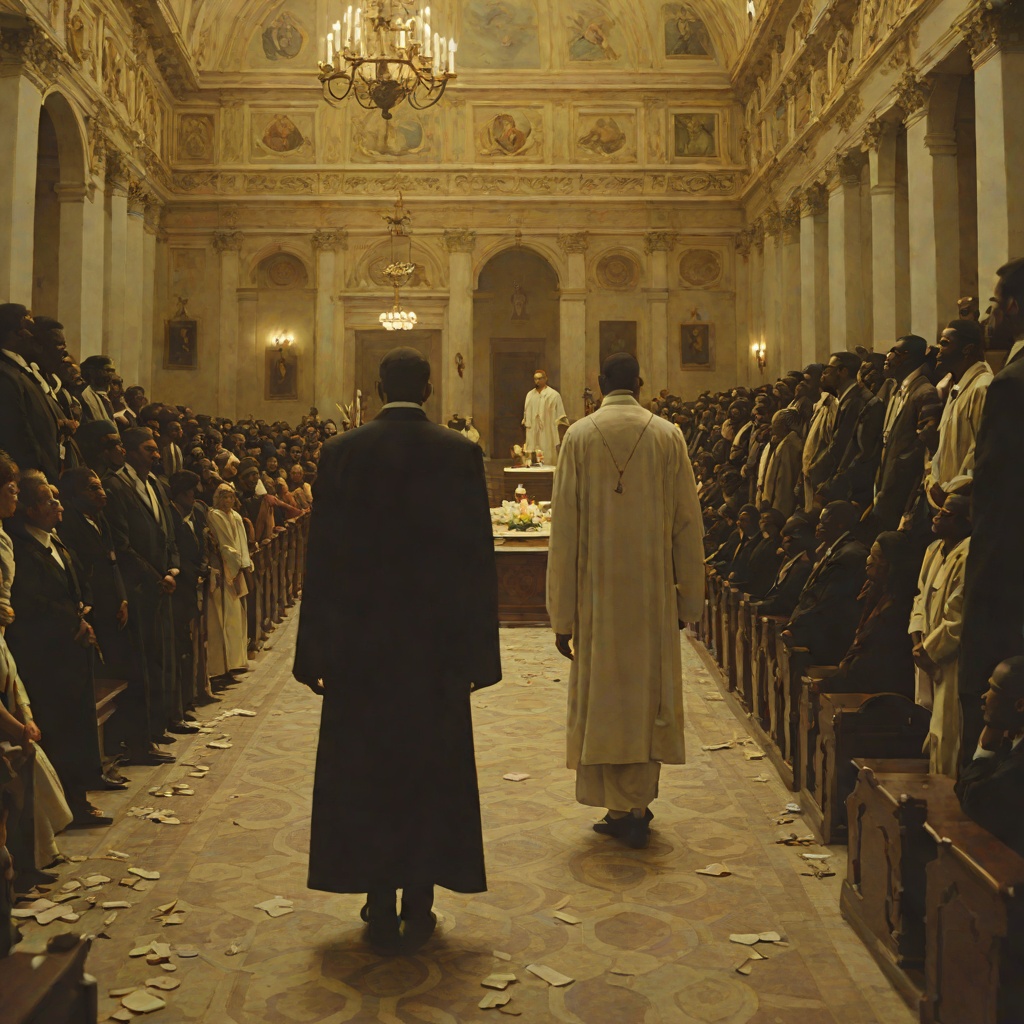
The narrator has treated St. Timothy's as a home for years, but an overnight watch reveals that the building itself offers no automatic spiritual protection. Sitting in the balcony, he waits with a six-volt Bearscare Superbeam, imagining its beam striking the altar at the speed of light and comparing that speed to the finger of God. Amber crime-prevention lights turn the block into an indoor crime scene, while the church's stained-glass figures appear yellowed and obsolete. The creak of an oak pew and the two Doppler pitches of a police siren seem to be absorbed into the stone, as though the building were filing away its own crisis without responding to it.
The watch becomes a humiliating failure of vigilance. The narrator dozes, then wakes to the crash of dishes and races down the stairs with the Superbeam raised like a club. In the pantry he finds the smell of hashish, male body odor, and a pungent female pheromone scent, along with an additional odor he associates with lipstick or lollipop. Dish cabinets have been damaged, panes are shattered, cups and saucers lie on the floor, and one cup is still rocking. The alley door stands open, and something large seems to move beyond it before a deep metallic sound rises through the floor.
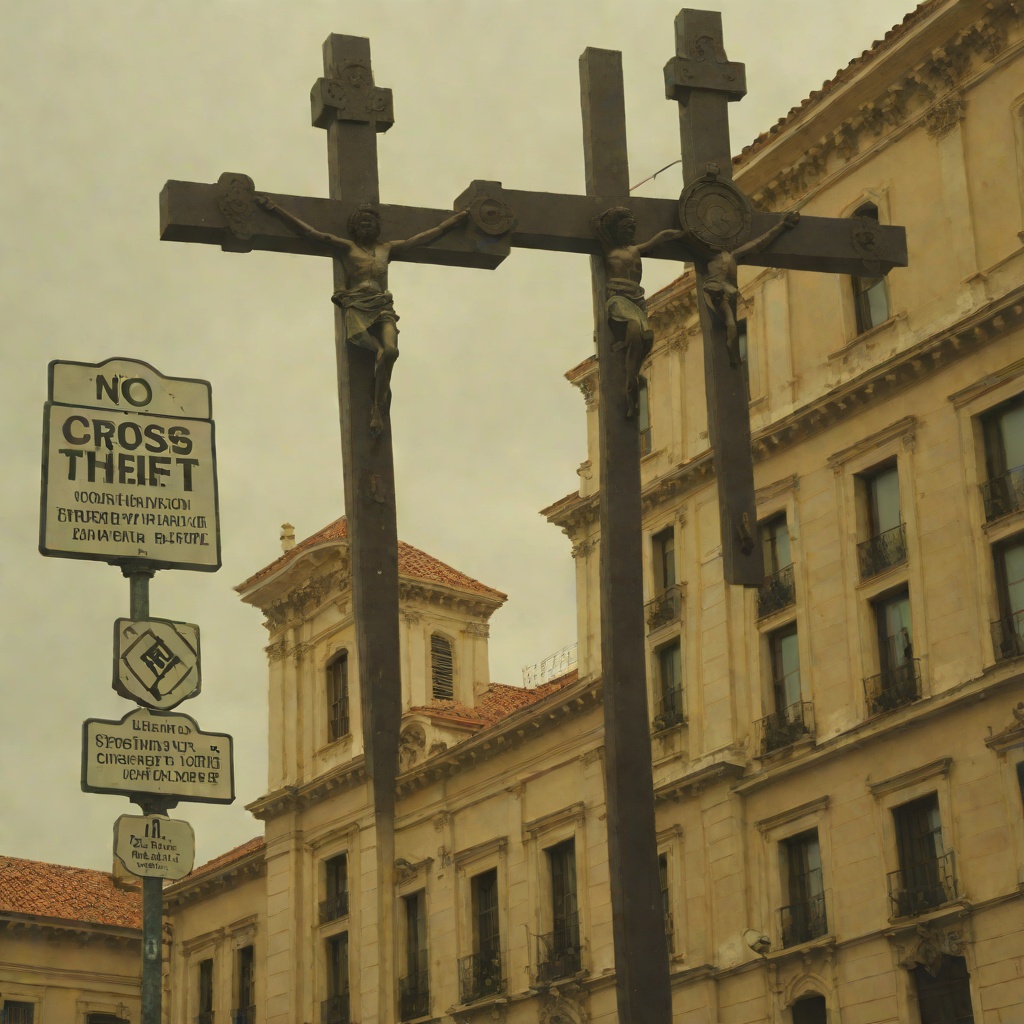
The decisive discovery comes when the narrator sweeps the light toward the turning shadow. Behind the altar, where the large brass cross should be, only the shadow of a crucifix remains in the unfaded paint left by a predecessor's poor taste. The real detective's explanation strips the theft of devotional grandeur: criminals would target a synagogue for a Torah because its handwritten form might bring at least five thousand dollars, whereas the church's cross has virtually no book value and, on the street, is merely scrap metal. The church is thus caught between sacred significance and commercial valuation; the object that defines its altar can be treated by the outside world as nothing more than metal.
The Displaced Cross and Interreligious Connection
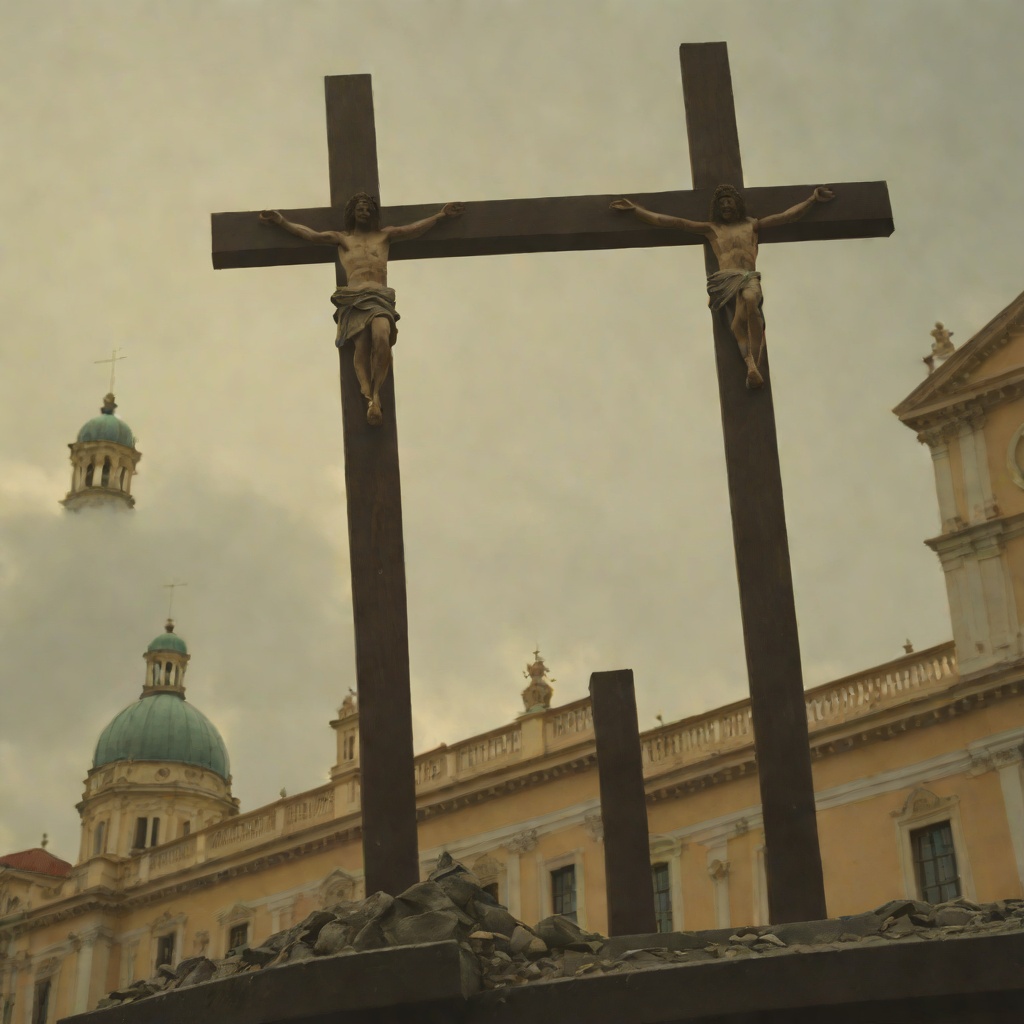
The church's missing cross later reappears on the roof of Joshua Gruen's building, where it is found by the narrator during a visit to Joshua and Sarah Blumenthal. Joshua leads him up an iron ladder through a trapdoor, and the narrator emerges onto a flat roof overlooking the chimneyed brownstone roofs around West End Avenue and Riverside Drive. With the autumn sun behind the apartment houses and the river breeze on his face, he experiences the exhilaration and slight vertigo of standing above the city. That heightened perspective prepares the reversal: Joshua points toward the Ninety-eighth Street frontage, where the eight-foot hollow brass cross from St. Timothy's lies flat on the black tarred roof, its transverse parallel to the building's front and its upright pressed against the granite pediment.
The roof changes the cross's position without resolving its meaning. Removed from the altar, it is neither restored to Christian worship nor simply discarded. Its tarnish and old nicks remain visible in the autumn light, while its placement above a Jewish household and congregation gives the object an interreligious and almost theatrical displacement. The church is absent from the roof scene, but its identity is carried there by the cross. The building's sacred center has become a mobile sign, capable of creating a new crisis once separated from the institution that originally housed it.
That displacement also resonates with the novel's treatment of sacrifice. A discussion of ancient religion explains sacrifice through images of animals surrendering a part of themselves to escape a greater danger: the lizard leaves its tail, the fox chews off its foot, and mythic figures divert pursuit by giving up pieces of themselves. Against that logic, the stolen cross becomes an object through which the book questions whether loss creates redemption, whether a fragment can preserve a whole, and whether inherited symbols retain authority after their institutional setting has been removed.
From Church to Theater
When the narrator later returns to the East Village to see what has become of St. Timothy's Episcopal Church, he finds the building compressed by urban development. Its brownstone steeple, once probably the tallest structure in the neighborhood, now stands recessed behind a tiny churchyard and jammed between tenements. The street is marked by the signs of ordinary rent-payers: cleaners, a bodega, a bar, and a shop where checks are cashed. The few gravestones in the patchy grass have sagged over the years like shoulders bowed in grief.
The church has not simply fallen into ruin. It has become a theater company. Gothic lettering over the doors announces the Theater of St. Tim's, where Anton Chekhov's The Seagull is being performed. This conversion preserves the building's public function while replacing religious ritual with drama. The old churchyard, gravestones, steeple, and Gothic lettering remain as a visual vocabulary of sacred history, but the building now stages human performance rather than Christian worship. Pem's observation that drama was born from religion gives the change a conceptual frame: gods leave, ordinary Greeks enter, and the ritual space becomes a place where the secular world performs its own mysteries.
The theater's presence does not erase the church's earlier meanings. Instead, it makes them newly visible as theatrical forms: entrances and exits, inherited roles, gestures of belief, and an audience gathered for interpretation. The building's transformation suggests that sacred institutions may persist less through fixed doctrine than through their capacity to organize attention, memory, and communal performance.
A Site of Questioning and Reinterpretation
St. Timothy's stands in contrast with the Synagogue of Evolutionary Judaism, where traditional forms are retained but subjected to historical and intellectual examination. At the synagogue, services begin and end with traditional liturgy in English, while the middle becomes a rabbinically directed seminar. Congregants study the documentary hypothesis and examine the Torah as a collection of historically distinct sources rather than as an untouched original. In this setting, religious practice is not abandoned but reconstructed through modern scholarship.
The congregation's argument over what may be questioned makes the church's transformation more legible. An elderly man accepts intellectual discussion and appreciates the modest congregation, yet insists that some matters cannot be challenged, including the belief that the Torah was given by the Creator and the acceptance of the yoke of the Kingdom of Heaven. He regards such belief as the boundary between religion and mere tradition. The disagreement exposes the same pressure that St. Timothy's embodies materially: a religious form can be preserved, repurposed, or critically examined, but each alteration raises the question of what remains when its original authority is no longer taken for granted.
The church also shadows the book's larger theological crisis. In a final address to God, Pem condemns the genocidal violence of the modern age, arguing that mass death has brought God into disrepute and made divine silence part of the problem. The thought carries the church's empty altar into a wider moral landscape. A missing cross is a local mystery, but the absence of any adequate divine response to historical catastrophe is the novel's larger absence. St. Timothy's therefore functions not only as a setting for investigation but as an architectural image of belief after certainty has been damaged: the walls remain, the symbols travel, and the space must be continually reinterpreted.