State of War
City of GodState of War is a conceptual state in E. L. Doctorow's City of God, defined as a condition "neither French nor German nor American" but "founded to contest all sense and meaning." It is the narrator's imaginative frame for picturing his father during World War I, yet it extends far beyond that single battlefield to become the novel's governing metaphor for atrocity, legal failure, and the limits of representation. The state recurs across the book's disparate episodes—from the trenches of the Western Front to the pursuit of a Nazi war criminal in Cincinnati—binding them into a single meditation on how violence undoes the very categories by which meaning is made.
Definition and Origins
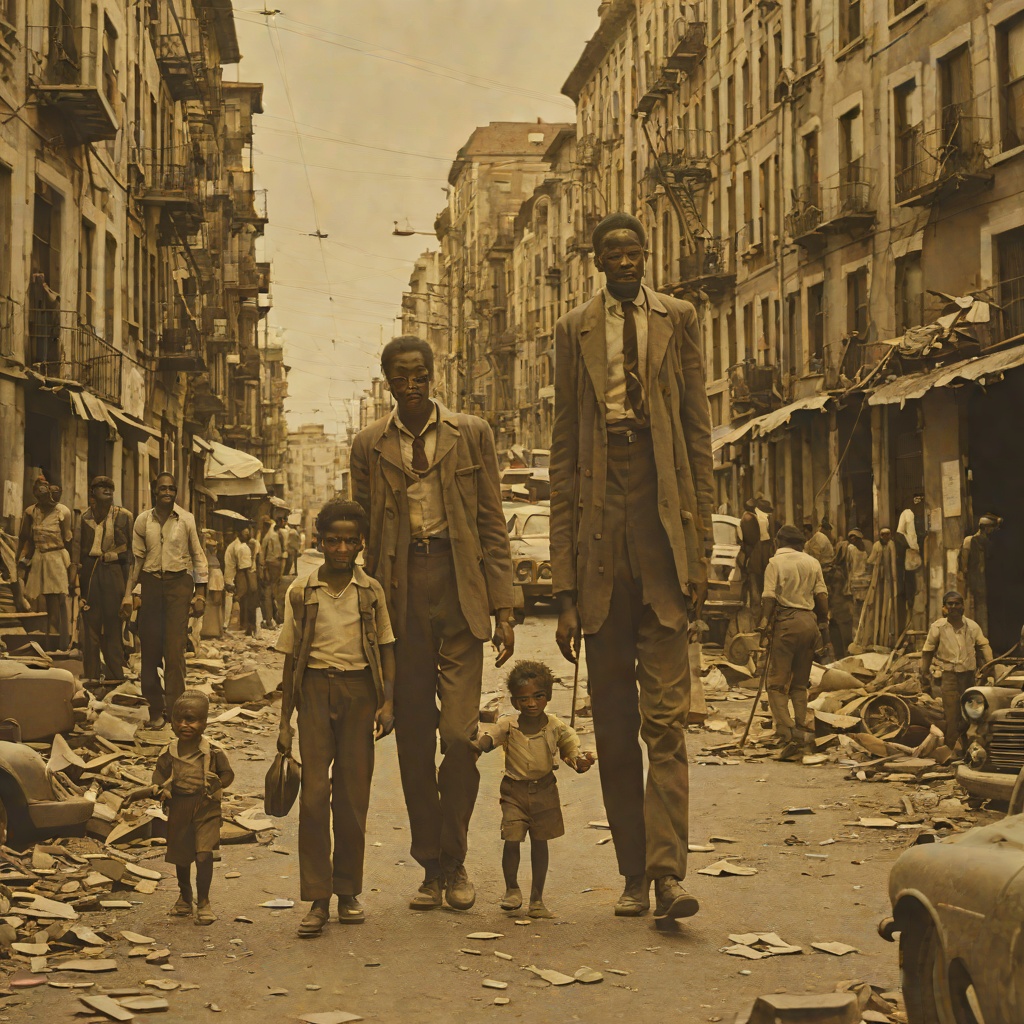
The State of War is first conjured as a way of seeing. The narrator pictures his father in the state of war, a condition that is "neither French nor German nor American" but "founded to contest all sense and meaning." This is not a geographical territory with borders and a government; it is an anti-territory, a zone whose sole purpose is the negation of the rational order that nations claim to uphold. The phrase deliberately strips war of its national flags and patriotic justifications, presenting it instead as a pure force of meaninglessness that overrides the distinctions—French, German, American—that ordinarily organize human allegiance. The state is located along the southern reaches of the broad battleground that stretched from the Belgian coast on the North Sea southeasterly in a great crescent of devastation to the Swiss border at Bernevesin, a landscape of total ruin that gives the abstraction a concrete geography. The narrator's father is placed within this landscape, a figure whose experience of war is inseparable from the state's defining negation of sense.
The sensory details of the battlefield reinforce the state's character as a realm where ordinary perception fails. Very flares lighted the night sky a radiant mustard, and shells blew in sizzling flashes, like ground lightning, transforming the familiar world into something alien and illegible. In the acrid white fog of the following sunlit morning, when the German infantry was understood to be finally advancing, the very elements—light, sound, air—conspire to dissolve the certainties that soldiers might otherwise cling to. The mustard-colored flares and ground lightning are not merely atmospheric; they are the visual signature of a state that has broken with the natural order, where even the sky becomes a weapon and the morning brings not clarity but fog.
The State as a Frame for Atrocity
The State of War is not confined to the trenches of World War I. It reappears as the implicit condition of the Holocaust, specifically in the figure of S.S. Major Schmitz, the commandant of the Kovno Ghetto. The novel's pursuit of Schmitz is conducted through the legal and documentary apparatus of the postwar world, and the State of War shadows every attempt to bring him to justice. The rabbi has faxed her father's file, which contains his letters to the Justice Department and their bureaucratic replies, along with two 1977 articles from the Times covering a deportation hearing and its finding. Three people testify that the man in question is the ghetto commandant, Schmitz, but his lawyer shoots down their testimony, characterizing the witnesses as elderly and easily befuddled. The defendant testifies that he is Helmut Preissen, an ex-corporal who only did guard duty in the ghetto for three months before being shipped to fight on the Russian front—the same identity he presented to the immigration authorities after the war. The judge finds in his favor.
The State of War here is not the battlefield but the condition that allows a war criminal to vanish into the ordinary world. Schmitz, or Preissen, has crossed out of the state of war and into the state of peace, where the rules of evidence and the presumption of innocence protect him. The novel's point is that the State of War does not end when the shooting stops; it persists as a rupture in the moral order that the peacetime legal system is structurally unable to repair. The letters to and from the Simon Wiesenthal Center show a functionary agreeing with Sarah's father that Preissen is almost certainly Schmitz, but short of convincing documentation, the identification cannot be made to justify reopening the case, although the file is being kept open. The Department of Justice offers less agreement, its lawyer somewhat defensive about his handling of the case. Every institution that might close the gap between the State of War and the State of Peace—the courts, the Justice Department, the Wiesenthal Center—proves inadequate to the task.
The State and the Failure of Legal Closure
The State of War's most corrosive effect is on the very possibility of closure. The novel stages this failure through the figure of the ex-Times man, who flies to Cincinnati with an open-ended return ticket to investigate the suspected war criminal. He checks in at a hotel, the Something Arms, on one of the residential streets in the hills above the downtown, rents a car, and cruises around to get the feel of the place. The whole city smells like beer, with lots of red brick and white granite steps, sun bronzing off the Ohio River down below—a scene of American domesticity that stands in stark contrast to the State of War he is hunting. He remembers from accounts of the Eichmann kidnapping that the major problem was identification, that they would have the right guy. The suspected Eichmann worked under an assumed name, wore heavy black-rimmed glasses, looked unprepossessing, and came home to a not very nice neighborhood, a cubelike flat-roofed cinder-block house in the middle of an empty lot outside Buenos Aires, hardly befitting a man of his achievement. On the other hand, with its small windows on all four sides, it could not be sneaked up on; he could enfilade the entire lot.
The ex-Times man's meditation on the Eichmann kidnapping becomes a meditation on his own inadequacy. He realizes he comes from the other culture—the culture of reporting the fact, getting the story, getting the spelling right. It is like a ball and chain that drags on him, a heavy weight to pull. It is one thing to have the resolve to end a story, another to make the muscles actually do it, to actually make something happen in the world. All his life he has looked on; civilization paid people like him for doing nothing, for living subsidized, the way a farmer is paid for not planting crops. The State of War demands action, but the culture of observation that the ex-Times man inhabits is structurally incapable of providing it. He can document the State of War, but he cannot end it.
The novel's final verdict on the pursuit of Schmitz is delivered by Pem, who learns that the son of a bitch died two months ago. "Schmid, Schmitz, whatever the fuck his name was. The Nazi who ran the ghetto. Died in his sleep. A home in Yonkers. We had him good and nailed, too. Damn!" The State of War's ultimate triumph is that its perpetrator escapes the courtroom entirely, dying in his sleep in a nursing home in Yonkers rather than standing up in court and letting the world take a look at him for what he was. The legal machinery that was supposed to provide closure—the impounded chest at JFK, the Justice Department attorney present when it is cracked open, the irreproachable circumstances of the unsealing—all of it is rendered moot by the banality of a death in a Yonkers home. The State of War does not end with a verdict; it ends with a whimper, with the war criminal simply ceasing to exist.
The State as a Condition of the Novel's Form
The State of War functions as the novel's organizing principle, the conceptual ground that unites its otherwise disparate episodes. The novel's structure is itself a kind of war zone, a network of nodes—the trenches of World War I, the Kovno Ghetto, the JFK impoundment, the Cincinnati investigation, the Yonkers nursing home—that are connected not by linear narrative but by the recurrence of the State of War as a condition that contests all sense and meaning. The state is the one constant in a book that otherwise refuses to settle into a single story. It is the frame through which the narrator pictures his father, the lens through which the novel views the Holocaust, and the shadow that falls over every attempt at justice. The State of War is not a place one enters and leaves; it is a condition that the novel suggests may be the permanent background of modern life, a state that persists beneath the surface of peacetime and erupts whenever the attempt is made to confront the atrocities of the past. The novel's refusal to provide closure—Schmitz dies unpunished, the ex-Times man can only watch, the legal system fails—is not a failure of the book but its deepest insight: the State of War is founded to contest all sense and meaning, and no amount of documentation, testimony, or legal procedure can fully restore the order it has destroyed.