Synagogue of Evolutionary Judaism
City of GodThe Synagogue of Evolutionary Judaism is a small congregation on Manhattan’s Upper West Side, located in a brownstone on West Ninety-eighth Street between West End Avenue and Riverside Drive. More than a backdrop for the novel’s religious conversations, it is a working experiment in how a faith might preserve its ethical and communal force after traditional claims about divine authorship and unquestionable authority have been placed under scrutiny. Its services, seminars, and intimate domestic scale give physical form to the tension between inherited religion and the desire to rebuild belief through history, reason, memory, and human need.
Setting and Physical Form
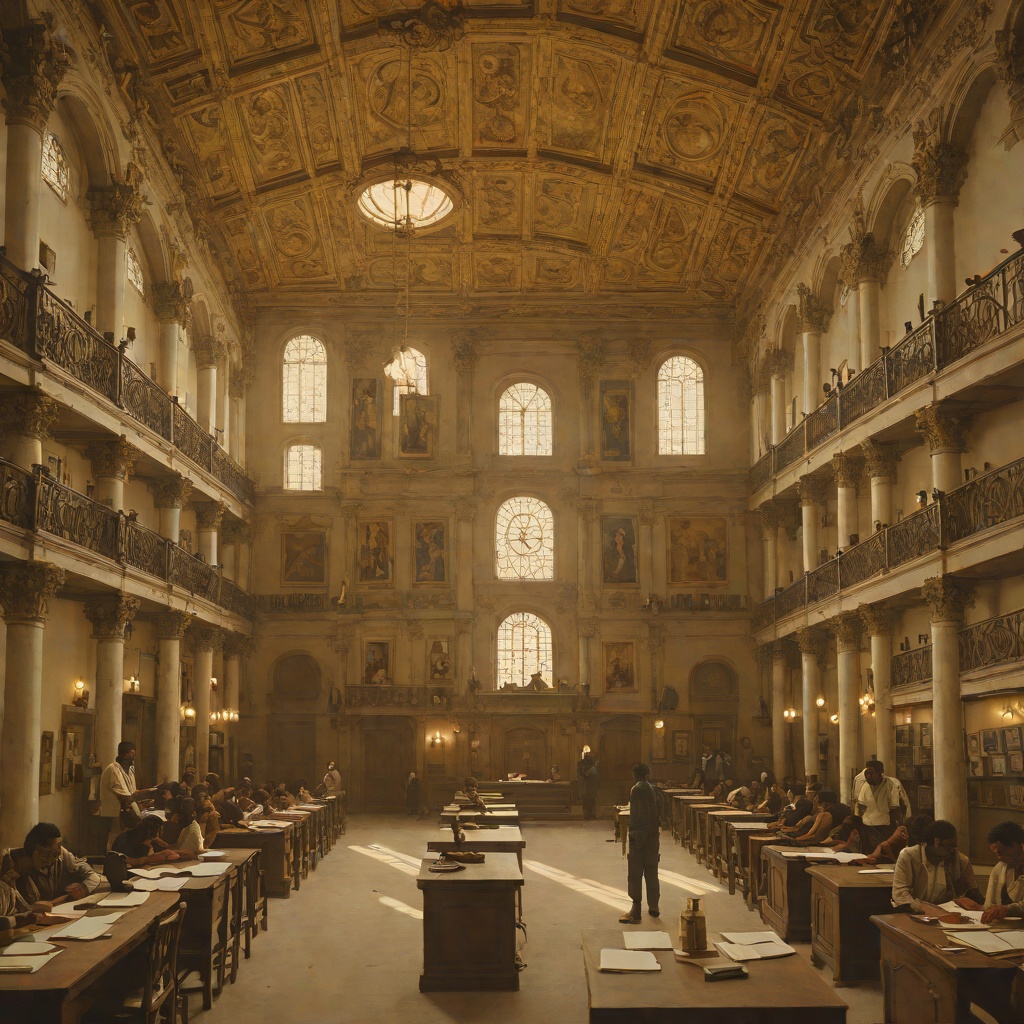
The congregation occupies a converted brownstone rather than an imposing monumental sanctuary. A steep flight of granite steps leads to the entrance, and the modest interior is reached through the building’s domestic rooms. On the second floor, the synagogue consists of a converted parlor or living room with an Ark at one end, a platform table for reading the Torah, shelves of prayer books, and a few rows of bridge chairs. The arrangement is functional and deliberately ungrand: a sacred meeting place assembled within ordinary urban architecture rather than separated from it by institutional scale.
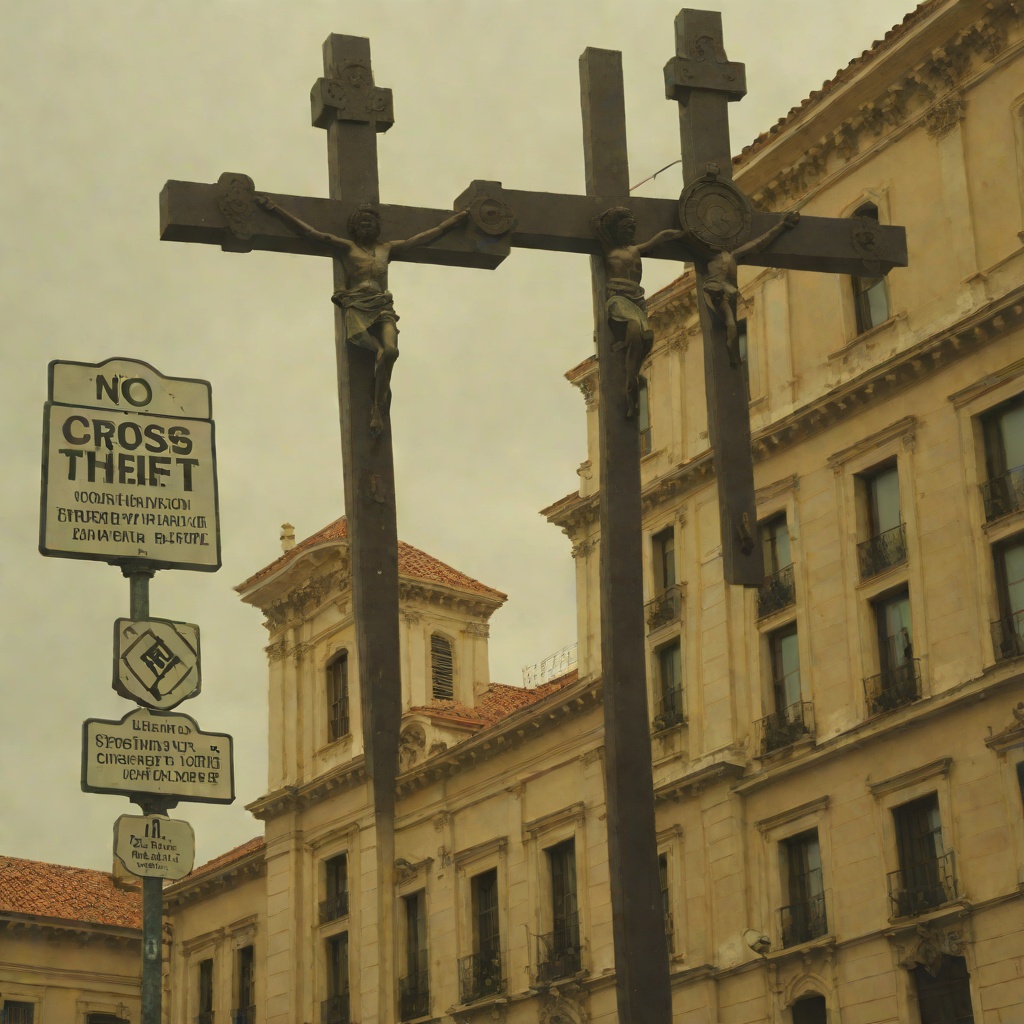
The synagogue’s location also gives it a visual and symbolic relation to St. Timothy's Episcopal Church. When Thomas Pemberton first visits at Rabbi Joshua Gruen’s request, the congregation’s roof becomes the unexpected resting place of the stolen eight-foot hollow brass cross from St. Timothy’s. The cross lies flat on the black tarred roof, its transverse parallel to the building’s frontage and its upright pressed against the granite pediment. The object’s tarnished surface catches the autumn sun, turning the roof into a charged border between Christian and Jewish spaces. The placement does not erase the difference between the institutions; it makes that difference impossible to ignore.
Congregation and Religious Experiment
The Synagogue of Evolutionary Judaism is presided over by Joshua Gruen when Pemberton first enters its world. Gruen is a young rabbi who lives and works within the same compact brownstone environment as his congregation. His wife, Sarah Blumenthal, is also a rabbi and an assistant rabbi at Temple Emanuel. After Gruen’s death, Sarah conducts the services, and the synagogue’s survival becomes inseparable from the question of whether its intellectual and theological project can continue without its original presiding voice.
The congregation is small and socially varied. On one Friday evening, Pemberton finds no more than ten or twelve people in attendance, less than half the number present when Joshua Gruen was presiding. Its members include a professor of Comparative Religion at Columbia, a judge of the State Supreme Court, a young woman studying at the Actors Studio, two physicians who are married to each other, a Barnard junior, and an elderly white-haired man whose son carries him up the brownstone stairs and retrieves him afterward. The range of professions, ages, and bodily circumstances gives the synagogue the character of a discussion community rather than a congregation organized around uniform social identity.
The setting is also connected to family life. Joshua and Sarah’s children occupy the third floor, where they remain among primary-color wall boxes filled with stuffed animals and cling to their Guatemalan nanny. The proximity of children, domestic rooms, rabbinical work, and worship prevents the synagogue from appearing as a sealed religious institution. It is a household, classroom, and congregation at once, with theological argument taking place inside the ordinary pressures of marriage, parenthood, grief, and work.
Services, Study, and Scriptural Criticism
The synagogue’s Sabbath services are being redesigned through study and discussion among the congregants. Their emerging essentials include the Shema, understood as a declaration of the oneness of God and the principle of abstract monotheism; a Kaddish for the dead, retained because it comforts mourners, renews memory, and restores gratitude; recognition of the Sabbath as a time of freedom and reflection; and sustained study of the Torah in order to derive the imperatives that will complete the restructuring of the services and provide a theoretical basis for the evolved faith.
This program does not simply discard tradition. It separates what appears inessential, intellectually untenable, or blindly customary from what remains crucial and defining. The weekly Friday evening service, repeated more or less on Saturday morning, begins and ends with traditional liturgy in English, while its middle becomes a rabbinically directed seminar rather than a conventional sermon. Holidays provide additional occasions for inquiry. In this form, the synagogue becomes, ironically, a continuing-education yeshiva: a place where religious practice is maintained by examining its origins and reasons rather than by treating its inherited forms as self-justifying.
One sustained subject is the documentary hypothesis of biblical authorship. The first five books of the Bible are examined as collected texts associated with different historical sources, identified as J, E, P, and D. The discussion also distinguishes original textual materials from interpretive commentary that developed across the centuries before and after the Common Era. Because the biblical texts were written without vowels or punctuation, later scholars, priests, and sages interpreted contradictions, troubling sentiments, morally unsavory passages, and difficult actions through metaphor, symbolism, allegory, punctuation, syntax, and other forms of reimagining. The synagogue therefore treats scripture not as a transparent transmission from the divine but as a layered textual history whose formation must itself be understood.
Conflict Over Authority and Tradition
The synagogue’s openness to questioning produces a direct conflict over the limits of religious inquiry. During a seminar on the mitzvoth, a well-dressed middle-aged woman contrasts Reform Judaism’s retention of many commandments with the more radical questioning practiced by the congregation. An elderly man then objects that some matters cannot be questioned, especially the belief that the Torah was given by the Creator and the acceptance of the yoke of the Kingdom of Heaven. For him, without such assent there may be tradition, but there is no religion.
The exchange exposes the pressure point within the EJ project. The old man’s intervention is comic in its interruption and social awkwardness, yet it carries a serious theological demand: a religion must possess more than historical explanation and ethical usefulness. Pemberton sees the moment as one in which rationalism encounters a limit. The synagogue can analyze the sources of scripture, reconstruct the rationale of ritual, and debate the meaning of tradition, but the question remains whether a community can preserve religious intensity after surrendering the security of unquestioned revelation.
Sarah’s response is complicated by grief. Pemberton wonders whether he sees in her eyes a longing for Joshua Gruen’s resurrection and whether Joshua had been carrying more of the congregation’s theology than she could immediately carry forward. The synagogue’s institutional debate is thus inseparable from a personal absence. Its intellectual method is tested not only by argument but by bereavement: the loss of a rabbi threatens to become a loss of interpretive center.
Cross-Cultural and Theological Significance
The cross on the synagogue roof makes the congregation part of the novel’s larger inquiry into sacrifice, atonement, and the circulation of religious symbols. In a discussion of the origins of the sacred, the scholar Burkert’s image of an animal leaving part of itself in the predator’s mouth, or sacrificing a body part to escape a trap, is used to describe sacrifice as the surrender of a portion to save the whole. Ancient myths repeatedly represent human beings escaping monsters by giving up pieces of themselves, and the logic of sacrifice becomes a way to think about the relation between individual loss and collective survival.
That logic is placed under severe pressure in Pemberton’s final address as a Christian and former Christian priest. Speaking to God after the historical catastrophes and genocidal violence of the modern age, he argues that the mass deaths of the century have consigned countless people to anonymous oblivion and made resurrection impossible even as an act of Christian imagination. He further contends that humanity’s use of God for murderous purposes has brought God into disrepute, so that the idea of life itself has been degraded. The synagogue’s experimental theology matters within this context because it seeks a religious language that can acknowledge historical suffering without relying on easy redemption or inherited explanations.
The congregation’s importance therefore lies less in offering a settled alternative than in making uncertainty communal and disciplined. Its brownstone rooms hold traditional liturgical beginnings and endings together with source criticism, ethical debate, mourning, and the practical demands of belonging. The cross’s movement from an Episcopal church to the roof of this Jewish congregation dramatizes a transfer of sacred weight; the synagogue’s seminars ask what, if anything, can still be carried forward once the old explanations have been examined. In that sense, the Synagogue of Evolutionary Judaism is both a place of worship and a workshop for the unfinished reconstruction of faith.