The Holocaust
City of GodThe Holocaust is the decisive historical catastrophe in City of God, the event against which the novel measures theology, memory, evidence, and the possibility of moral response. Its significance extends beyond the engineered slaughter of European Jews: it becomes a test of Christian belief, a wound carried by survivors and their children, a reason to preserve documents at mortal risk, and a historical absence that later legal procedures cannot fully repair.
A Crisis for Christianity
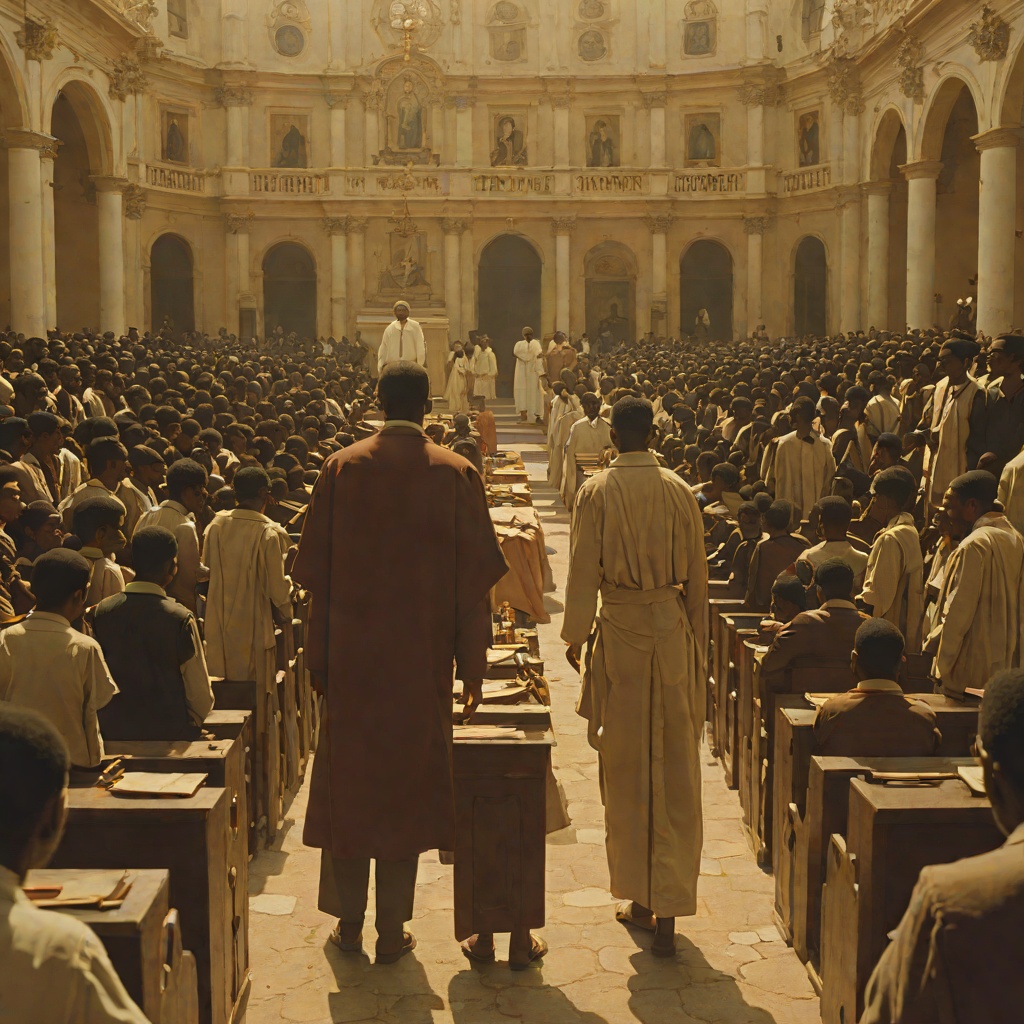
The Holocaust first appears as a direct challenge to Christian self-understanding. In a large congregation, Thomas Pemberton asks what the engineered slaughter of the Jews in Europe has done to Christianity and to the story of Christ Jesus. He refuses to treat the catastrophe as a problem belonging only to Jewish theologians. Instead, he asks what Christian mortification, ritual, or practice could be commensurate with the disaster: perhaps mass exile, or a lifelong commitment by millions of Christians to wandering derelict through the world, or the clearing of lands and cities surrounding every death camp. He admits that he does not know what the proper response would be, but insists that he would recognize it if he saw it.
This demand turns historical knowledge into an ethical obligation. The Holocaust is not presented as an event that can be absorbed by familiar religious consolation. Pemberton’s question is whether a faith that responds with habit, doctrine, or empty reassurance has become a form of self-deluding complacency. The catastrophe therefore destabilizes the inherited Christian narrative rather than simply adding another tragedy to it.
The narrator later connects the Holocaust to the accumulated violence of modern European history. Small, quiet resentments are imagined as gathering in the ears of a generation before the disaster arrives as an accelerating historical mass. From this perspective, the twentieth century makes the traditional religious concept of God difficult to maintain. The narrator’s proposed alternative is not a return to scripture but a search for God in the irreducible laws of the universe: gravity, the ordering of matter, and the comprehensible structure of reality. Even the bending of starlight can become a sacrament, but this sacrament is radically different from a providential explanation of suffering. It offers awe without pretending that the catastrophe has been justified.
The Ghetto, the Child, and the Witness
The Holocaust is also reconstructed through Sarah Blumenthal’s childhood in the ghetto. At ten years old, Sarah served as one of seven runners, carrying warnings, instructions, and reports between families, council members, and posts near the bridge. The runners watched for the open car carrying soldiers and the half-track behind it, signs that another disaster was about to begin. Sarah ran through back alleys and side streets, wearing a military-style cap and a jacket marked with a star.
The uniform created a grotesque illusion of privilege. Sarah secretly admired aspects of the enemy uniforms and treated her star as a sign of rank, imagining herself as the star runner. Yet she knew exactly what was happening. The childish fantasy of military importance existed beside full awareness of death, making the testimony more than a recollection of victimhood. It records the psychological distortions imposed by persecution: a child is given responsibility beyond her age and made to interpret the symbols of degradation as symbols of office.
Sarah’s father was not formally appointed as a runner. He had made himself useful because he was small and quick, and the community gradually came to depend on him. The official runner’s cap, given toward the end, helped save his life in more than one way. Sarah’s response to the written account is therefore divided between correction and recognition. She objects to inaccuracies, including the absence of details about vodka, soap, and the black market, but she is deeply moved because the account has caught her father’s voice. Historical truth here is not identical with literal completeness: a narrative may be inaccurate in particulars while remaining true to the presence of a person and the shape of inherited memory.
The same tension governs the photographs later recovered from the archive. One shows seven little boys standing at attention before a wood cabin, wearing military-school caps and stars as possible insignia of their work as runners. They are underdressed, some in short pants, worn sweaters, or jackets they have outgrown; one boy hunches his shoulders in instinctive self-protection or cold. Their posture tries to impose order on a world organized by death. Sarah recognizes her father in the front row, and the photograph turns a list of names and dates into an encounter with living children who already understand the fate surrounding them.
Documentation Against Erasure
The Holocaust produces an archival imperative in Josef Barbanel. Whenever reports reached him, he either recorded them verbatim or required the informant to write a statement. His diary gathered regulations, execution orders, deaths, council minutes, orders signed by Commandant Schmitz, prohibitions, directives, and identity papers for work details. He wrote on whatever paper was available, including unused student exercise books, producing a record whose small, neat Yiddish script seemed to stitch each moment into permanence.
Barbanel’s writing was illegal because the Germans understood that records and photographs could establish culpability. Cameras had been confiscated, and unauthorized writing was forbidden. His position as Dr. Koenig’s chief aide gave him a practical disguise: he could appear to be writing as part of his formal duties while secretly preserving the history of the ghetto. When Yehoshua asked whether he was a historian, Barbanel answered that he was one by necessity. The phrase defines the archive’s moral character. It is not an academic project detached from events but an emergency response to the danger that murder will be followed by denial, confusion, and disappearance.
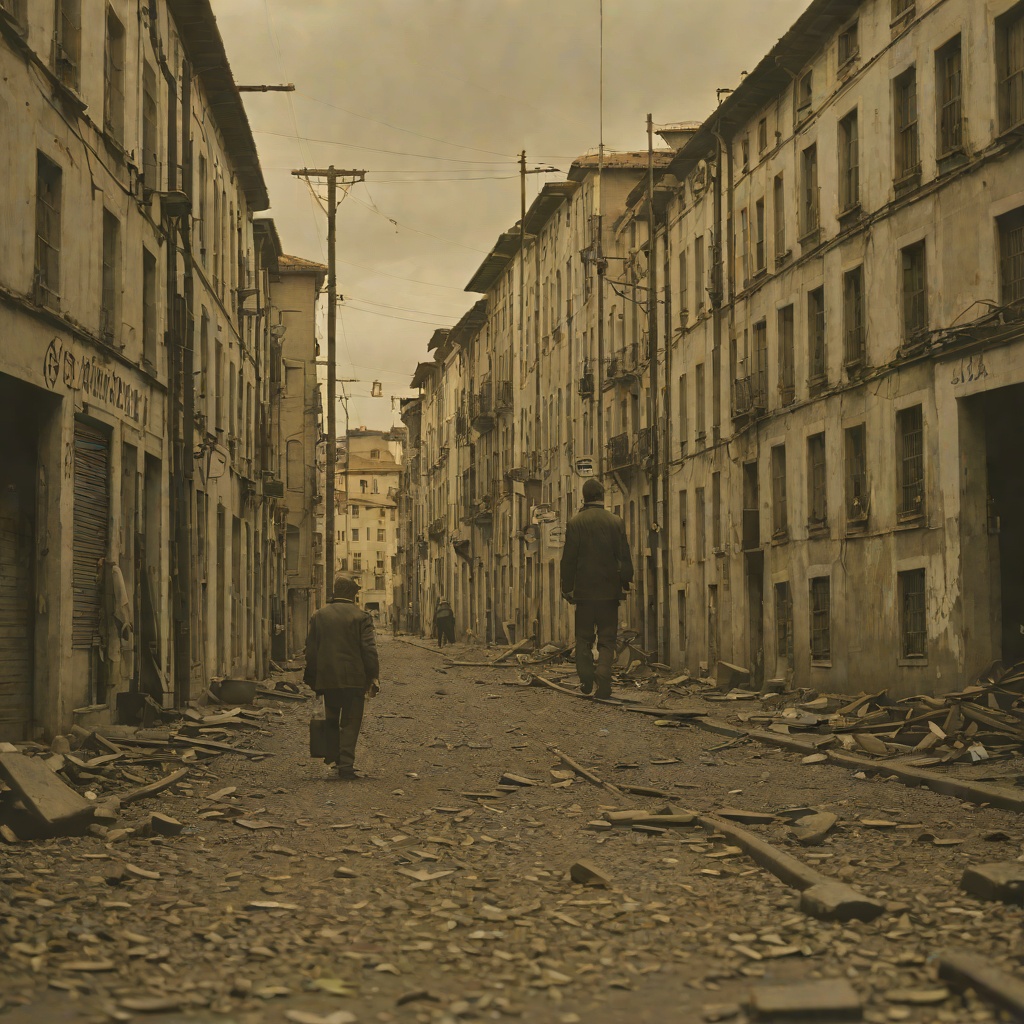
The archive grows to thousands of pages, eventually filling an entire trunk. Neither Barbanel nor Greta Margolin survives the destruction of the ghetto, and the papers are imagined as remaining hidden in the earth of Eastern Europe, amid rubble, wreckage, and dust. Their disappearance gives the archive a double meaning. It preserves the dead while also embodying the destruction that prevented its creators from completing their lives. The papers are not only evidence of crimes; they are the surviving form of a couple whose ordinary, modest existence has been made historically immense.
The archive also depended on clandestine communications. Barbanel kept a shortwave radio inside a wall in the attic dormitory above the council offices. Two or three nights a week, the boys helped open the wall, connect the radio to the single light fixture, and practice closing it quickly. One boy watched the window while another guarded the door. The children’s participation links testimony to danger: preserving knowledge required collective discipline, secrecy, and the willingness to act before anyone could know whether the record would survive.
Memory, Inheritance, and Religious Reconstruction
The Holocaust passes from Sarah’s father into Sarah’s own religious life. At the Synagogue of Evolutionary Judaism, she stands behind the reader’s desk with the EJ Torah scroll open before her, its edges charred after recovery from the catastrophe. The damaged scroll makes the past physically present within a contemporary service. It is neither a relic that can be left untouched nor a document that can be treated as intact. Its survival demands interpretation.
The congregation studies the Torah through historical and source-critical methods, treating its first five books as texts assembled from different sources rather than as a transparent original revelation. The discussion separates original texts from later interpretive commentary and notes how scholars, priests, and sages altered, punctuated, or allegorized passages that seemed contradictory or morally unacceptable. This scrutiny does not erase tradition, but it removes the illusion that readers possess an untouched scripture.
Sarah’s theology goes further than preservation or consolation. She explains that reconstruction is only a beginning: tradition must be subjected to irreverence so that it can return to a level of unmediated awe, a direct perception of divine presence in consciousness and therefore in everyone and everything. The charred scroll thus stands between destruction and renewal. The Holocaust has made inherited forms impossible to accept innocently, but it has not made religious attention impossible. It forces the tradition to confront its own human mediation and to seek meaning without guarantees.
This inherited history also shapes Sarah’s relationship to her father. She reads his experience through testimony, family recollection, documents, and images, while recognizing that no single form can contain the past. Her corrections to the narrative coexist with her recognition of its emotional truth. The result is a form of postmemory in which the child of a survivor receives an event not through direct experience but through voice, silence, objects, and the burdens of explanation. Sarah’s religious vocation is consequently inseparable from the problem of how a later generation can remain faithful to suffering it did not itself endure.
Evidence, Justice, and the Failure of Closure
After the war, the Holocaust enters the legal and investigative present through the attempt to identify and prosecute the former ghetto commander, Schmitz. Sarah’s father wrote to the Justice Department, whose bureaucratic replies were preserved alongside newspaper articles about a 1977 deportation hearing. The accused claimed to be Helmut Preissen, an ex-corporal who had served only as a guard in the ghetto before being sent to the Russian front. Three witnesses identified him as Schmitz, but his lawyer undermined their testimony by presenting them as elderly and easily confused. The judge ruled in his favor.
The legal file shows the distance between moral certainty and admissible proof. The Simon Wiesenthal Center agreed that Preissen was almost certainly Schmitz but lacked convincing documentation sufficient to reopen the case. The Justice Department was less accommodating, and the responsible lawyer appeared defensive about the earlier handling of the matter. The Holocaust therefore remains present in the form of an unresolved identification: the archive may reveal what happened, yet institutions can still fail to convert testimony into judgment.
The recovery of the ghetto archive is arranged with the same concern for evidentiary legitimacy. The ghetto archive chest is impounded at JFK Airport until an attorney from the Justice Department can attend its opening. If it contains documentary proof that the accused man was Schmitz, the unsealing must withstand a court challenge; even the circumstances of discovery must be irreproachable. At the airport, customs officials photograph the Russian writing on the chest, remove rusted locks with hammer and chisel, cut the rope, and unwrap oilskin packages containing diaries, manuals, folders, blueprints, diagrams, and documents labeled in neat Yiddish script.
The act of opening the chest is intimate as well as procedural. Sarah winces when the wood splinters, as though her father’s history were seeping into the room. Inside are typed lists of the dead and of those taken from the ghetto never to be seen again, with dates and places of birth and, often, entire families grouped together. The documents turn abstract historical numbers into exact names, while the forbidden black-and-white photographs restore bodies, gestures, clothing, and faces to the record.
Yet legal closure remains beyond reach. The Nazi who ran the ghetto dies in his sleep in a home in Yonkers two months before the investigators can bring him before a court. The discovery of his death confirms his identity to those pursuing him but deprives them of the public confrontation they wanted: he will never stand in court while the world looks at him for what he was. The Holocaust’s historical record can outlast the perpetrator, but it cannot recreate the missed moment of judgment. That failure is one of the novel’s central consequences: evidence survives, memory persists, and justice may still arrive too late to provide release.