The Old One
City of GodThe Old One is the name Albert Einstein gives to God and the novel’s most exact expression for a divinity understood through cosmic age, unity, and physical law rather than scripture or religious reassurance. The phrase gathers together the narrator’s attempt to find transcendence in a universe whose origin, structure, and capacity to produce consciousness remain both scientifically describable and existentially astonishing.
Name and Concept
The expression is introduced through Einstein’s habit of calling God “the Old One.” The narrator treats the wording as more than a colorful nickname: Einstein’s precision makes the phrase conceptually exact. God is “very old” because divinity precedes human history and reaches back toward the earliest imaginable conditions of existence. God is also “One” because, by definition, God is not duplicated, not limited to one region of reality, and without gender. The expression therefore strips away familiar anthropomorphic assumptions while retaining a name for the encompassing reality behind the universe.
The phrase carries an important tension. Einstein’s God is not necessarily the concerned deity to whom people pray or address petitions. The narrator acknowledges that this conception is remote from ordinary religious devotion, yet regards it as a beginning: a way to speak of transcendence without pretending that inherited religious language remains intellectually or morally sufficient.
Physics as a Route to Divinity
The Old One is sought in the universe’s measurable behavior. Einstein is described as tracking God through gravity, the weak and strong nuclear forces, and the speed of light, as though divine presence might be disclosed in the fundamental operations of matter and space. This image does not make physics a substitute theology in any simple sense; instead, it presents scientific inquiry as a disciplined pursuit of what has always been there, waiting for perception to become more perceptive.
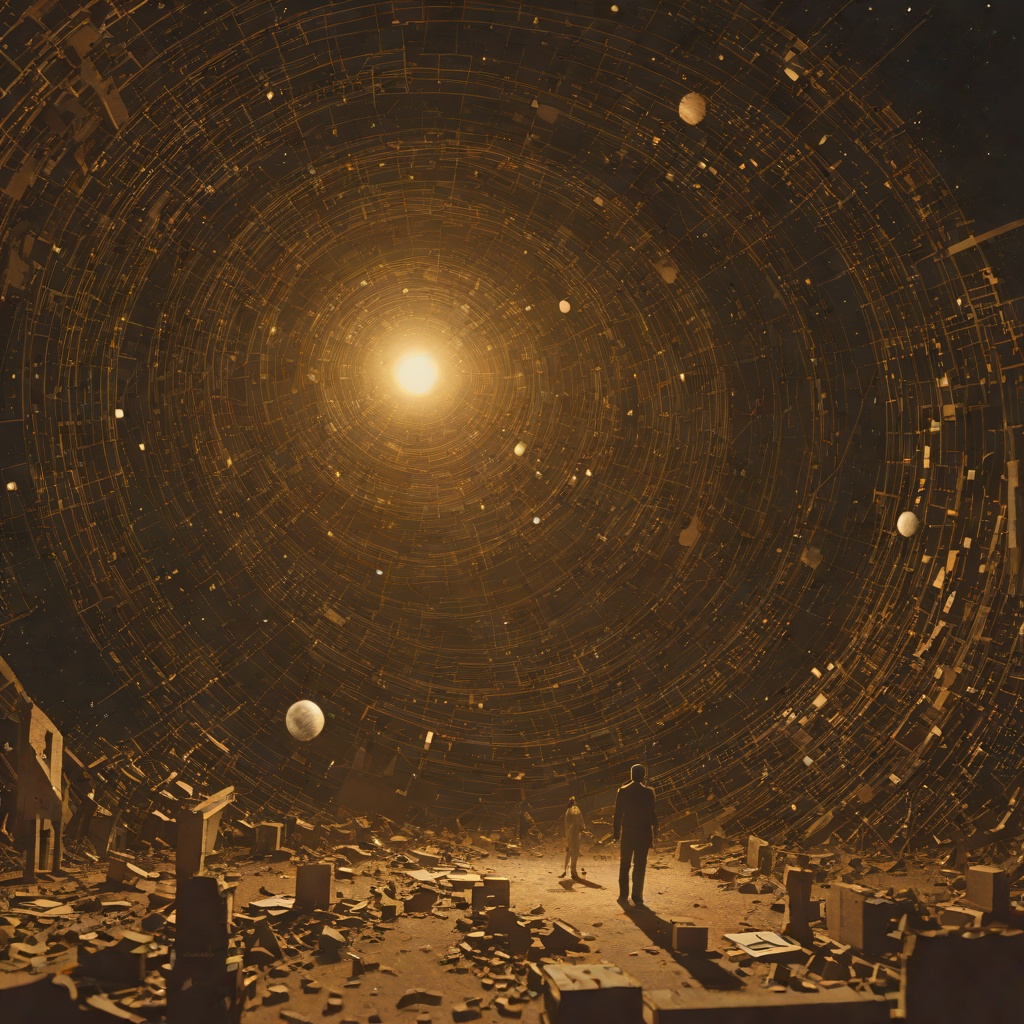
The narrator connects the expression to the universe’s origin. The Big Bang is described not as an explosion into pre-existing space but as the expansion of space itself, carrying gas, matter, darkness, and light outward from an original singularity. Because that beginning contained all space and time in submicroscopic form, the question of what space expanded into becomes a metaphysical pressure point. The Old One names the unresolved depth behind a cosmos that can be modeled while remaining difficult to imagine.
The same meditation extends to the universe’s continuing history: star matter evolves through elemental dust, nebulae, burning, glowing, and pulsing, while galaxies move away from one another across roughly fifteen billion years. The physical account does not eliminate wonder. Its very intelligibility becomes a source of astonishment, since the universe is not only immense and ancient but, incomprehensibly, comprehensible.
Crisis of Traditional Theism
The expression acquires moral force after the narrator confronts the Holocaust. The disasters of twentieth-century European civilization make the traditional religious concept of God impossible for him to maintain seriously. A God who is conventionally imagined as concerned, responsive, or providential cannot be reconciled without strain to the historical catastrophe the narrator places before the reader.
The Old One offers a different theological possibility. Rather than locating God in religious scriptures, the narrator seeks divinity in irreducible laws of the universe understood as transcendent behavior. These laws are cold, eternal, and imageless, but their beauty can still console. The consolation is not a promise that suffering has been supervised or redeemed; it lies in the fact that the universe has an order that consciousness can partially apprehend.
This position rejects easy comfort while preserving the possibility of glory. Gravity, for example, is praised as the curvature of space, and light itself is imagined as bending under its force along the curvatures leading toward celestial objects. Such descriptions transform abstract physical principles into a naturalistic sublime: a mode of reverence grounded not in divine personality but in the strangeness and coherence of what exists.
Neutrinos, Consciousness, and the Living Universe
The Old One’s universe is also presented through the barely perceptible. Neutrinos pass through the Earth with extraordinary ease, and physicists build enormous tanks of heavy water beneath mountains, under the Aegean Sea, at the bottom of Lake Baikal, beneath the Alps, and below the Antarctic ice cap to detect the minute voltage produced when they pass through. Their near-invisibility makes them an emblem of a reality that exceeds ordinary perception while remaining experimentally approachable.
The narrator links this scientific world to human consciousness and to the anthropic principle. The universe expanded at an inflationary rate, remained obscured by gases for billions of years, and became illuminated only when photons could move through cooling space. From the resulting stars, stellar dust, and dark matter came the elements that made human life possible. The anthropic principle thus suggests that the universe’s composition is hospitable to consciousness, or at least that the conditions of this universe have permitted observers to arise within it. In this context, The Old One is less a supernatural person than a name for the depth of a cosmos capable of producing both life and minds that can wonder about its origin.
Narrative Function and Significance
As an expression, The Old One holds together the novel’s conflict between religious inheritance and secular explanation. It allows the narrator to retain the word God while refusing the habits and consolations traditionally attached to it. The term is simultaneously intimate and impersonal, ancient and scientifically oriented, theological and skeptical.
Its force also comes from defamiliarization. Familiar religious language is made strange by being placed beside singularities, neutrinos, gravity, photons, dark matter, and the speed of light. Conversely, scientific facts are made newly perceptible when they are approached as possible traces of divinity. The expression therefore changes the reader’s relation to both domains: religion can no longer rely on automatic formulas, and physics cannot remain merely technical description.
The Old One finally names a disciplined uncertainty rather than a solved doctrine. The narrator does not claim to have recovered the traditional God. He proposes instead that the universe’s age, unity, lawful structure, and openness to consciousness may constitute the strongest available ground for reverence. The phrase survives because it preserves awe without disguising the violence of history or pretending that cosmic order answers every human need.