Thomas Pemberton and Moira
City of GodThomas Pemberton and Moira form the novel’s central illicit attachment: a relationship initiated through glances and imaginative projection, consummated through hesitant and troubling physical encounters, and repeatedly reinterpreted by Pemberton as either salvation or material for a story. Its decisive significance lies in its instability. Moira appears to offer Pemberton an authentic life beyond clerical habit and social performance, yet the affair also reveals how quickly he converts another person’s vulnerability into a private laboratory for fiction, moral analysis, and self-knowledge.
Recognition and Idealization
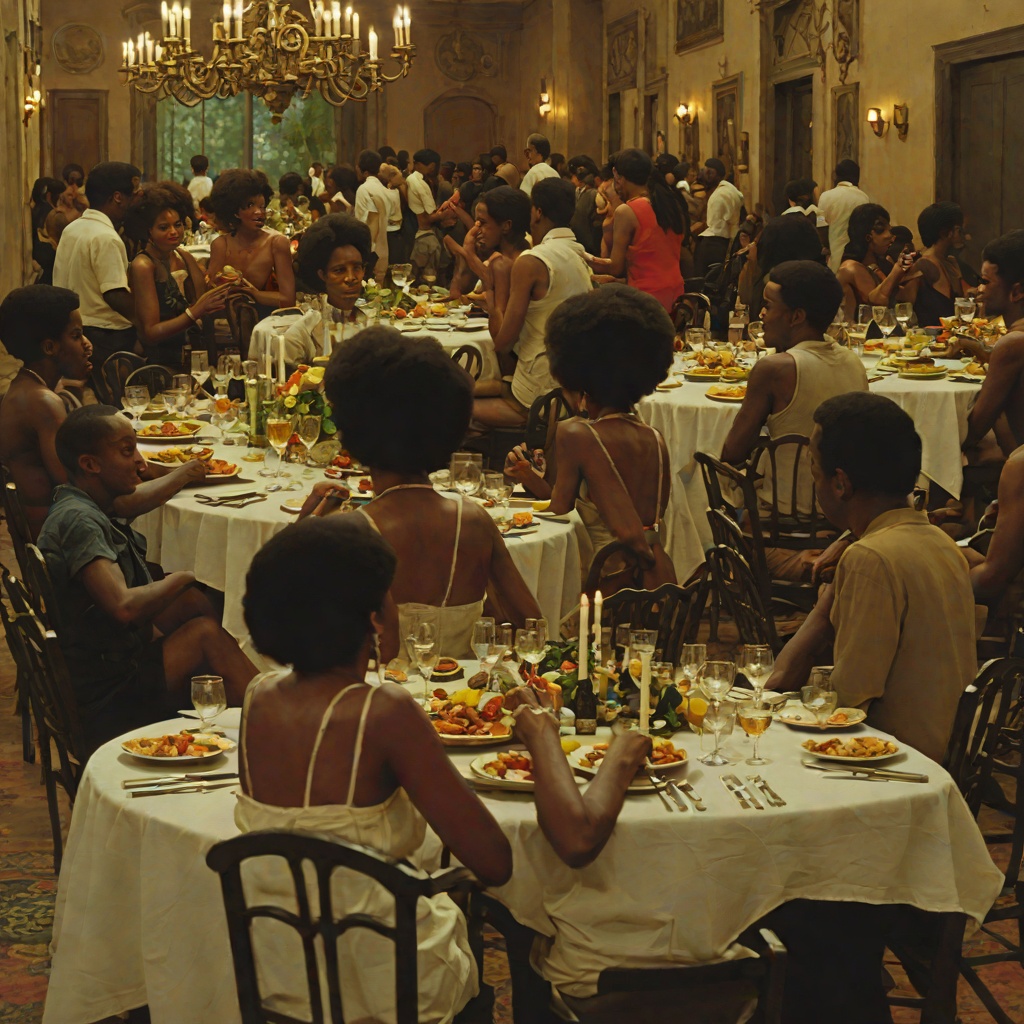
Pemberton first identifies Moira through a heightened bodily response rather than through conversation. After seeing her over a year or two and speaking with her only briefly, he recognizes in himself an unusual degree of attention and a momentary tightness when she is near. At a formal dinner, after the guests are instructed to move to new tables, he finds Moira staring at him with a solemn intensity that verges on anger. The look transforms an otherwise miserable evening into the beginning of a private drama, one in which desire appears first as mutual recognition rather than declared intention.
Their first planned meeting is deliberately cultural and public. Moira agrees to lunch near the museum, where they look at the Monets. They make further plans while standing before the large blue-green water-lily paintings, arranging their next encounter around the difficulty of her schedule. The setting allows Pemberton to experience the relationship as an elevated affinity: they have not touched, and still do not touch as they leave the Metropolitan Museum of Art, yet her glance from the cab seems to him a moment of declared trust. He experiences that trust as a blow to the heart because it is precisely what he has sought and immediately feels burdened by once it is granted.
Pemberton’s idealization intensifies after the museum meeting. He imagines that Moira possesses an integrity almost beyond belief, an unstudied grace, and an exemption from the coarse ideologies of her period. Rather than merely anticipating an affair, he imagines finding salvation in an authentic life with her. The language of salvation is crucial: Moira is not initially encountered as an ordinary lover but as a possible answer to Pemberton’s crisis of faith and dissatisfaction with the roles he inhabits. His attraction therefore carries a theological pressure that exceeds the evidence of their actual acquaintance.
Social Background and Unequal Freedom
Moira’s history complicates the serene figure Pemberton invents. She grew up in a working-class family in Pennsylvania, attended Penn State for two years, left school, and came to New York. While working as a temp in a corporate headquarters, she was noticed by the chief executive who would become her husband. He had her assigned to his secretarial staff, took her out, proposed, and began ending his twenty-year marriage. Their marriage carried her across class lines, but it did not free her from dependence; it placed her inside a new structure of wealth, status, and emotional obligation.
Moira has severed the small connection she once had with her family by not inviting them to her wedding. Pemberton reads this estrangement as part of the genealogy of her composure and her apparently unimpressed manner among the publishing, artistic, advertising, journalistic, and financial circles surrounding her husband. He is fascinated by the contrast between her origins and her polished social position, but that fascination is also a form of narrative possession: he turns a complicated biography into the explanation for her attractiveness.
Her marriage is organized around her husband’s need for continuous admiration. He is a powerful business figure, frequently quoted in newspaper articles about the economy, yet Moira describes him as a child who depends on her praise. She must listen to his anguished accounts of business matters she does not understand and endure his violent private swings from vanity and pride to self-doubt. His fears appear physically in night sweats and in the dread that everything he has made and owns will someday be taken away. The affair consequently unfolds within a network of unequal emotional labor. Moira is a wife, mother, social accessory, and caretaker before she becomes Pemberton’s lover; her husband’s dependence and her two young children make any movement toward Pemberton difficult to separate from the obligations already consuming her life.
Physical Intimacy and the Collapse of the Fantasy
The relationship changes when Moira comes to Pemberton’s rooms after two soft taps at the door. The meeting begins awkwardly, with her examining his books and prints while he struggles to speak. She drinks only water from the tap, and her quietness places him in thrall. When she enters the bedroom and closes the door, the silence becomes the scene’s dominant fact. She lies in bed with the covers drawn to her chin, appears skittish and resistant, turns her head away from his kiss, and has to be dragged into the encounter and held down to do what she came to do. The scene makes desire inseparable from hesitation, coercive pressure, and the failure of romantic language to provide a stable account of consent or mutual intention.
Pemberton’s response is not straightforward pleasure or remorse. Afterward, he experiences himself as lying in the blue-green warmth of a Monet pond, with wet lilies clinging to his skin. The image returns the physical encounter to the aesthetic ideal that had governed the museum meetings. He processes sex through art, converting the disturbing reality of the encounter into the sensuous atmosphere of the water-lily paintings. The transformation is revealing: even when Moira’s body and resistance challenge his fantasy, he seeks to restore the affair as an image of immersion and salvation.
The fantasy suffers another blow when Moira later tells him about herself and then smiles, turns on her side, and puts her tongue in his ear. Pemberton’s surprise is not simply erotic. He is shocked by the vulgarity of the gesture and by the sense that it comes from a different person than the woman he had imagined. The act exposes the gap between an actual woman with unanticipated habits and the morally elevated figure constructed by his desire. Moira’s sexuality becomes most destabilizing when it refuses to remain graceful, silent, and legible according to his preferred script.
Affair as Story and Moral Experiment
Pemberton repeatedly treats Moira’s life as narrative material. He describes her as becoming a story about a woman crossing class lines and recognizes that the affair can be developed as a movie about an elegant trophy wife, a business leader, and a man moving through the loosely bordered New York society of publishing, the arts, advertising, journalism, and Wall Street. He also notices his own snobbery and understands that his ability to spend afternoons at the museum distinguishes him socially from Moira’s working-class past while helping produce the very fantasy he attributes to her.
His fictionalizing impulse gives the affair an episodic, self-observing quality. Instead of allowing the relationship to remain only an encounter between two people, he tests it as a plot: attraction, class difference, adultery, betrayal, and the possibility of moral transformation. He says the only way to proceed would be to intensify the characters’ moral natures, adding motors to them until they become a movie. The remark exposes both his craft and his evasion. He knows that narrative requires pressure and consequence, but he also risks treating Moira’s pain as the mechanism that will make his private drama meaningful.
The affair becomes a laboratory inside Pemberton’s skull. He sees himself as abandoning a woman who has committed herself to him obsessively and adoringly, leaving her with the shattered husband she has betrayed. He frames the situation as a secular version of Amphitryon, translating adultery into mythic and intellectual terms. This elevated framing does not resolve the ethical problem. It instead displays his tendency to make moral confusion aesthetically intelligible before it has become morally bearable.
The relation is set against the book’s wider concern with performance and reproduction. The Midrash Jazz Quartet’s standards are described as songs capable of reproducing themselves from constituent parts: words can summon melody, and melody can summon words. Pemberton’s affair operates similarly in his mind. A glance, a sexual gesture, a remembered phrase, or a scene in the museum can regenerate an entire emotional narrative. Yet the recurrence also makes the relationship less stable, because every fragment can call up a different version of Moira and a different version of Pemberton.
Limits of the Relationship
The evidence presents no secure romantic resolution. Moira’s schedule is governed by two young children and a nanny, while her marriage binds her to a husband whose emotional needs already occupy much of her attention. Pemberton’s desire moves between pursuit and retreat: he seeks her attention, feels wounded when she offers trust, fears the responsibilities implied by intimacy, and then reimagines the same danger as salvation. Their bond therefore resembles a pursuit structured by withdrawal, though the text does not reduce either person to a fixed psychological type.
The relationship’s central conflict is between Pemberton’s need for authenticity and his dependence on mediation. He wants Moira as an escape from religious and social forms, but he encounters her through paintings, songs, myths, cinematic plots, and the language of moral experiment. Moira’s actual presence continually exceeds these forms: she stares angrily, arranges her life around childcare, drinks tap water, resists a kiss, performs an unexpected sexual gesture, and carries the burdens of a class-crossing marriage. Pemberton can recognize the force of those details, but he cannot prevent himself from turning them into art.
The affair thus remains consequential without becoming a conventional love story. Its emotional force comes from the contradiction between the clean, almost sacred attraction Pemberton imagines and the compromised circumstances in which the relationship must exist. Moira may appear to him as a route toward an authentic life, but the affair instead reveals how desire, class, marriage, parenthood, clerical identity, and artistic self-consciousness are entangled. The relationship changes Pemberton’s understanding of himself, yet the available evidence offers no final promise that either lover can convert recognition into a shared life.