Valdemingomez
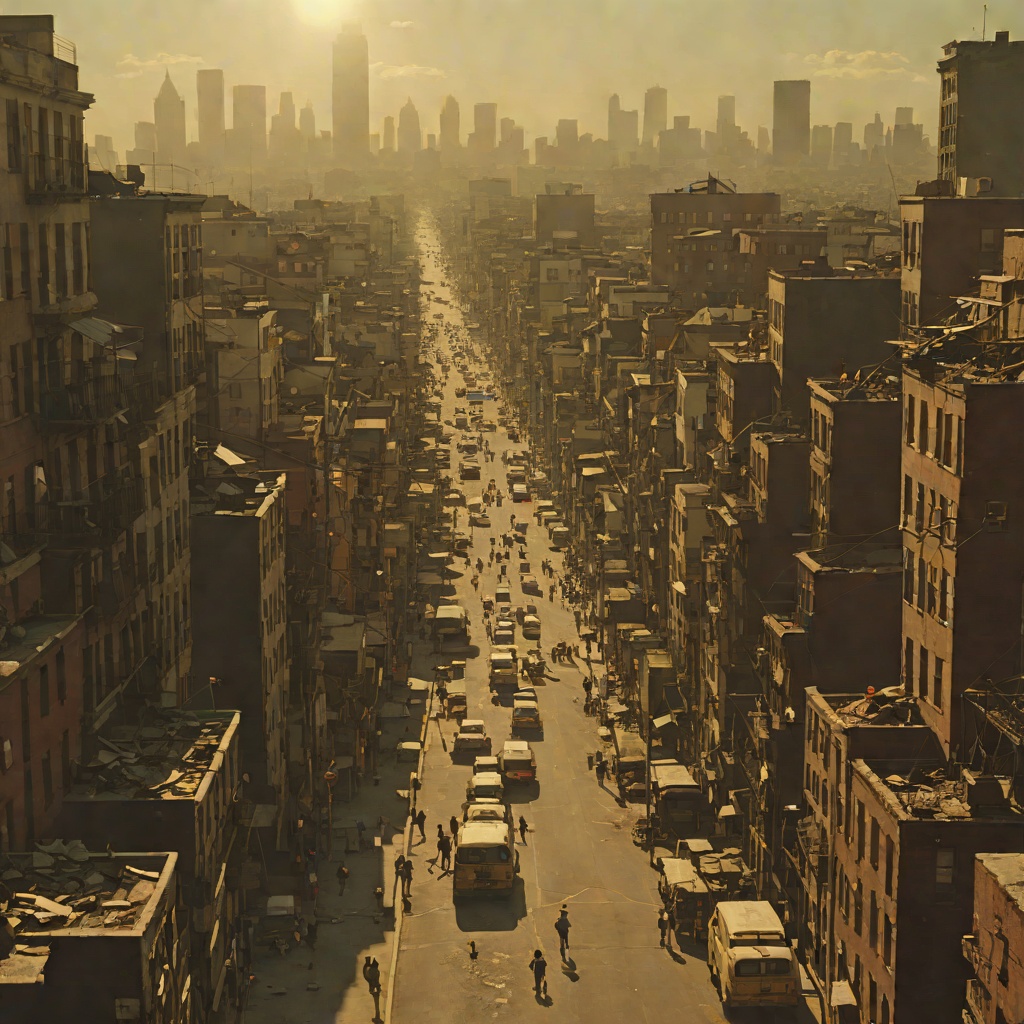
City of GodValdemingomez, an enormous garbage dump north of Madrid, is reimagined as the City of Birds, a vast urban aviary whose inhabitants turn human refuse into a durable habitat. The place gives the book one of its clearest nonhuman cities: a landscape of sulfurous gases, discarded containers, rusty cans, television cabinets, sofas, chicken bones, and paella shells in which birds establish their own continuing society. Valdemingomez therefore functions not merely as scenery but as an ecological counter-image to the human metropolis, showing organized life flourishing amid the remains of urban consumption.
Definition and Setting
Valdemingomez lies beyond the cultivated and monumental image of Madrid, yet the narrative presents it as a destination worth visiting after the Prado. Its scale is described as enormous, and its atmosphere is marked by the miasma of sulfurous gases produced by the dump. With help from the trade winds, that odor can travel as far east as Rome, giving the site an atmospheric reach that exceeds its geographical boundaries. The dump is thus both intensely local and strangely continental: a concentrated residue of the city whose effects spread across national space.
The place is called the City of Birds because its inhabitants do not simply gather there temporarily. More than 130 species remain through summer and winter, including storks, hawks, egrets, linnets, kites, jackdaws, ravens, condors, and turkey buzzards. Even accidental visitors from the tropics, such as the albatross and the blue-footed booby, arrive to inspect the site. The avian population makes Valdemingomez resemble a metropolitan center with immigration, resident communities, and unexpected arrivals, while its permanent residents overturn the usual expectation that birds must migrate away from an inhospitable environment.
Avian Life in the Dump
The birds of Valdemingomez have adapted the discarded objects of human commerce to the basic structures of life. Eggs are laid in old Big Mac containers, nests are lined with cassette tape, songbirds move in and out of rusty cans, and grackles gather in television cabinets. These details make refuse materially productive rather than inert. Objects designed for food, entertainment, or communication are stripped of their original purposes and absorbed into an avian infrastructure of reproduction, shelter, and movement.
The dump also generates a distinct soundscape. Gulls drop the clamshells of paella onto old sofas, while flocks of Rock doves coo and peck through fields of chicken bones. The bones clack like train tracks, clink like wind chimes, and shiver like shuffled cards; their sounds are also compared with a bongo and bop ensemble and a hot marimba band. The comparison does not reduce the birds to decoration. Instead, it gives the dump an autonomous acoustic order, a noisy composition produced by feeding, scavenging, and the continual rearrangement of waste.
Valdemingomez's birds do not migrate because the dump supplies a reason to stay. Summer and winter are gathered into one permanent cycle of habitation, and the site becomes a place where abundance and toxicity coexist. The birds inhabit gases, metal, plastic, packaging, and decomposing food without waiting for the environment to recover its natural form. Their persistence presents adaptation as neither pastoral harmony nor simple triumph: it is a practical occupation of a damaged world.
The Counter-City
The City of Birds stands beside the book's recurring attention to cities as collective organisms. In human streets, thousands of people move in every direction through transport systems, markets, parks, and dense infrastructure; the city depends on the human need to walk among strangers, and its crowds help individuals define themselves. Valdemingomez offers a parallel formation without human planning. Its population is assembled from many species, its structures are improvised from urban discards, and its boundaries are shaped by food, shelter, wind, and waste rather than by municipal design.
This contrast is especially sharp beside observations of Central Park. There, brown Ants build an underground city beneath a tree, sending trails outward from a mound and exchanging chemical messages through antennae. Their collective behavior appears to form an invisible group brain without any visible center of decision-making. Valdemingomez extends that image from the miniature to the expansive: its birds are not a single organism, but their persistent coexistence creates another metropolitan order, one that can be perceived only by attending to species, movement, sound, and material reuse rather than to streets and institutions.
The dump also complicates the distinction between the natural and the artificial. The birds are not outside the city; they are living in its leftovers. Human packaging becomes nesting material, discarded food becomes sustenance, and metropolitan waste becomes the foundation of a nonhuman settlement. Valdemingomez consequently reveals an urban ecology in which the city continues beyond its buildings and its citizens, reproduced in the organisms that feed on its excess and reorganize it into life.
Narrative and Thematic Significance
The location's force comes from its reversal of familiar hierarchies. A garbage dump, ordinarily treated as the city's excluded underside, becomes a place with a population, a seasonal stability, a built environment, and a recognizable social identity. The phrase City of Birds echoes the distinction between the Earthly City and the City of God, but Valdemingomez refuses a clean opposition between degradation and transcendence. Its avian city is neither sacred paradise nor mere emblem of human failure. It is a material, difficult, noisy, and inventive form of habitation.
That reversal belongs to the book's larger meditation on creation and order. Cosmological reflections describe the Big Bang as an expansion in which space itself bursts outward with matter, darkness, and light; later discussions of the anthropic principle ask how the elements of the universe permitted human life to appear. Valdemingomez returns those questions to the scale of discarded objects and living bodies. It shows order arising not from a visible central author but from repeated interactions among organisms and their environment. The dump's birds make a world out of what another world has thrown away.
The setting also resists purely human measures of value. The narrative repeatedly finds significance in birds, women, language, Ants, crowds, and the fragile brilliance of the modern city. Valdemingomez gives that attention its most concentrated geographical form: a place where nonhuman life commands the scene, where species usually noticed only as scavengers become a resident population, and where the waste of urban civilization supports an alternative civilization of its own. Its enduring image is therefore not simply that birds survive in a dump, but that the dump has become a city because the birds have made it one.