Arthur Hill
Clown in a CornfieldArthur Hill is both the wealthy absentee whom Kettle Springs hopes will rescue its failing economy and one of the men behind the violence that devastates it. His transformation from an imagined benefactor into an active conspirator culminates in a confrontation with his son, Cole Hill, and an escape that leaves him legally declared dead but without a recovered body.
Identity and Public Image
Arthur’s importance to Kettle Springs is measured first in money and absence. At a town gathering, when residents argue over dwindling resources and how to attract visitors, one speaker claims Arthur may attend the parade and might reinvest if he likes what he sees on Main Street. The suggestion quiets the room: his possible return carries more force than the proposed billboard or the other efforts to draw business. People have not seen him in town for almost a year, and they understand his presence as a potential turning point for local commerce.
That hope rests on a real economic dependence. George Dunne describes Arthur as one of his oldest friends, though the two rarely speak by phone, and argues that Arthur is no longer invested in Kettle Springs emotionally or financially. The town had been waiting for the refinery to reopen, but George says Arthur will not put money into a place whose population is falling and whose young people, in his view, show no respect for local history. Arthur’s wealth therefore functions publicly as a promise the town cannot compel him to keep. The residents’ eagerness to interpret a possible parade appearance as a route to recovery contrasts sharply with the private purpose he eventually reveals.
Grief, the Factory, and the Town’s Expectations
George’s public account of Arthur’s losses gives the town’s economic anxiety a personal face. Arthur lost a child the previous year, and his factory burned the week before the meeting. George presents these events as a substantial burden of grief, while also treating the factory’s reopening as the investment Kettle Springs wants from him. The two losses are joined in the speech: the town imagines its own recovery through the return of Arthur’s business, even as it recognizes that he has suffered a private bereavement.
The speech also exposes a difference between George’s public framing and Arthur’s later explanation of himself. At the meeting, George asks whether Arthur can be blamed for withdrawing from a town after what has been taken from him. Later, Arthur makes his grievance more accusatory and expansive: he says Cole took his livelihood, Victoria, and the town’s hope, and that he retaliated by taking what Cole cared about. This is not simply a request for the town to understand his grief. Arthur turns loss into a justification for retaliation, extending personal blame into a rationale for collective punishment.
Father and Son
Arthur’s relationship with Cole is not repaired by the danger of their final encounter. When Cole pleads with him to stop, Arthur says Cole has not been his son for years and that he lost him long before the reservoir. Cole answers that he was grieving without his mother, but Arthur does not respond with reconciliation. Instead, he identifies Cole as the one who got his little girl killed and recalls how much she looked like Cole’s mother. The exchange makes their conflict more than a dispute over the town’s future: each speaks from a history of family loss, but Arthur uses that history to condemn his son.
The physical encounter sharpens the separation. Arthur puts his hands around Cole’s throat, easing his grip only after George clears his throat. Cole tells him that he wishes every day he could trade places with Victoria and urges him to stop what he is doing. Arthur replies that it is already done. His words and actions close off the possibility that Cole’s plea will change his course; the father treats the son’s suffering not as a reason to relent, but as something he can use to make his revenge felt.
Earlier, George had already shown Cole how the conspiracy sought to control the story of Cole’s violence. He holds up an envelope marked for Cole’s father, written in handwriting close enough to Cole’s that Cole has to question whether he wrote it. The envelope contains a confession, but not the particulars of the spree killings. A lawyer in the Improvement Society has reviewed it so that Cole’s father would not be legally culpable for Cole’s actions and might receive another insurance payout. The forged account would make Cole appear responsible while protecting Arthur. Cole distrusts the scheme and doubts his father would believe it, but the episode shows how the conspiracy uses both money and a manufactured narrative to redirect blame.
Conspiracy and Reversal
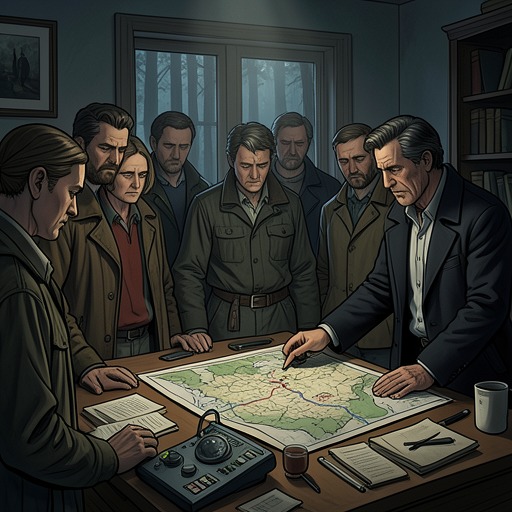
Arthur’s private rage belongs to a broader plan rather than an isolated act of vengeance. In the aftermath, the novel states that Arthur and George’s plan, carried out with twelve conspirators known to the Federal Bureau of Investigation, had saved Kettle Springs—though not in the way they intended or anticipated. The reversal is pointed: the conspirators’ effort to save the town produces a massacre and a population devastated by violence, while the attention that follows brings television crews, law enforcement, and true-crime documentarians into Kettle Springs. Their presence supplies visitors, customers, and a months-long economic boost. The recovery Arthur and George sought arrives through consequences they neither designed nor foresaw.
Arthur’s claim that the town has been deprived of hope thus carries a bitter irony. He participates in a plan presented as an answer to the town’s decline, but the resulting revival depends on outsiders arriving to investigate the catastrophe. The town’s survival and the conspirators’ intentions come apart: the plan can be said to have worked only in a sense its authors did not intend. Arthur’s personal losses do not make the plan merely private, and its public ambition does not erase the revenge at its center.
Disappearance and the Frendo Image
After Arthur is shot, the scale of the blood and the ensuing manhunt lead to his being declared legally dead, but no body is found. Drones search the cornfields and dogs are brought in. Blood leads from where he was shot to an exit of the Baypen factory, then the trail goes cold. Searchers had spent six hours being redirected to look for children in Tillerson B-field, leaving Arthur many possible directions of escape—and many places where he might have died alone. The uncertainty is not resolved by the search; the corn seems to have swallowed him.
The closing glimpse makes disappearance feel less like a settled death than a concealed continuation. On a flight, Arthur keeps his sunglasses on and places his black garment bag across from him, as though the suit inside were another passenger. He has concluded that money is enough to keep a person alive and out of jail if cash is kept on hand, and that failure can be temporary if someone remains determined to finish a plan. He also takes George’s lesson about symbols to heart: they can gather people around a legacy and give them something on which to pin their hopes. Then, balanced in the small bathroom, Arthur pulls up his jumpsuit and lowers his mask before sitting on the aluminum toilet to wait for touchdown and taxiing to end. The final image does not disclose what he will do next, but it connects his survival to the symbolic identity of Frendo. Arthur’s absence from Kettle Springs is therefore both a legal status and an unresolved threat: the man declared dead may still be preparing to carry his legacy forward.