Baypen refinery
Clown in a CornfieldBaypen refinery is the abandoned industrial landmark through which Kettle Springs’s economic decline, nostalgia, and violence become materially visible. From the fields it first appears as a vast, damaged silhouette, its clown emblem still legible above a building whose productive life has ended. After the fire, the refinery remains more than a ruin: its name persists in civic display and local slogans, while its loading bays and burned interior become the setting for the final struggle over Cole Hill’s life.
Setting and Appearance
Quinn Maybrook first sees the factory from a distance, beyond the cornfields and breaking the horizon. She estimates that the main structure is five stories tall, not counting the chimney stack tilting behind it. Its roof sags like an animal with a broken back, giving the building a wounded, almost bodily outline against the landscape. The scale makes the refinery conspicuous even at a distance; its decay is part of the view rather than something hidden away from town.
A clown is painted on the factory’s side, and the name Baypen stretches across the top of the building. At first, Quinn has no particular urge to investigate the name, and the clown registers as an unexplained image attached to an industrial ruin. Ruston Vance later identifies the figure as Frendo, Baypen’s mascot, and explains that the company made corn syrup. The factory’s visual pairing of corporate lettering and clown imagery therefore introduces two strands that recur throughout the story: Baypen’s former economic reach and Frendo’s continuing life as a town symbol.
The building’s abandoned state is not simply the result of age. Ruston tells Quinn that the refinery burned down recently, and explains that his father had worked security there, beginning at the age Ruston was then. He also says the company shipped its syrup across the country, expressing a striking pride in a product and workplace that were not his own. The refinery’s empty structure thus stands in contrast to the breadth of its former business and to the generations of local labor associated with it.
Industry and the Town’s Prospects
Baypen’s closure belongs to a wider account of Kettle Springs’s economic contraction. In Ruston’s description of local amenities, a frozen-yogurt shop has disappeared since Baypen closed, while the Eureka Theater on Main Street remains a place to see films. For a mall, he points Quinn toward Jamestown, about twenty miles away once one reaches the highway. These details place the refinery’s loss within everyday geography: the consequences of its closure are felt not only in the empty factory but in the limited options Ruston describes to a newcomer.
The town’s leaders also regard the refinery as a possible route back to prosperity. In a public appeal, one speaker says that flyers have been distributed at the St. James Mall and that Arthur Hill may attend the parade. If Arthur likes what he sees on Main Street, the speaker suggests, he might reinvest and reopen things. The hoped-for return of Baypen is tied to a larger argument about Kettle Springs’s population decline and the perceived indifference of younger residents toward the town’s history and heritage. The refinery is therefore not merely a former employer; it becomes an object onto which the town projects a possible economic recovery and a struggle over what kind of community it should be.
That hope is complicated by Arthur’s personal losses. The same speech recalls that he lost a child the previous year and that his factory burned the previous week, while noting that residents had been waiting for the refinery to reopen. The appeal to investment thus places civic need beside private grief, treating the damaged plant as both a business prospect and part of a family’s history. Its ruined condition makes the proposed reopening uncertain, but the town continues to organize its hopes around it.
Frendo and the Factory’s Afterlife
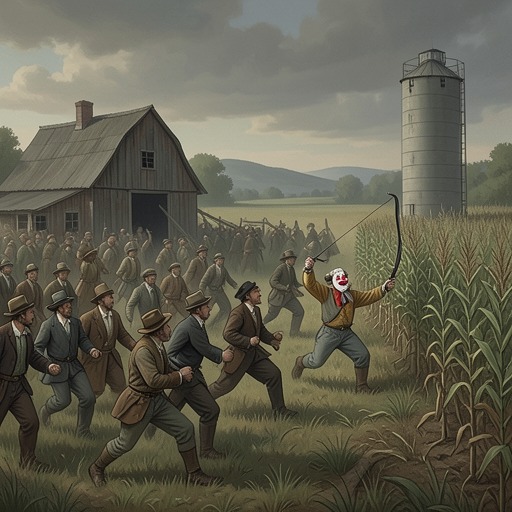
The refinery’s mascot outlives the business in public imagination. Cole Hill tells Quinn that the town loves Frendo and that local young people have been trying to remake the mascot’s image, making him more homicidal. The videos Quinn sees include a killer-clown stunt at a haunted barn, showing how the figure has moved from company branding into informal entertainment and provocation. Frendo’s presence is not confined to the factory mural: the mascot becomes a repeatable image that young people can adapt, even as older residents continue to treat him as part of the town’s identity.
The gap between those uses is visible in the Founder’s Day parade preparations. A giant ear of corn, built from papier-mâché and fiberglass, bears the new words Happy Founder’s Day and Kettle Springs. But the paint does not fully hide the older message, From Baypen, which remains visible beneath it. The parade display tries to present a local celebration detached from the company, yet its surface retains the lettering it was meant to cover. The factory’s history persists not as a complete civic account but as a mark showing through an attempted repainting.
Baypen’s products also survive as a slogan and a joke. Ronnie Queen sings that a little drop of Baypen makes everything better, while Cole points out that corn syrup is sugar: it may make food taste better, he says, but it is not better for people. The contrast turns the company’s promotional promise into a compact ambivalence. Baypen is associated with a product distributed nationwide and remembered with local pride, but its apparent benefit is qualified by Cole’s blunt assessment. The slogan can be repeated as celebration even when its meaning invites correction.
The factory’s destruction is also bound to Cole’s responsibility and his complicated response to loss. Janet Murray says that he burned it down; Cole corrects her by emphasizing that it was his family’s factory, or at least his father’s, and that it had been empty for more than a year when it burned. He calls the act a mistake and admits that he messed up, but explains that the boarded-up building had been rotting and reminded him of how things used to be. He is not sad that it is gone. His account does not undo the damage or erase the family connection; instead, it makes the factory’s ruin a site where guilt, resentment toward the past, and the town’s investment in that past meet.
The Burned Interior and the Final Confrontation
After the fire, the refinery’s damaged machinery is still capable of movement. Sheriff George Dunne presses a button on an opener strapped to his dashboard radio, and the loading-dock shutter begins to rise. Its gears grind against rust and heat-warped parts, but the mechanism still works. This stubborn remnant of function gives access to the factory floor, where the old industrial site is repurposed for a planned execution. The building is no longer producing corn syrup, yet its surviving equipment can still open a path into its interior.
Cole sees a charred image of Frendo painted across a double-wide bay door. As the steel door rises, the opening seems to form the clown’s mouth. The image is at once a remnant of company identity and a threatening entrance into the burned building. Inside, a noose hangs from a burned-out catwalk leading toward the foreman’s office. The suspended walkway and the noose make the factory’s vertical industrial architecture part of the immediate danger: the catwalk is not just a route through the building but the place where Cole is to be displayed and killed.
Arthur Hill tells Cole not to proceed, but Mr. Murray, Janet’s stepfather, pulls the Frendo mask down over his eyes and carries Cole farther onto the suspended walkway. In this setting the mask has ceased to be a mascot costume and become an executioner’s hood. The noose remains visible below the metal slats as Mr. Murray lifts Cole toward the end of the walk. Company imagery, family authority, and physical menace converge in the factory that had already carried the town’s arguments about history and renewal.
The attempted execution is interrupted when Glenn Maybrook has to dive clear of a speeding pickup truck. The truck tears through one of the loading-bay doors, leaving a large hole and scattering the last pieces of shrapnel. Ruston Vance, who has driven it into the factory, tries to get out but ducks back inside when Dunne fires down at him. Rust later fires his shotgun toward the stairs; the blast sends sparks from the handrails and metal steps as Dunne continues down toward the warehouse floor. The refinery’s metal structure, once part of its working plant, now shapes the rescue as cover, obstacle, and route of pursuit.
Quinn reaches the base of the stairs as Dunne stumbles with his gun wavering and blood from his abdominal wound running over his belt and down his trousers. She lets her rifle hang at her side without dropping it, then goes to Cole, whom Rust has cut down and laid in front of the truck. Rust is administering CPR. The location’s final transformation is stark: the distant factory glimpsed beyond the corn has become a place of attempted hanging, forced entry, gunfire, and emergency resuscitation. Its history is not resolved by reopening or restoration; instead, the burned refinery’s remaining structures become the means by which the threatened characters reach one another and fight to survive.