Blighted-crop doctrine
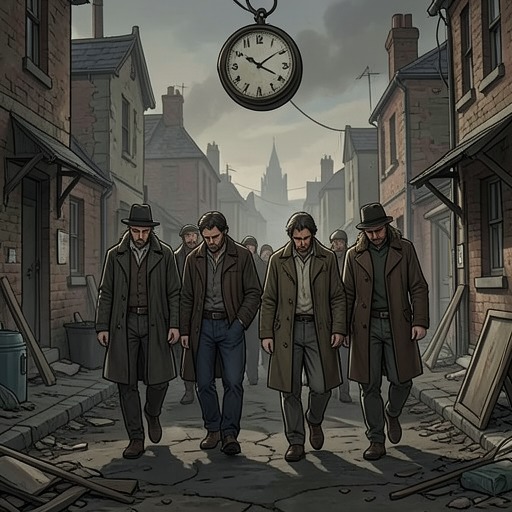
Clown in a CornfieldThe Blighted-crop doctrine is Sheriff George Dunne’s rationale for treating Kettle Springs’ young people as a danger to be eliminated rather than as members of the community. By comparing a generation to diseased crops, he makes collective violence sound like farm management: identify the blight, cull what is affected, and sacrifice a harvest to preserve the land. The doctrine’s force comes not only from that metaphor but from the way Sheriff George Dunne prepares a receptive audience for it, converting economic decline and generational grievance into a case for violence.
Definition and Agricultural Metaphor
In Sheriff George Dunne’s explanation to Cole Hill, young people are bad whether they were born that way or made that way by phones, the internet, music, or social media. He dismisses the question of cause in favor of what he calls the result. The distinction matters: if the young are classified as harmful by their outcome, then their individual conduct and differences become secondary to the category imposed on them.
Sheriff George Dunne makes that classification explicit by calling Cole Hill and his friends a blighted crop. He describes fungus, beetles, and other agricultural scourges as threats that spread unless a farmer cuts and culls them. The proposed remedy escalates from removing the affected plants to burning the entire harvest if necessary, then leaving the field fallow for a couple of seasons. The agricultural sequence gives the doctrine an orderly, practical sound, while its human meaning is the destruction of a generation and the deliberate absence that follows.
The metaphor draws its apparent plausibility from the landscape around Kettle Springs. The town is encircled by cornfields, and Quinn Maybrook first sees the crop stretching beside her new home. At night, Cole Hill explains that farmers receive a subsidy when they plant corn, not when they harvest it. With Baypen closed and no longer buying the crop, clearing the B-fields may not be worth the trouble. These details do not establish that the fields themselves caused the conflict; they show how crop production, government subsidy, the lost refinery, and uncultivated fields form part of the material setting in which Sheriff George Dunne’s language resonates. He turns the familiar agricultural landscape into a model for deciding who belongs in the town’s future.
Public Rhetoric and the Town’s Grievances
The doctrine’s public groundwork appears at a town meeting before Sheriff George Dunne gives Cole Hill its full formulation. When Cybil Barton asks about the Baypen investigation and the dropped charges against Cole Hill, Sheriff George Dunne says he cannot comment on an ongoing investigation. He then shifts from the limits of law to what he presents as a conflict between legality and what is right, suggesting that legal authority may not be enough to preserve Kettle Springs. He invokes community unity and says that Mr. Vern has discouraged certain students from attending the next day’s event.
Sheriff George Dunne connects that call for action to the town’s losses. He says Arthur Hill lost a child the previous year and that the factory burned the previous week; before the fire, townspeople had been waiting for the refinery to reopen. He also points to a declining population and accuses young people of indifference to local history and heritage. The assembled PTA, City Council, and Neighborhood Watch members respond with nods. In this setting, the doctrine does not arrive as an isolated private fantasy: it grows out of a public speech that presents community decline, grief, and young people’s alleged disrespect as parts of one crisis.
Sheriff George Dunne’s rhetoric also shifts the boundary between lawful authority and collective action. He implies that the powers of law may not go far enough, urges the town to stop waiting for rescue, and says that people must act. When he later describes the doctrine to Cole Hill, that language of action has acquired its concealed practical meaning. The contrast exposes how a public appeal framed as civic resolve can prepare listeners to accept a far more extreme answer than the words initially disclose.
From Doctrine to Organized Action
Sheriff George Dunne traces the immediate impetus for the plan to the stunt at Founder’s Day, which he says made people think they had to act quickly. He describes the Kettle Springs Improvement Society as an organization assembled over several months from people whom its organizers believed would listen and had a role to play. Information was not shared with everyone at once. Dr. Weller, initially a vocal supporter, threatened to reveal the plan; Sheriff George Dunne says the group dealt with that threat together.
His account of persuasion is as important as the doctrine itself. The organizers did not begin by openly advocating a cull. Instead, they listened to people, affirmed what they wanted to hear, and gradually pushed the limits of what they would accept. Sheriff George Dunne describes this as changing morality: moving the boundary while others are not watching, then erasing the older one. The doctrine’s apparent consensus is therefore manufactured, not simply discovered. Its gradual method allows participants to approach violence through smaller acts of agreement before they are told the full destination.
Sheriff George Dunne distinguishes the planned violence from its chosen occasion. He rejects Cole Hill’s blunt description of the plan as killing high-school students at a party, insisting that the party was merely convenient. The organizers knew when and where the gathering would take place and that Cole Hill’s social circle would be there; Sheriff George Dunne calls it an opportunity to save the town. His wording preserves a distinction between the group’s stated purpose and the setting it used, but it also confirms that the gathering was deliberately selected because the intended victims would be present.
Conflict and Significance
Cole Hill challenges both the doctrine’s moral premise and its generational politics. He argues that Sheriff George Dunne is proposing to wipe out a whole generation because it supposedly fails to respect older people, while the older generation refuses to hear how young people experience the present. He also ridicules the slogan of restoring Kettle Springs and calls Sheriff George Dunne a psychopath. The exchange makes clear that the doctrine is not a neutral application of agricultural expertise: it is an ideological answer to conflict over whose values and losses define the town.
The doctrine’s central contradiction is that it claims to protect a community by designating part of that community as a contaminant. Its language of cultivation and recovery conceals the agency of the people who choose the targets, develop the rationale, and arrange the opportunity. By casting a generation as blight, Sheriff George Dunne turns a political judgment into something that sounds natural and necessary, as though violence followed from the crop rather than from a decision to destroy people. The abandoned fields and burned Baypen refinery give the metaphor a local setting, but they do not make its human consequences inevitable; the account of the Kettle Springs Improvement Society shows those consequences being organized by people who present themselves as the town’s rescuers.