Cole Hill
Clown in a CornfieldCole Hill is a student in Kettle Springs whose family history becomes entangled with the town’s violence: he burns his father’s abandoned factory, carries regret over the night his sister Victoria died, and becomes one of Sheriff George Dunne’s targets in a campaign against the younger generation. His arc moves from guarded observation and public suspicion to desperate physical survival; its final reversal is that the old friend who once shared his childhood mischief, Ruston Vance, saves him and becomes his partner.
Identity and Introduction
The prologue introduces Cole at the south shore of Kettle Springs Reservoir, barefoot and posing for a phone image. His sister Victoria frames him while struggling to zoom, and Janet Murray recognizes the effort behind his expression: he is trying to hold in his stomach so that it looks like a six-pack, not lost in serious thought. The scene gives his performance a light, sibling intimacy, but its setting acquires a darker significance because Cole later speaks of the night at the reservoir and what happened to Victoria as a source of lasting regret.
At school, Quinn Maybrook first notices Cole in a back-corner seat. He has a notebook open and a pen in hand, apparently prepared to work if the world will let him. The detail complicates the image of him as merely a disruptive or reckless boy: he is positioned at a remove from the classroom, watching it, yet also equipped to take part. His guardedness is visible before the plot fully explains what has made him a subject of town gossip.
The Factory Fire and the Town’s Judgment
That explanation begins to assemble when Janet cuts through Tucker Lee’s overprotective attention to Cole by saying that Cole burned down the factory. Cole corrects her on ownership rather than denying the fire: it was his family’s factory, his father’s in particular, and it had been empty for more than a year when it burned. The correction does not make the act less serious, but it places it within a family and an economic landscape rather than leaving it as a bare accusation. At a town meeting, a resident asks Sheriff George Dunne about the Baypen investigation and notes that the charges against Cole have been dropped. The legal status has changed; the public appetite for an explanation has not.
Dunne exploits that distinction in front of the assembled community. He suggests that legality and righteousness have diverged, invokes the need to preserve Kettle Springs, and connects the factory fire to the loss of Arthur Hill’s investment and the town’s declining population. He then blames a younger generation he describes as indifferent to local history and heritage, insisting that its members need to be brought in line. This speech supplies the public frame around Cole: before Dunne openly describes a plan to eliminate young people, he has already made their presence stand for the town’s troubles. Cole’s individual act and the charges dropped against him become part of a wider argument that treats youth as a collective threat.
Old Friendship and the Attack
Cole’s relationship with Ruston Vance reaches back to childhood. When Rust offers friendship to Quinn as a newcomer, Cole describes himself and Rust as once having been thick as thieves, little hellions running around together. Rust replies that it was a long time ago, marking the distance that has opened between them without erasing their shared past. The exchange is brief, but it establishes a history that later becomes consequential under pressure.
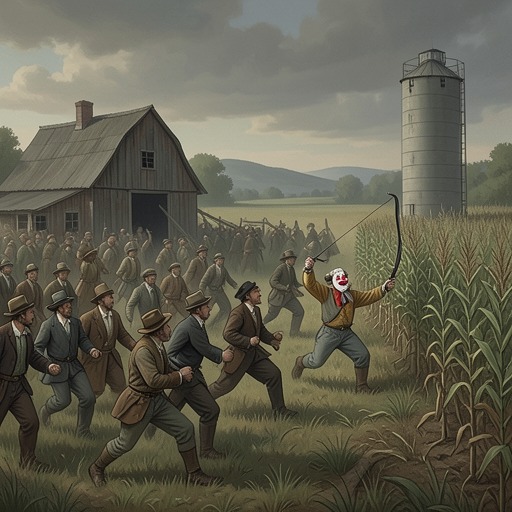
During the attack at the barn, Cole watches Frendo take aim at Janet and fire. The crossbow bolt misses her but strikes someone else; in the confusion, Cole cannot tell whether the person hit is Pat Horner. His vantage makes him a witness to the threat rather than an all-knowing observer of its result. Later, at the silo, he opens the door to let Quinn and Rust inside. To do so, he punches Matt Trent, whom he has wanted to lay out for years because of Matt’s insults about the past and his use of the word cuck. Cole’s knuckles throb and begin to swell, but the punch also shuts Matt up; Ronnie Queen stops screaming long enough to help close the door. The immediate refuge remains precarious: a steel-toed boot and white-gloved hand wedge into the doorway as the attacker pushes against them. Cole cannot let go, and Rust notices the danger. In these moments Cole’s violence is directed not only by anger but by the urgent task of keeping the door shut and his friends inside.
Dunne’s Doctrine and Cole’s Resistance
Later, after a long silence in Sheriff George Dunne’s car, Cole asks why. Dunne turns the question toward Cole’s videos, asking whether the point was laughter, then explains the ideology behind his actions. He connects the young people who were at the reservoir on the night Victoria died, including those he says were not directly responsible, to a supposedly corrupted generation. He lists phones, the internet, music, and social media as possible causes, but claims that the result matters more than its origin.
Dunne’s central metaphor is agricultural: he calls Cole and his friends a blighted crop and compares them to fungus, beetles, and other scourges that must be cut out or burned so the land can recover. The language turns a generation into a diseased harvest and violence into farm management. Cole answers by rejecting both the logic and the grievance beneath it. He points out that Dunne’s generation does not care about young people any more than it accuses them of disrespect, and mocks the appeal to make Kettle Springs great again. His reply does not erase his own involvement in the events surrounding Victoria, but it refuses Dunne’s leap from personal blame to the destruction of an entire generation.
The Confrontation with Arthur Hill
At the burned factory, Cole sees his father, Arthur Hill, emerge from the suspended foreman’s office and pleads with him not to proceed. Arthur’s response makes the conflict intimate and reciprocal. With his hands tightening around Cole’s throat and his thumbs pressing against Cole’s windpipe, Arthur tells him that what Cole wants stopped has already happened. He accuses the people around him of taking his livelihood, taking Victoria, and extinguishing the town’s hope; he then says he has taken what Cole cares about to get what he wants. The exchange puts the family’s grief and the town’s collapse into a single confrontation, while making clear that Arthur’s answer to loss is further harm. He addresses his son as Colton, a name that underscores the family intimacy of a scene in which recognition offers no protection.
Cole is later left dangling with a rope around his neck. A truck approaches, slows instead of striking him, and nudges his hip, lifting his weight off the rope. Cole rouses on the hood, coughing and struggling to stand. After Sheriff George Dunne is dead, Quinn finds Rust cutting Cole down and working over him. The moment initially appears to be an attempt to revive Cole, but it turns into a kiss: Cole, red-faced with a white mark around his neck, returns Rust’s kiss passionately. Quinn’s exhausted request that Rust let him breathe punctures the terror without undoing its aftermath. Cole survives through the intervention of the person whose affection his earlier account of childhood friendship had left unspoken.
Survival and Aftermath
At the diner afterward, Cole sits close against Rust. Rust appears uncomfortable for only a moment before settling back; Quinn senses that his ease depends less on being comfortable in general than on being with Cole. Cole still attracts attention, while Rust prefers not to be so visible. The contrast gives their newly acknowledged relationship a specific shape: intimacy is possible between them, but public visibility remains uneven. Their closeness follows the kiss and the rescue, making survival more than a return to the earlier status quo.
The town’s damage remains present in the same scene. Roughly twenty percent of Kettle Springs’ population is dead, headed to prison, or has moved away. Cole asks Quinn how her father, Glenn Maybrook, is doing, and she answers by complaining about having to nail together more campaign signs that nobody wants on their lawns. This exchange places Cole back in an ordinary conversation without suggesting that the catastrophe has been neatly repaired. His concern for Quinn’s family, his closeness with Rust, and the diminished town coexist in the aftermath. Cole’s significance lies in that unresolved combination: he is implicated in Kettle Springs’ conflicts and marked by grief, yet he remains capable of choosing connection over the logic of blame and culling that Dunne imposes.