Cole Hill's grief, guilt, and self-destructive impulses
Clown in a CornfieldCole Hill’s grief, guilt, and self-destructive impulses emerge through a series of conflicts over who is responsible for Victoria Hill’s death and whether Cole still cares if he lives. His remorse is plain to those closest to the tragedy, but it does not become a settled confession: Cole rejects the claim that he wanted to die in the Baypen fire even as other characters describe his safety as something he has long ceased to protect.
The reservoir as a lasting wound
The night at Kettle Springs Reservoir is the central point around which Cole’s guilt and other people’s accusations gather. Sheriff George Dunne investigated the accident, and Cole and his father know how deeply Cole regrets both that night and what happened to his sister. Dunne, who is portrayed as especially aware of Cole’s remorse, connects it to the conduct of Cole and his friends. His account treats the event not merely as an accident in the past but as the origin of a continuing judgment on the young people involved.
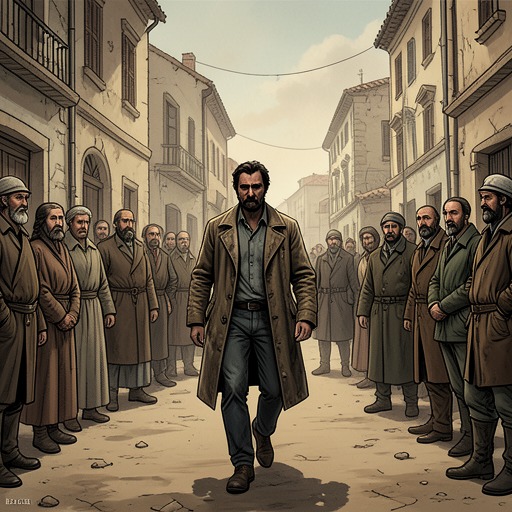
Dunne’s accusation is broader than Cole’s individual responsibility. He condemns the group, including people he says were not directly responsible, and calls them a blighted crop that must be cut, culled, or burned to protect the land. The agricultural language turns blame into an extermination doctrine: the young are described as a spreading infestation rather than as individuals capable of remorse or change. Cole does not give Dunne the denial he is waiting for. That silence does not establish agreement with Dunne’s ideology; it instead reflects how little there is to gain, in that moment, by disputing a man who already knows the depth of his regret.
Remorse and the risk of self-destruction
Cole’s care for his own safety is questioned during the confrontation around the smoke-filled space. Matt Trent says Cole has not cared about his safety since Victoria’s death and reminds him that other people are present. Ronnie Queen makes the allegation more specific: she says Tucker Lee told them Cole wanted to die in the Baypen fire. Cole immediately rejects it, insisting that they had all been drunk and that he is not suicidal. The exchange leaves a deliberate tension between a reported wish to die and Cole’s emphatic denial; it does not resolve whether his behavior expresses an intention to die or a disregard for the consequences of danger.
That distinction matters because Cole’s denial does not erase the conduct that prompted concern. Matt’s appeal asks him to consider the safety of others even if he will not consider his own, while the stronger smell of smoke and Cole’s involuntary gagging make the immediate danger physically present. His response is framed as defensive and reluctant: he does not want to discuss the accusation then. The scene therefore presents self-endangerment not as a clear declaration of intent, but as a contested pattern recognized by those around him and resisted by Cole himself.
His father’s blame and their estrangement
The conflict with Arthur Hill gives Cole’s guilt a familial dimension. When Cole pleads with him, Arthur says he lost his son years earlier, long before the reservoir. The statement makes the rupture older than the accident, while Cole’s answer points to another source of pain: he says he was sad without his mother. Their exchange suggests that grief and estrangement have become entangled, but it does not supply a complete account of how their relationship deteriorated.
Arthur later says that he came around to Sheriff George Dunne’s view that the whole generation is rotten, while still singling Cole out as the person who got his sister killed. His grief surfaces in his recollection that Victoria Hill looked so much like their mother, but he directs none of that tenderness toward Cole. Cole answers without presenting his wish as exaggeration: he says he wishes every day that he could trade places with Victoria. The statement gives his remorse its clearest personal form. He does not claim that this can undo her death; he expresses a continuing desire to have borne its cost himself.
Arthur’s response turns accusation into physical violence. Before Cole can finish asking him to stop, Arthur puts his hands around Cole’s throat and rebukes him for calling him Dad. The attack makes the family rupture immediate and bodily: Cole’s appeal to his father is met not with reconciliation but with rejection. It also gives the repeated claim that Cole is responsible for Victoria’s death a present consequence, as Arthur acts against him while invoking the loss that has already defined their relationship.
The limits of Cole’s remorse
The evidence presents Cole’s grief as intense but unresolved. He acknowledges regret over the reservoir night, tells Arthur that he wishes he could have died in Victoria’s place, and nevertheless denies wanting to die in the Baypen fire. These statements need not cancel one another: the wish to exchange places with his sister is an expression of grief and guilt, while his denial responds to a specific accusation about his intentions during the fire. The narrative leaves the difference between a desperate wish and a plan unsettled.
Cole’s pain is also used by others in sharply different ways. Matt invokes it to urge caution; Ronnie invokes the Baypen fire as evidence that Cole may not value his survival; Sheriff George Dunne turns the reservoir tragedy into justification for condemning an entire generation; and Arthur makes Cole the personal object of blame for Victoria’s death. Against those judgments, Cole’s own words reveal remorse without offering any means of repair. His self-destructive impulse remains legible through the danger others see and the exchange he says he wishes he could make, but it is never reduced to a definitive confession that he intended to die.