Founder’s Day
Clown in a CornfieldFounder’s Day is a town festival that interrupts the school routine and briefly gathers Kettle Springs around food, music, rides, games, and a parade. Its modest public festivities become more consequential in retrospect: Sheriff George Dunne later identifies a stunt at Founder’s Day as the event that made residents think the town’s conspirators needed to act quickly.
The school calendar and the invitation
Founder’s Day first enters Quinn Maybrook’s experience through the school calendar. Her new science teacher, Mr. Vern, insists that the approaching Founder’s Day weekend does not cancel a Monday test. The class’s collective groan places the festival against the familiar demands of school, while Mr. Vern’s lecture to the juniors and seniors frames the students’ frustration as something they should outgrow. For Quinn, who has only just arrived, even the class’s composition is uncertain; the weekend is already a local reference she does not yet understand.
The festival also marks a boundary around who is welcome. Cole Hill tells Quinn she is invited for the day after Founder’s Day, but the invitation sounds more like a challenge than a casual suggestion. She has little time to ask what Founder’s Day is or whether Mr. Vern has formally excluded her from the public event, as he has the other students. At supper, however, Sheriff George Dunne tells her father that the next day is Founder’s Day, welcomes the family to town, and says he expects to see Quinn there. Quinn controls her anger at being addressed as sweetheart and takes the invitation as evidence that, at least from the sheriff’s perspective, she is not banned. The two exchanges leave her navigating competing signals: a school authority’s exclusion and a town official’s public welcome.
The festival in the school parking lot and on Main Street
Quinn is initially reluctant to attend and cannot think of a good reason to give her father for skipping the festival. After an hour there, nobody has approached to remove her or tell her she is banned. The gathering proves larger than she expected: its crowd may include visitors from neighboring towns, and the school parking lot holds a small carnival, with rides and midway games brought in on trailers. Food and music fill out the celebration. The details establish Founder’s Day as a visible public occasion, but not a grand one; it is a local festival assembled from practical, temporary attractions.
The parade sharpens that contrast. As it turns onto Main Street, Quinn finds it shabbier than even her low expectations. The high school apparently has no marching band, so prerecorded John Philip Sousa music plays from loudspeakers mounted on streetlights. The familiar ceremonial sound does not disguise the makeshift presentation; instead, the recorded music and the parade’s modest scale make the gap between civic pageantry and available resources hard to miss. Founder’s Day can draw a crowd and occupy the town’s central street without appearing polished or prosperous.
The stunt and its consequence
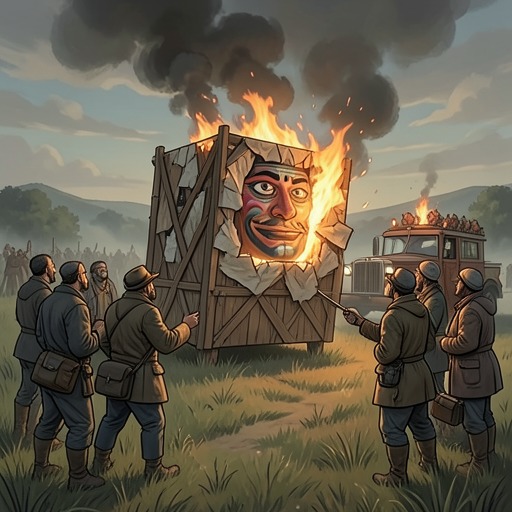
The festival’s largest consequence emerges later, when Sheriff George Dunne explains how the Kettle Springs Improvement Society tried to persuade people to participate in its plans. He says the stunt at Founder’s Day was what turned the group’s efforts into a matter of urgency for the town: it got people thinking they needed to act fast. His account places the public event within a longer campaign. For months, the Society had been bringing together people it believed would listen and had a role to play, while withholding parts of its purpose so as not to frighten potential supporters away. The stunt therefore functions in his explanation as a pressure point in an existing recruitment effort, not as the whole of that effort.
Dunne also connects the Society’s secrecy to opposition and violence. He says that Dr. Weller, once one of its most vocal supporters, threatened to expose the group, and that the members dealt with the threat together. The account makes the apparently ordinary festival retrospectively central to the conspiracy’s escalation: a public celebration provided the moment that helped convince the Society’s intended allies that action could not wait. The evidence does not specify the stunt’s mechanics here, but it establishes its political effect and the place of Founder’s Day in the chain of events.
Significance
Founder’s Day holds two different meanings in the novel’s chronology. For Quinn, it is at first an unfamiliar holiday entangled with school rules, an uncertain welcome, and the awkward task of deciding whether she is allowed to attend. On the day itself, it is a crowded but modest civic performance, with temporary carnival rides and a parade accompanied by recorded music. In Dunne’s later account, the same occasion becomes a catalyst: the stunt helped transform the Improvement Society’s gradual effort to assemble supporters into a perceived need for immediate action.
That movement from local spectacle to political consequence gives the festival its narrative weight. Its public openness contrasts with the Society’s selective, concealed organizing, while the school’s attempted exclusion contrasts with the sheriff’s invitation to Quinn. Founder’s Day brings people together in visible ways, yet the later disclosure reveals that its gathering also affected a much more secretive coalition. The festival is both a community occasion and a turning point in the explanation of how that coalition gained momentum.