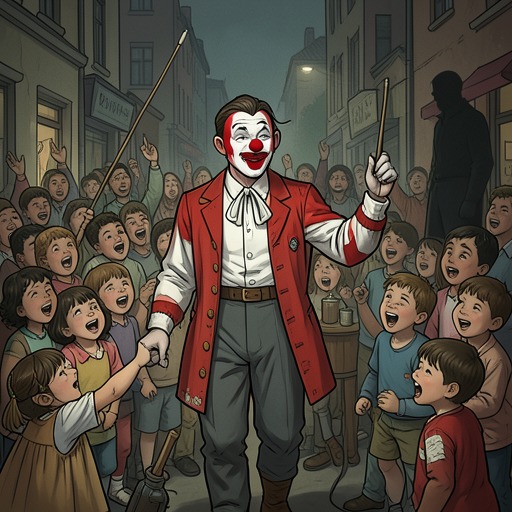
Frendo attacks the Tillerson Farm party
Clown in a CornfieldFrendo attacks the Tillerson Farm party is the violent rupture at the center of the celebration: an armed assault that transforms a crowded gathering into a fight for survival and reveals that the attack is not the work of a lone clown. The massacre also follows a public effort to frame Kettle Springs’ young people as a threat and rally the town around decisive action.
Causes and Background
Before the attack, Kettle Springs was already arguing over how to revive its fortunes and what to do about the next generation. At a meeting about Founder’s Day, Harlan Jaffers defended the reduced-budget parade, praising its floats and costumes and recognizing Janet Murray for hand-painting banners. Complaints about a damaged fire-engine pump and the town’s finances soon redirected attention to Arthur Hill: Harlan suggested that Hill might attend the parade and reinvest in local businesses. The prospect briefly quieted the room, although Hill had scarcely been seen in town for nearly a year.
Sheriff George Dunne recast that economic anxiety as a moral and generational crisis. He invoked Mr. Vern’s efforts to discourage certain students from attending Founder’s Day, argued that legality and righteousness might diverge, and urged residents to take action to restore the town. Dunne then asked willing, able-bodied adults to be deputized and told those unwilling to leave. Harlan objected to the proposal, but the crowd responded with murmurs of enthusiasm. Later, Dunne explained that the Founder’s Day stunt had persuaded people that urgent action was needed: for months, organizers had gathered supporters in the Kettle Springs Improvement Society, limiting what different members were told. He also said that Dr. Weller, once a vocal supporter, had threatened to expose the group and had been dealt with by its members.
The festival itself initially offers a contrasting public face. Quinn Maybrook had been reluctant to attend, but after an hour she had not been asked to leave or told she was banned. Founder’s Day proved larger than she expected, with food, music, visitors from neighboring towns, and a small carnival of rides and midway games in the school parking lot. During the parade, spectators mistook unexpected sparks and pops for part of the show and applauded; Quinn recognized that the display was unofficial but found that it brought people joy. That festive misreading prefigures the more dangerous confusion between performance and genuine threat at the party.
The Party and First Attack
The violence begins at the Tillerson cornfield party, after Quinn Maybrook, Cole Hill, and Janet Murray break through the cornstalks into a clearing roughly the size of a high-school running track. An old barn stands across the clearing, its doors open to the dark rows beyond; beside it, a disused silo leans, its red paint cracking, while the barn roof sags. The setting is already precarious before the attack: the farm buildings appear close to collapse, and the party has gathered young people among corn, a barn, and a silo with limited routes out.
At first, the crowd turns the clearing into a space of release. The barn’s open doors do little to relieve the heat; after three songs, the crush of bodies makes the dance floor oppressive. The music mixes underground hits with souped-up country, and Kettle Springs High School students even form three lines to line-dance. That makes the later rupture sharper: the gathering’s shared energy and improvised festivity are suddenly recast as panic, with the barn and its surroundings becoming obstacles to escape.
After Ginger collapses, Janet tries to check her pulse and reach for her phone, but drops it into a puddle of beer. Quinn sees a clown emerge from the corn, shoulders uneven and chest heaving. Ten feet away, the attacker raises a crossbow and fires low. The bolt passes between Quinn and Janet and buries itself in the dirt, missing Ginger’s head by inches. The weapon and the clown’s emergence make clear that the danger is no longer a prank or a stray effect of the celebration.
Cole watches the masked killer aim at Janet and fire again. The bolt misses her but strikes someone in the chaos; Cole cannot tell whether the victim is Pat Horner. A shout that there is an active shooter sends the party into a disorganized flight. When the clown reloads and fires once more, the bolt hits Jake Peps, who falls face-first into a raised firepit. The flames flare around him as he screams and struggles in the embers. Cole instinctively moves toward his longtime friend, remembering their childhood connection, but Ronnie Queen pulls him back, insisting that Jake is gone, while Matt Trent helps move him away.
Cole loses sight of Quinn and Janet as partygoers divide between the corn and the barn, where a group tries to shut the large wheeled doors. He is swept instead toward the silo with Ronnie and Matt. Erin Werther holds its small entrance open for them; as they rush through, a crossbow bolt shoots through the gap between door and jamb and strikes her in the side of the head, shattering her glasses and killing her before she hits the floor. Her body lands at Matt’s feet. The door remains open about a foot, leaving the people inside confronted not with shelter but with the evidence of how readily the attacker can reach them.
Fire and Encirclement
The attack expands beyond the first crossbow shots into a coordinated assault on the whole party. From outside the clearing, the barn is already burning: flames climb its sides toward the corrugated-tin roof, while popping wood and flying sparks carry the fire higher. The smoke smells of chemicals and charred meat. Behind the closed rear doors, screams and fists striking the wood compete with the steady roar of the flames, turning the barn from a possible refuge into a trap for those still inside.
Ruston Vance’s warning that there is more than one attacker proves the danger is organized and surrounds the survivors. Two clowns step out of the corn to the south, toward the road, one carrying a hooked blade and the other a chainsaw. Another appears beyond the barn with a crossbow, while to the east a clown drags a freshman impaled on a pitchfork and a smaller figure stands nearby with an ax. The attackers approach from at least three sides, apparently undeterred by the survivors’ guns or by the fact that two of their own have already been shot.
As the clowns close in, Ruston Vance shouts for the survivors to run and fires at the large crossbow-wielding figure near the barn. His shot strikes the attacker’s side and shoulder but does not stop him from firing back. The bolt sails into the small crowd, renewing the immediate threat even as the survivors try to break out of the encirclement.
Political Meaning of the Attack
The attack’s significance extends beyond the immediate struggle to survive: it makes the town’s language of renewal and its actual violence occupy the same narrative arc. Earlier, Sheriff George Dunne had urged residents to take action against a generation he portrayed as a threat; later, he described the Founder’s Day stunt as the shock that persuaded supporters to act quickly. His account also reveals that the Kettle Springs Improvement Society cultivated support through selective disclosure, and that Dr. Weller was dealt with after threatening to expose the group. The party attack therefore unfolds against a political campaign already organized around urgency and control, though the evidence does not establish that the Society directed the attack itself.