Glenn Maybrook
Clown in a CornfieldGlenn Maybrook is a physician and the father of Quinn Maybrook whose move to Kettle Springs follows two forms of exhaustion: the ethical strain of corporate medicine and the devastation of Samantha Maybrook’s overdose. He arrives hoping the town can offer a fresh start, but the violence there soon tests the same qualities that brought him—care for others, protectiveness toward Quinn, and a persistent sense of responsibility. His survival and reunion with his daughter make their relocation less a simple escape from grief than the beginning of a life they must rebuild together.
Identity and Background
Glenn is a quiet, big-hearted doctor who struggles to express his concern in ordinary conversation. In Philadelphia, his work at a large hospital owned by a corporate healthcare conglomerate left him repeatedly telling families that insurance would not cover a procedure or medication, and treating children with gunshot wounds whose families could not afford the bills. The strain accumulated, but Samantha’s overdose became the breaking point. For the year that followed, Glenn went through the motions, unable to trust that life would remain stable. He was not sleeping, and Quinn sometimes woke to find him sitting in the dark, arguing with the absent Samantha.
The opportunity to work in Kettle Springs offered a practical as well as emotional alternative. Glenn had accepted a position associated with Dr. Weller’s practice, and the office was already equipped when he arrived: Dr. Weller had left so suddenly that a paper remained on the examination table, complete with a patient’s butt imprint. The detail gives the move an odd, mundane texture, but also shows how quickly Glenn’s new professional life was expected to begin. At dinner, he tries too hard to be neighborly, praising the food and its prices to Trudy; Quinn recognizes that small talk does not come naturally to him. His concern is genuine even when its expression is awkward.
Fatherhood and the Move
Quinn sees the move as a yearlong stop between her present and her future, and initially expects Kettle Springs to be little more than a sleepy cornfield. Glenn’s hopes are more urgent: after a year of hollowed-out routine, he believes a fresh start is what they both need, even though he knows it is not what Quinn wanted. Their different responses to the relocation coexist with their shared bereavement. Quinn imagines how Samantha would have found the move funny, while recognizing that if her mother were still alive, the family would never have left Philadelphia.
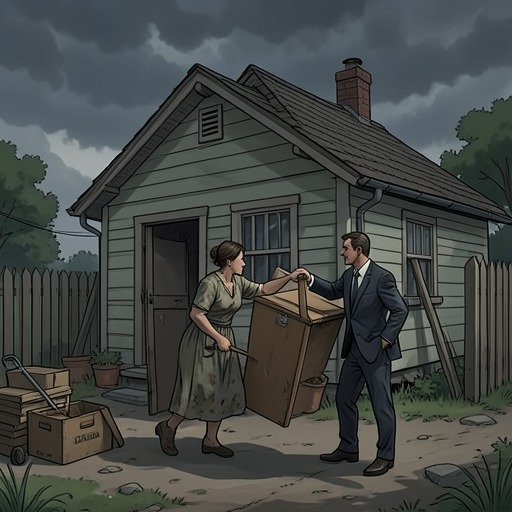
The arrival makes Glenn’s vulnerability visible before he can hide it. As the moving truck begins to pull away, he throws himself against its side, steadies himself on the running board, grips the mirror, and climbs up to plead with the driver. The truck is barely moving, lending the scene an almost comic disproportion, but Quinn can see how close her father is to losing his composure. Once they have arrived, Glenn claps his hands and repeats that they are there, as if the words might make the change real. Quinn reassures him that the belongings are manageable; underneath the practical work of unloading is the harder task of making a home after loss.
Glenn tries to assure Quinn that he is in a good place and that Kettle Springs is what he needed, then corrects himself: it is what they needed. The small revision matters. His decision is not only a private recovery project; he is trying to account for his daughter’s future as well as his own. He encourages her to attend a party and asks whether the neighbor boy will be there, despite his unease about letting her go out all night. At home, he keeps his hands soapy at the sink on purpose, using the chore to occupy himself rather than efficiently wash dishes. He knows Quinn is capable and wants her to make friends, but that knowledge does not quiet his fear. He is caught between protecting her and refusing to make a new home into another restriction.
Care Under Threat
Glenn’s protectiveness is not limited to his family. During the parade disaster, he is tending to an injured Cub Scout when a runaway float bears down on them. He launches himself backward and pulls the boy clear at the last moment. The truck continues past and collides with a lamppost; the rescue is immediate and physical, an extension of the physician’s impulse to attend to the injured even as the danger shifts toward him.
Later, an attacker strikes Glenn from behind and clamps a hand around his neck. He loses his golf club and struggles to breathe as an unfamiliar voice demands to know where his daughter is. In captivity, he is confronted with Dr. Weller’s corpse and the grotesque sight of a mouse emerging from its mouth. When Glenn screams, a deep, digitally disguised voice tells him to sit tight and count his blessings because he is still alive. The captors’ language does not make his situation feel safer: he is alive, but controlled and kept from Quinn, with no clear account of who has taken him or why.
Even in captivity, Glenn’s professional identity becomes a means of coercion. He is expected to treat a patient with only tweezers, an old scalpel, and a first-aid kit, and he protests that the supplies are not sterile. The voice answers that there were no medical supplies at his home and that he must do his best. Glenn has left corporate medicine partly because its conditions forced him to confront the limits imposed on care; now that conflict is compressed into a stark emergency. He has almost nothing with which to help, yet he cannot treat the patient’s danger as someone else’s problem. His despair is sharpened by the conviction that he is losing the patient despite trying.
Survival and Reunion
When the crisis moves toward its final violence, Glenn takes up the scalpel and prepares to act quickly if anyone comes down the stairs. His thoughts turn to Quinn, whom he hopes is still alive, and he whispers that he loves her as he begins to climb. The moment joins his two defining forms of care: the physician’s readiness to intervene and the father’s determination to reach his daughter. The scalpel, an inadequate medical tool moments earlier, has become the only weapon immediately available to him.
After hearing shots, Glenn nearly puts the scalpel into his own chest, then finds his feet and moves toward the light. He sees Quinn lying under a spotlight and recognizes that she is alive. Later, when Quinn hears a familiar voice in the darkness and asks whether it is her father, Glenn stumbles forward and falls. Quinn throws away her rifle, removes his Frendo mask, and runs to him. Their brief silence as they hold each other is a pause after violence, not a claim that its effects have disappeared. Glenn’s first words are an apology for making them move to Kettle Springs, followed by a request that Quinn find him a doctor who is not himself. The apology acknowledges the burden of the decision; the joke-like request lets him accept help instead of remaining only the person expected to provide it.
Aftermath and Continuing Work
In the aftermath, Quinn is the most able-bodied survivor and gathers the injured, leaning them against one another as the group makes its way toward the door. Morning light appears as they leave. Glenn has survived, but the ending does not suggest that a single reunion resolves the family’s bereavement or the survivors’ trauma. Later, Glenn is still seeing patients and swears he will give up his practice once Kettle Springs finds a replacement. He hopes to do so before he is officially sworn in as mayor, although Quinn doubts he can stop being a doctor so easily.
That tension gives Glenn’s recovery an unfinished shape. He had left a damaging medical system, but not his sense of obligation to people in need; the town continues to depend on the work he hopes to relinquish. His prospective mayoralty similarly places him in a public role just as he considers stepping away from professional responsibility. For Quinn, who initially accepted the move despite not wanting it, her father’s apology and their survival give the relocation a changed meaning. Glenn remains fallible—grieving, anxious, and unable simply to set care aside—but his persistence is no longer presented as proof that he can manage everything alone.