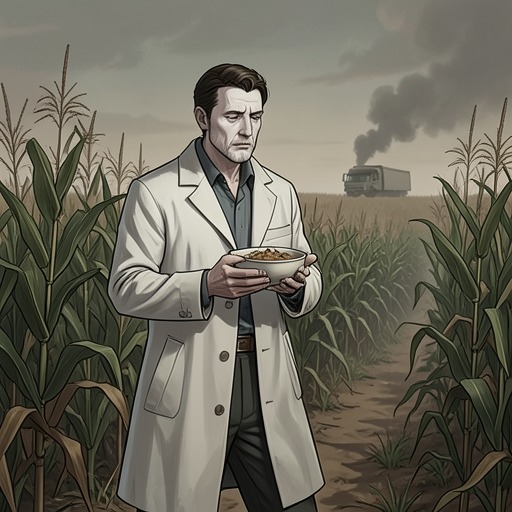
Glenn Maybrook’s kidnapping
Clown in a CornfieldGlenn Maybrook’s kidnapping transforms a domestic routine into a staged captivity whose immediate purpose is coercion: the abductors demand to know where Quinn Maybrook is, then force Glenn to treat a wounded woman while threatening Quinn’s life. The episode moves from an unexplained crash to a blacked-out assault, a locked basement enclosure, and a grotesque medical ordeal, making Glenn’s professional knowledge both the reason he is useful and the instrument by which his captors control him.
Causes and Attack
At 9:00, Glenn was cleaning dishes when an alarm reminded him to stop and move to the next task. He had set it to impose structure on his evening, and laughed uneasily at himself before reaching for his phone. A sudden crash against the outside of the house startled him so badly that the phone fell, bounced off the counter, and landed face down on the floor. The small domestic mishap marks the abrupt end of the evening’s ordinary rhythm; the impact is not explained before the danger escalates.
Outside, wind carried smoke and heat into Glenn’s face. He had initially treated the situation as a possible prank, but the flames and the threat to his safety became impossible to dismiss. Footsteps sounded on the grass behind him. The unseen attacker might have approached covertly, come around from the field, or simply appeared behind him; Glenn cannot establish which. He begins to turn with a golf club raised, but is struck sharply at the back of the head before he can defend himself. A tremendous pressure closes around his neck, his breathing fails, and the club slips from his grip onto the lawn.
The attacker asks where Glenn’s daughter is. He cannot answer: the blow has dazed him and the hold prevents him from speaking. His view of the amber flames gives way to darkness. The question makes the assault more than a random attack on a physician: from the outset, the abductors connect Glenn’s capture to Quinn, although their identity and full purpose remain concealed.
Captivity and Setting
Glenn wakes to the stench of rot and severe pain at the back of his skull. His medical knowledge supplies possible explanations for the headache, but not certainty; he cannot tell whether his symptoms indicate one kind of brain bleed or another. That professional habit of diagnosis persists even as he becomes a helpless patient himself. His surroundings gradually resolve into a confinement space rather than a room: a cramped enclosure, roughly the size of a bathroom stall, inside a larger basement.
The enclosure’s construction makes the captivity visible and difficult to escape. Its back wall is solid wood paneling reinforced with chicken wire; the roof lies far above the short walls, with concrete and steel beams discernible in the darkness. A chain-link door at the other end appears to be padlocked. Beyond it, a bare bulb illuminates a folding chair and stairs leading upward. The floor outside the enclosure is dirt-streaked concrete, marked by footprints that look as though they were made by large boots. Inside, Glenn is hemmed in by a pile of corn mixed with feces. When he tries to push himself upright, the material sucks at his clothes like quicksand, and the futility of the effort stops him.
The scene’s confinement is reinforced by what Glenn finds nearby. Dr. Weller is dead, and a mouse crawls out from between the corpse’s teeth after feeding on his tongue, its whiskers marked with pink froth. Glenn begins to scream, but a deep voice, digitally disguised and amplified by the darkness, orders him to stop and sit tight. The speaker says that Glenn is still alive and should count his blessings. The voice offers no identity or explanation, preserving the captors’ control over both the space and what Glenn is allowed to know.
Coercion and Medical Ordeal
The disguised speaker warns Glenn to do as he is asked and suggests that compliance may keep him from joining those who will die that night. The warning establishes the immediate stakes without telling him what the captors’ larger plan is. Glenn is not simply locked away: his survival is presented as conditional, and the unseen speaker controls the terms on which he may remain alive.
That leverage becomes concrete when Glenn is made to treat Trudy. He protests that he has only tweezers, an old scalpel, and an inadequate first-aid kit, and points out that the tools are not sterile. The voice answers that Glenn had no medical supplies at home, so they had to make do, and tells him to do his best. The exchange exposes the practical logic of the captivity: the abductors need Glenn to use his medical ability, but have supplied only makeshift equipment and leave him to bear the risk of trying to save a patient under those conditions.
Glenn’s professional identity is therefore turned against his wish to leave emergency medicine behind. As he recognizes that he is losing the patient, the work he had wanted to escape becomes an imposed duty with an immediate human cost. Trudy tries to spit at him but cannot reach him; Glenn drops her hand and steps back, his head still throbbing. Her pain and agitation do not make the situation clearer or safer. Instead, they sharpen the contrast between the clinical task Glenn must attempt and the brutal circumstances in which his captors have placed him.
Quinn as the Stakes
The kidnapping’s connection to Quinn becomes unmistakable only after Glenn has been forced into the medical ordeal. He recalls that the attackers asked for her when they took him and realizes that she, too, has become a target. The recognition retrospectively gives the earlier question at the scene of the assault a new weight: the captors did not merely want information in the moment; their interest in his daughter persists throughout his confinement.
The voice above Glenn warns him to consider his next action carefully, then says that his daughter is not dead yet. The threat makes Quinn’s survival a means of controlling her father and turns Glenn’s medical choices into part of a larger coercive arrangement. The available events leave the captors’ identities and ultimate objective undisclosed, but they establish the essential terms of the kidnapping: Glenn is imprisoned, Dr. Weller is dead, Trudy needs treatment, and Quinn’s life is being used to compel Glenn’s compliance. The movement from an alarm intended to organize the evening to a locked enclosure in which every decision carries a threat gives the episode its defining reversal.