Kettle Springs’ economic decline
Clown in a CornfieldKettle Springs’ economic decline is not confined to a closed factory or a shrinking population: it appears in the town’s aging streets, missing businesses, and fields of corn that may never be harvested. The collapse of Baypen’s refinery has weakened the commercial life built around processing the crop, while the town’s leaders look to Arthur Hill and Founder’s Day for a possible route back to prosperity. Across these details, the town seems caught between an agricultural system still in operation and a local industrial market that has vanished.
A town marked by stasis
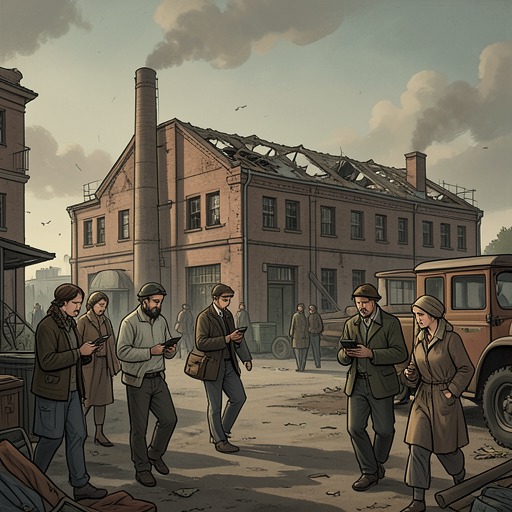
Quinn Maybrook first encounters the scale of Kettle Springs’ agricultural surroundings from her new home. The property borders miles of corn, and the crop encircles the town. Beyond it, the abandoned factory rises over the horizon: a dilapidated, apparently five-story structure with a chimney tilting behind it and a roof sagging like a broken-backed animal. Soot blackens a mural on its side, visible evidence of the calamity that ruined the building. The factory’s distant presence makes industrial decline part of the everyday view rather than a matter of town records alone.
The streets tell a parallel story. Walking toward school, Quinn sees larger, widely spaced houses whose upkeep and decorations seem shabby and tired. Her comparison with Philadelphia is pointed: in her experience, the city continually demolishes old structures and makes room for new life, whereas Kettle Springs appears to have left its best days behind. This is her impression, not a town-wide account of every household, but it establishes how decline is registered by a newcomer moving through ordinary streets. The town’s economic condition is encountered as a sense of arrested change.
Baypen’s collapse and the missing commercial life
Baypen’s closure has removed more than a major industrial operation. Ruston Vance tells Quinn that the Eureka Theater still shows mostly older films, though it sometimes gets newer ones, and that a frozen-yogurt shop disappeared after Baypen closed. For a prospective outing beyond town, he points her toward a mall in Jamestown, about twenty miles away once one reaches the highway. His inventory makes local life feel reduced: an old theater remains, one small business is gone, and the mall lies elsewhere.
The factory’s physical ruin sharpens that account. Baypen made corn syrup, Ruston explains, and its refinery burned down. The town’s economic hopes therefore depend not simply on restoring a building but on the possibility that its industrial activity might resume. The contrast between the vast cornfields and the blackened, abandoned factory is especially stark: the crop remains in view, but the local facility that processed it has failed.
Main Street and the effort to attract visitors
The Main Street Eatery preserves a more intimate record of the community. Its decorations include a plaque recognizing it as a runner-up for Missouri’s Best Chili in 1998 and photographs of Little League teams it sponsored across decades. The place is clean enough, and its collected objects have earned their place on the walls, but Quinn notices that nothing seems to date beyond the early 2000s. Rather than presenting a continuously growing business district, the Eatery’s interior feels like a storehouse of an earlier civic life.
At a town meeting, the immediate financial debate centers on how to draw people downtown. Helen Mars argues for a billboard on I-44 to bring out-of-towners to Main Street and help local businesses. The response is that flyers have already been distributed at the St. James Mall and that a crowd is expected for the parade. These plans show that residents are still trying to generate trade, but the discussion also exposes the limits of their resources: promotion, rather than a new employer or a reopened facility, is the practical proposal on the table.
Arthur Hill as the hoped-for investor
The meeting’s most consequential promise is that Arthur Hill may attend the parade. His possible presence silences the room because residents hope that, if he likes what he sees on Main Street, he might reinvest and reopen things. The hope is conditional and personal: the town’s prospective recovery is tied to the judgment and money of a single absent industrialist. He has not been seen in Kettle Springs for almost a year, and the only person regularly going in and out of his large house is his son, Cole Hill.
Sheriff George Dunne complicates the meeting’s earlier optimism. He describes Arthur as one of his oldest friends but says that Arthur is no longer emotionally or financially invested in the town. Dunne links that withdrawal to two losses: Arthur lost a child the previous year, and the factory burned down the week before. Before the fire, Dunne says, residents had been waiting for the refinery to reopen. He argues that Arthur will not put money into Kettle Springs as it is, with its declining population and young people whom he accuses of disregarding local history and heritage. Thus, the same factory that residents imagine reopening is also part of Arthur’s grief, and the town’s proposed economic revival cannot be separated from personal bereavement.
Corn, subsidies, and a failed local market
The cornfields reveal another dimension of decline: crop production can continue even when local processing and purchasing have disappeared. On a nighttime drive, Quinn asks when the corn will be harvested. Janet Murray answers that it will not be; Cole explains that government subsidies pay corn farmers when they plant, not when they harvest. He specifies that these are not the fields being cleared, and Janet presses him on whether clearing the B-fields is hardly worthwhile without Baypen and his grandfather to buy the crop. Cole does not answer. The exchange connects the unharvested fields to the loss of a local buyer, while also showing that planting remains economically possible under a subsidy system that does not depend on bringing the crop to market.
Later, Dunne turns the fields into an image for his justification of violence against young people. He calls them a blighted crop and describes cutting, culling, and burning a harvest to save the land before letting a field lie fallow. This is his ideological metaphor, not an explanation of agricultural policy, but its force draws on the surrounding landscape and the town’s unresolved material conditions. Kettle Springs’ decline is thereby made both visible and politically charged: the corn remains, Baypen is ruined, and the people arguing over the town’s future interpret its troubles in radically different ways.