Mr. Vern
Clown in a CornfieldMr. Vern is the science teacher whose angry classroom confrontation marks him as an opponent of the students he calls a blight on Kettle Springs. His authority reaches beyond the school: Sheriff George Dunne later cites his effort to keep certain students away from Founder’s Day as an example of the town’s response to them. The confrontation’s apparent petty dispute over a test therefore carries a darker implication, fulfilled when Quinn Maybrook removes Frendo’s mask and recognizes Mr. Vern’s dead face.
Identity and Introduction
Mr. Vern first appears as Quinn Maybrook arrives late to class. He does not ask her for a late pass or even her name; she makes her way to the only open seat, in the front row beside the projector bulb’s dusty, hot vent. He is teaching science, and the immediate subject is a test scheduled for Monday, despite the approaching Founder’s Day weekend. The class groans, but Mr. Vern insists that the school year is already a month underway and that its juniors and seniors must deal with exams. Quinn, new to the room, is not even sure whether the class combines both grades.
The scene gives him a memorable physical presence without making him imposing in any conventional sense. He has thin arms, a mustache, and an upper lip that quivers as his control begins to falter. He is not wearing a sweater vest, though Quinn’s impression is that he owns several. That detail belongs to her first, uncertain reading of a teacher she has not yet met: at first, he can seem like a familiar school stereotype, but his anger quickly makes the classroom feel less ordinary.
Classroom Conflict
The dispute escalates when Mr. Vern orders Janet Murray, Ronnie Queen, and Tucker Lee out of class, along with Cole Hill, sending them to the in-school room. He frames their arguments about the test as deliberate disruption and insists that they are wasting their classmates’ time. Cole protests that he was trying to help and calls the punishment unfair. Mr. Vern, already shaking, struggles to control his stutter as he tells the students that they are out of control and that the town has put up with them for years.
His language changes the scale of the conflict. Rather than treating the interruption as a classroom-management problem, Mr. Vern describes the young people as a blight on the community. Quinn initially finds the tantrum absurd, and a laugh slips out before she can stop it. When he consults what appears to be a roll sheet and singles her out by name, she realizes that the argument is not simply about a Monday test or students provoking a teacher. Mr. Vern complains about their antics and videos, and suspects that Janet is filming him. Quinn recognizes that a recording of his outburst could be taken to the school board, adding the prospect of public exposure to his loss of composure.
He then turns the students’ removal into a broader punishment. Addressing Janet and Ronnie at the doorway, he tells them to inform the boys waiting outside that they are all banned from Founder’s Day. The room falls silent; no one else wants to risk being included. Janet answers that he cannot bar them from a public event. Her matter-of-fact objection exposes the gap between Mr. Vern’s declaration and his apparent power to enforce it. His ban nevertheless gives the classroom dispute consequences beyond school, making his hostility part of the town’s wider attempt to control the young people.
Public Role in Kettle Springs
At a town meeting, Sheriff George Dunne connects Mr. Vern’s action at school to the community’s response to the students. Speaking off the record, Dunne says that legality and rightness may diverge, and suggests that the law might not be enough to keep Kettle Springs as its residents know it. As evidence of the town coming together against the students’ behavior, he mentions that Mr. Vern had discouraged certain students from attending the next day’s Founder’s Day event.
Dunne’s account confirms that the classroom ban was not merely a private flare-up: Mr. Vern’s effort to exclude students is already being invoked in a public argument about community authority and the limits of law. The incident also places the teacher within a larger pattern of adults treating the young people as a threat to the town. The evidence does not explain Mr. Vern’s private motives, but his classroom language and Dunne’s later reference establish the reach of his opposition—from a test dispute, to a claimed right to ban students, to a civic atmosphere in which legal and moral limits are openly being questioned.
Unmasking and Death
Mr. Vern’s apparent identity as a teacher gives way during Quinn’s rescue mission. She began the effort with a shotgun, but the gun she is using is not supposed to be hers, and she had not paid close attention while Ruston Vance explained how to operate the rifle. After a shot, she thinks she has missed the clown; then she sees a wound blooming on Frendo’s chest. She continues forward despite the danger that the barn could collapse in the wrong direction and burn or crush her.
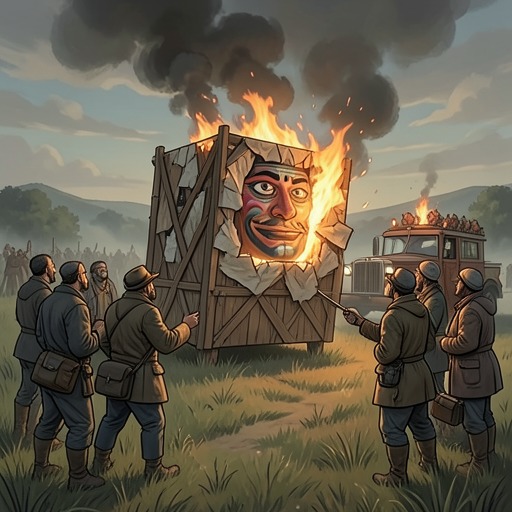
Quinn kneels and removes Frendo’s mask. The second shot has left a small hole in the bridge of the clown’s nose. Beneath the mask, the dead face belongs to Mr. Vern: his eyes are lifeless, and blood and spit froth around his small mustache. The reveal resolves the earlier conflict with a violent reversal. The teacher who had accused students of being a blight and sought to keep them from Founder’s Day is exposed as the figure behind Frendo, and Quinn’s rescue mission ends with the discovery of his body. His ordinary school identity had made his public denunciations seem like one more expression of local hostility; the mask’s removal shows that the danger was not confined to the classroom.