Quinn Maybrook
Clown in a CornfieldQuinn Maybrook is a bereaved teenager whose move from Philadelphia to Kettle Springs begins as an attempt to escape the scrutiny surrounding her mother’s death. The town does not offer a clean slate so much as a new setting in which Quinn must confront grief, danger, and the decision to make a home after violence.
Identity and Background
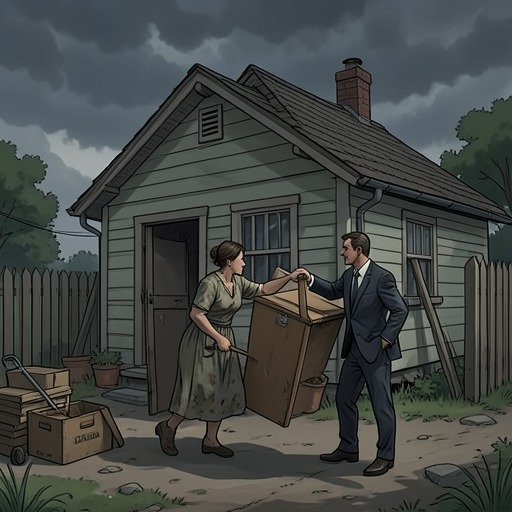
Quinn arrives in Kettle Springs with her father, Glenn Maybrook, after the death of her mother, Samantha Maybrook. The move is difficult even before the family has settled in: as they bring their belongings inside, Quinn tries to reassure Glenn that the task is manageable, while recognizing that his effort to appear composed is close to failing. Their new home is inseparable from their loss. Quinn imagines that her mother would have found the move amusing, then acknowledges that if her mother were still alive, the family would never have left Philadelphia for Missouri.
For Quinn, relocation offers the prospect of a pause rather than a settled future. She hopes to keep her head down, recover for a year, and then apply to Penn, Temple, or another college in the Philadelphia area. In Kettle Springs, she expects to be free of the identity she had acquired at home: the girl whose mother had been visibly unwell at a regional sporting event. The distance matters because Quinn wants to avoid the whispers and the public knowledge of her family’s private tragedy, not because she has stopped grieving it.
School, Visibility, and Grief
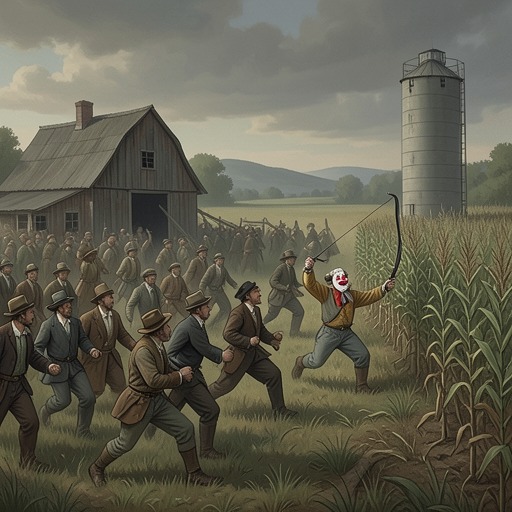
On her first day, Quinn identifies the school as the destination that marks her entry into Kettle Springs life. Later, at a party in a standing cornfield, she steps onto spongy, uneven soil crossed by fallen stalks. Cole Hill has driven straight into the crop and pushed stalks down beneath his car; the group gathers in a clearing where vehicles are kept out of sight from the highway. The concealed setting offers a sharp contrast to the social exposure Quinn fears: she has left Philadelphia, but she has not escaped being watched.
At school, other students are fascinated by Cole, and when Quinn is with him their attention turns to both of them. She feels like a fishbowl attraction, a position that recalls the previous year she spent trying to disappear. Her mother’s death has become searchable gossip: classmates can learn that Samantha Maybrook struggled with opioid addiction, progressed to heroin, and died when her brain stopped signaling her lungs to breathe. Quinn wants to vanish under the weight of that knowledge. Her therapist, Dr. Mennin, argues that withdrawal is not a workable way to cope; Quinn calls the advice nonsense, even as she privately recognizes that the therapist has a point.
Quinn had begun seeing Dr. Mennin shortly before Samantha’s final overdose, after her mother had promised to get clean. Before the death, Quinn already wanted to float away; afterward, she felt flattened. Glenn Maybrook initially anchored her to ordinary life through practical, repeated acts of care: he got her out of bed, made sure he was home when she returned from school, took her to movies, insisted she eat, and lay beside her bed until she fell asleep. Over time Quinn began to feel better, but then Glenn’s grief surfaced. Dr. Mennin’s repeated reminder that grief does not follow a calendar helps frame the family’s recovery as uneven rather than finished.
That unevenness returns while Quinn dances with Cole and notices the people watching them. Instead of being able to inhabit the moment without qualification, she thinks about calling her therapist. The impulse is evidence not that she has made no progress, but that social attention and new intimacy can bring old pain back into view. Quinn can recognize the need for help even while the prospect of being known through her mother’s death continues to make her want to disappear.
From Survival to Resistance
The violence in the cornfield turns Quinn’s wish to stay unnoticed into a series of choices made under immediate threat. When an arrow flies toward Janet Murray, Quinn does not stop to weigh the danger or their limited acquaintance. She tackles Janet shoulder-first into the dirt; the arrow passes over them and embeds itself in a tire, its shaft trembling. Quinn makes the danger plain: the attacker is trying to kill everyone. In the instant of impact, self-preservation becomes inseparable from protecting someone else.
After the attack, Quinn approaches Frendo at the burning barn despite the risk that the structure might collapse and crush or engulf her. She kneels beside the clown, sees the small hole her second shot made in the bridge of his nose, and pulls off the mask. The person beneath it is a science teacher. The reveal converts the figure who had seemed an inhuman threat into a recognizable member of the town, and makes Quinn’s act of looking directly at the danger part of the discovery itself.
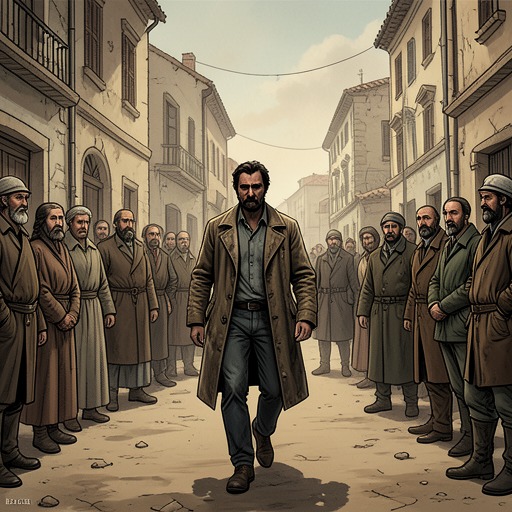
Later, Quinn uses a rifle to force Arthur Hill into the circle of light, with the weapon pointed at his back. Sheriff George Dunne has a rope around Arthur’s neck and keeps a hand on him; Quinn demands that the rope be removed and threatens to kill Arthur if it is not. Dunne responds with a chuckle and calls her the new girl, treating her intervention with admiration even as he remains in control of Cole Hill. The encounter places Quinn between the armed sheriff and the captive Arthur, turning her from a bystander in the town’s violence into an active opponent of it.
Quinn’s confrontation with Dunne ends on the metal stairs. He is badly wounded, struggling to focus, and his hand wavers around his gun as blood runs over his belt and down his trousers. Quinn understands that the wound is fatal, but fires at him as he takes a step toward her. Dunne’s hat flies backward; he collapses onto the stairs and slides down to the ground, dead at her feet. The shot is both a response to an immediate armed threat and a decisive crossing of a line: Quinn has survived by taking a life, and she knows she did so.
Aftermath and the Decision to Stay
With Sheriff George Dunne dead, Quinn’s attention turns to the ammunition bag, but a familiar voice in the darkness interrupts her. She recognizes her father, Glenn Maybrook, as one of his worn white Reeboks stumbles into view and he falls. Quinn throws away the rifle. The narration distinguishes the weapon from the choice she made: it did not betray or seduce her; it enabled her to do what she wanted—to survive, and to kill. Her reunion with Glenn comes at the threshold of that recognition, after she has already crossed into an irreversible act.
The attack does not leave Quinn unchanged. Her hands sometimes shake, she keeps the lights on around the house, and her dreams remain terrible, as they had been since her mother’s death. The account treats these reactions as small but consequential signs of trauma, not as an experience she can simply put behind her. Having survived one catastrophe after another, Quinn must now live with both the town’s violence and what survival required of her.
In the immediate aftermath, Quinn persuades Glenn that they should remain in Kettle Springs. Leaving would be an understandable attempt to escape the attack, but she regards the town as their home now; blood has been spilled to make it so, and retreat would mean that the perpetrators had won. Her decision marks a change from the move’s original purpose. Kettle Springs had first offered a year of recovery and distance from the public story of Samantha Maybrook’s death; now Quinn claims it as a place she has a reason to defend.
The ending sets that choice against the conspirators’ own intended victory. Arthur Hill, Sheriff George Dunne, and twelve conspirators known to the FBI had, in one sense, saved Kettle Springs—but not in the way they planned or expected. Quinn’s insistence on staying does not endorse their design; it separates the town’s future from the people who tried to control it. Her arc therefore closes not with an uncomplicated return to safety, but with a commitment to remain in a damaged place and refuse the meaning its attackers meant to impose.