Tillerson Farm party massacre
Clown in a CornfieldThe Tillerson Farm party massacre is the novel’s decisive rupture between a town’s public festivities and its concealed violence: a crowded party in a barn and cornfield becomes a coordinated killing ground, and the attack is later exposed as part of a plan to preserve Kettle Springs by sacrificing its young people. Before the first assault, the story builds a world in which danger can be mistaken for entertainment, while the town’s adults and teenagers struggle over who gets to define disorder and belonging.
Causes and Background
Quinn Maybrook arrives at Founder’s Day reluctant to attend and unsure how to explain to her father why she wants to avoid the festival. Yet for an hour nobody tells her to leave or reminds her that she is banned. The event proves larger than she expected: food, music, visitors from neighboring towns, and a small carnival assembled from rides and midway games in the school parking lot make the celebration feel expansive, even as shuttered businesses line Main Street.
The festival’s public order is already unstable. Janet Murray joins Quinn and presents herself in a thin cardboard half-mask shaped like Frendo the Clown; nearby, Tucker Lee wears a more elaborate Frendo costume and rides a bicycle. The masks make the festivities playful, but they also blur the line between a costume and a credible threat. When sparks and pops begin along the parade, the crowd applauds, assuming the commotion is part of the show. Quinn knows it is not official, yet she smiles at the joy it gives people and tries not to let anxiety spoil the moment. The scene makes misrecognition part of the event’s groundwork: spectacle can absorb signs of danger until a sudden change in context makes them legible.
That public performance also carries an undercurrent of adult resentment toward the young. At Kettle Springs High School, Mr. Vern’s anger over students’ videos and antics turns a classroom outburst into a wider accusation: he describes the students as an impediment to learning and suspects Janet is filming him. His hostility suggests that the conflict is not simply about pranks or school discipline. The students’ cameras and online performances have become symbols in a generational dispute, one that the later violence will exploit rather than resolve.
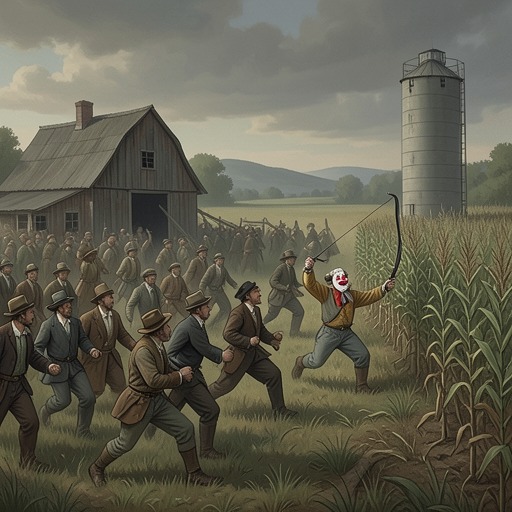
The party at Tillerson Farm brings the crowd into a more isolated setting. Teenagers push through the corn toward a clearing roughly the size of a running track, where the barn’s open doors frame the dark rows on the far side. Beside it, the disused silo leans; its sparse red paint is cracking, and the barn roof sags. The buildings look neglected even before danger enters them. Inside, the packed dance floor grows oppressive after three songs despite both barn doors standing open, as body heat accumulates among the partygoers. The gathering’s apparent openness will soon prove deceptive: movement through the corn and the doors themselves will determine who can escape.
The Assault and the Flight
The party’s change from crowded celebration to lethal attack begins when Quinn Maybrook and Janet Murray are still beside Ginger Wagner, who has fallen. Janet scrambles for her phone, which she drops into a puddle of beer; as she reaches for it, a clown emerges from the corn. His shoulders sit unevenly, and his chest heaves as if he has been running. The costume is no longer a festive disguise but the first clear sign that the party has been invaded by an armed assailant.
Frendo stops about ten feet away and raises a crossbow. Quinn is too stunned to move as he aims low and fires. The bolt passes between Quinn and Janet and strikes the dirt, missing Ginger’s head by inches. For an instant, Quinn assumes the clown has missed. Then Ginger, who is in Quinn’s arms, slumps forward and gives a final shudder: the bolt has passed through her head, entered at the base of her skull, and exited through her left eye socket before burying itself in the ground. The speed of the shot and Quinn’s delayed recognition turn a near miss into the scene’s horrifying confirmation that the clown is killing deliberately.
From the edge of the barn, Cole Hill sees the same attacker take aim at Janet. This shot goes wide of her but hits someone in the confusion; Cole cannot tell whether the victim is Pat Horner. At the barn entrance, shouts to run and warnings of an active shooter send the party into panic. The familiar language of school emergency drills becomes the crowd’s frame for understanding what is happening, but it offers no protection from the actual violence.
As Cole, Janet, and Quinn head for the barn doors, Frendo finishes reloading and fires again. Jake Peps falls face-first into a raised firepit; the flames flare around him, and he screams and writhes in the embers. Cole instinctively starts toward him, remembering a friendship that reaches back to kindergarten and the French toast sticks Jake’s mother made for them after Cole’s first sleepover. Ronnie Queen yanks Cole back, insisting that Jake is gone, while Matt Trent grips his arm and helps pull him away. The flight forces Cole to abandon the impulse to help a familiar classmate, replacing the ordinary obligations of a small school with the immediate work of survival.
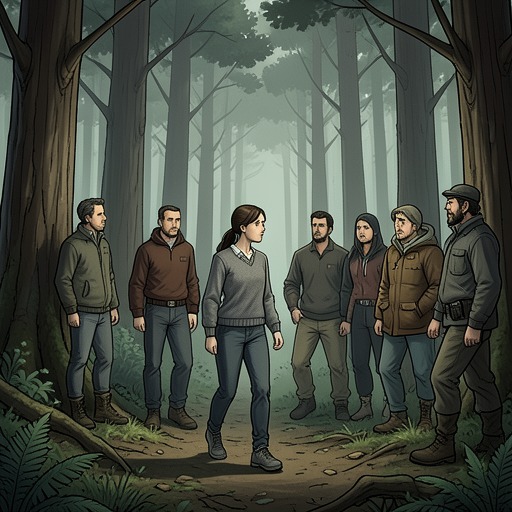
The crowd breaks in different directions: some partygoers run toward the corn, while others try to get into the barn as a group works to close its large wheeled doors. Cole is instead swept toward the disused silo with Ronnie and Matt. Erin Werther holds its small door open as they approach; a crossbow bolt slips through the gap between door and jamb and strikes her in the side of the head, shattering her glasses and killing her before she reaches the floor. Matt sees Erin’s body land at his feet and turns away, coughing as if he is about to vomit. The door remains open by about a foot as the survivors stand horrified, the narrow entrance offering no reliable boundary between shelter and attack.
The Attack Expands and the Escape Narrows
The survivors’ flight does not end at the barn. Ruston Vance points out a chain joining the handles of the closed back doors, secured by a padlock on the outside. The discovery explains why their classmates cannot get out: the doors are not merely blocked by the panic and crush of the crowd but deliberately fastened against them. Quinn Maybrook raises her shotgun and focuses on the instruction Ruston Vance had given her about bracing the stock, while they run toward the doors to help those trapped inside.
Ruston Vance tries to break the lock with his shotgun. He rests the weapon almost horizontally, with its butt in the dirt and the padlock wedged against the barrel, and warns the people inside to move back before firing. The blast tears away part of the barn doors in a shower of splinters, but it strikes high, away from the area where he hopes people are standing. When he reaches for the chain, he burns his hand on the lock. The attempt makes the obstruction—and the danger to the people on both sides of it—plain: even a rescue effort risks injuring those it is meant to free.
The threat also proves larger than a single masked attacker. Frendo pursues Janet Murray out of the cornfield, no longer carrying the crossbow but a smoking circular saw with a blade at least a foot and a half wide. He closes the distance as she turns to face him. Ruston Vance and Quinn Maybrook then see two more clowns emerge from the corn near the road, one carrying a hooked blade and the other a chainsaw. From the far side of the barn, another armed clown appears with a crossbow. The number and spread of the attackers overturn any possibility that the violence is one assailant’s isolated rampage: the party is being surrounded by a coordinated force.
When Sheriff George Dunne arrives, the survivors’ weapons and the costumes worn by Ronnie Queen and Matt Trent feed his suspicion rather than persuading him that they are victims. He notices Quinn Maybrook holding a shotgun and treats the two boys’ Frendo outfits, their drinking, and the apparent fake blood as reasons to question their account. He describes a night of confused reports, including a call about a fire in Tillerson B-field and another caller’s mistaken impression that an explosion had created a mushroom cloud. His response leaves the survivors struggling to make themselves credible at the very moment the scale of the attack demands that they be believed.
The Conspiracy Revealed
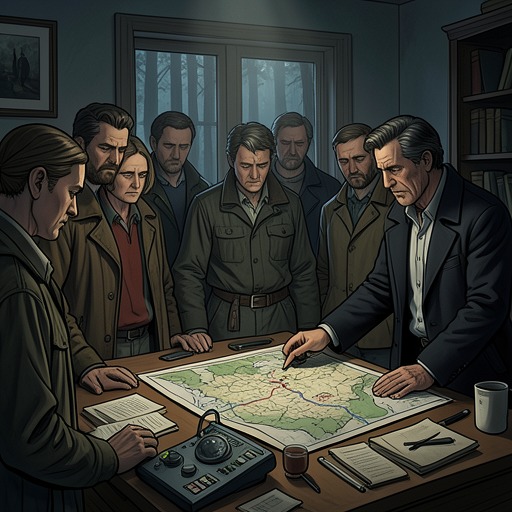
The massacre’s apparent chaos is finally explained as a political operation. As Sheriff George Dunne drives Cole Hill away from the farm, Cole realizes they are not heading back to town. Dunne traces the conspiracy to the Founder’s Day stunt: it made residents believe that action had to be taken quickly. For months, he says, he and his allies had been gathering people into the Kettle Springs Improvement Society, disclosing their intentions gradually and selectively. Dr. Weller, once among their vocal supporters, threatened to expose them; Dunne describes that threat as a problem the group resolved together. The account makes the assault more than a sudden outbreak of violence: it was the culmination of a campaign to move the town toward accepting the killing of its young people.
Dunne also explains how the conspirators manufactured consent. Rather than openly proposing a purge, they listened to residents, affirmed what they wanted to hear, and steadily shifted the limits of what the town would consider acceptable. The party was not necessarily the original purpose of that campaign; it was a convenient opportunity. The conspirators knew where and when the gathering would take place and that Cole’s social circle would be there, making the farm a setting where they could target the teenagers they had identified while presenting the violence as a solution for Kettle Springs.
The planned cover-up turns the survivors’ vulnerability into part of the attack. Dunne intends to make the deaths look like a suicide and blame Cole, Quinn Maybrook, and Ruston Vance. He says the conspirators used crossbows and chainsaws to reduce ballistic evidence, then boasts that the scene may provide more evidence against the three teenagers rather than less. His scheme depends on the public finding a story of an armed, heartbroken teenager more plausible than a coordinated conspiracy by adults. The uniforms and weapons that made the survivors seem suspicious to Dunne at the farm are thus not incidental details: he is preparing to use them as props in a false account.
This revelation recasts the event’s earlier confusions without making them less consequential. At Founder’s Day, a crowd mistook unauthorized sparks and pops for part of the entertainment; at the farm, the attackers’ Frendo masks and the students’ own costumes helped blur who was performing, who was in danger, and whom authorities should believe. Dunne’s plan exploits that confusion deliberately. The massacre is therefore both a physical assault and an attempt to control its public meaning: the conspirators seek not only to kill the teenagers, but to make their deaths appear to confirm the very threat the town has been taught to fear.