Tillerson cornfield party
Clown in a CornfieldThe Tillerson cornfield party is the night’s passage from small-town celebration into catastrophe. Janet Murray has spent much of the week organizing it, and Quinn Maybrook arrives as a newcomer drawn into the group; among the corn, music, and crowded barn, the party briefly offers a place to belong. But the clearing’s isolation cannot protect the teenagers. A warning that people will die turns celebration into flight, and Erin Werther is killed as partygoers force their way into a silo.
Invitation and the festival backdrop
Quinn Maybrook’s route to the party begins with an attempt to enter a conversation. After asking where the group filmed its creepy clown video, she hears that it was made at Tillerson barn. Cole Hill stops mid-thought and points toward Janet Murray, who says the gathering is open to everyone. Cole clarifies that Janet has spent much of the week putting a party together, then tells Quinn she is definitely coming. The invitation leaves Quinn buying time with a question of her own: she is not yet sure what she has agreed to, or how much she wants to join the group.
The invitation follows another, public gathering: Founder’s Day. Quinn had been reluctant to attend the festival and had struggled to think of a reason to give her father for skipping it. After an hour there, however, nobody had told her she was banned or asked her to leave. The festival is larger than she expected, with food, music, visitors from neighboring towns, and a small carnival of trailer-borne rides and midway games in the school parking lot. This welcome contrasts with Quinn’s hesitation about entering a new social circle, while also showing how readily Kettle Springs’ teenagers make room for their own, less official celebration.
An earlier parade has already blurred the boundary between sanctioned festivities and youthful disruption. Whistles and pops along the route are mistaken by the crowd for part of the show, and people clap and cheer. Quinn knows the sparks are not on the official program, but she smiles too: the prank may be Janet’s act of defiance, yet it is giving people joy. That mixture of rule-breaking and pleasure carries into the party, where the teenagers make their own event beyond the town’s formal spaces.
Through the corn to the clearing
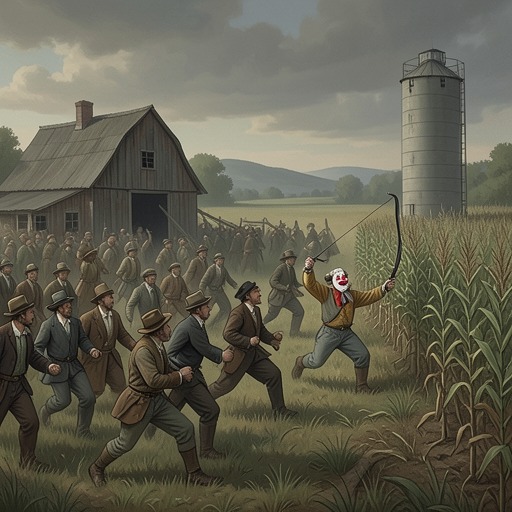
Before reaching the party, Quinn, Cole, and Janet encounter Frendo standing in the road. Janet’s startled, involuntary kick into Quinn’s back accompanies her warning; Cole brakes and swerves, but the car sideswipes the clown, sweeping its polka-dot body over the roof. Cole gets out and kicks the head in anger. The skull bursts into hay: Frendo is a scarecrow. Matt Trent emerges laughing from the corn and identifies the encounter as a prank, calling it his best one yet. The scare is thus exposed as a staged trick before the group follows Matt toward the party.
Cole drives off the highway and straight into standing corn, pushing down stalks until the car reaches a small clearing several dozen yards in. The cars are kept out of sight from the road in case a highway patrol officer passes and decides to break up a high-school party. Matt’s cherry-red two-seater is so small that he climbs out through its driver’s-side window. From behind the front seat he retrieves two Frendo costumes in clear plastic laundry bags and tosses one to Ronnie Queen. The masks and costumes extend the evening’s clown imagery, which has moved from a roadside scare into party equipment.
Quinn, Cole, and Janet continue on foot, passing lost teenagers using phone flashlights to find their way. Music first reaches Quinn as a muffled, atonal buzz, then resolves into a familiar Kid Cudi song. Orange firelight and strobes rise above the corn, while more arrivals rustle and break the stalks around them. Some carry six-packs; others bring tiki torches. When the three finally emerge from the rows, they find a clearing about the size of a high-school running track, perhaps larger. Tillerson barn stands open at both ends, so the dark rows remain visible through it. Beside it, the old silo’s sparse red paint is cracking and its structure leans; the barn roof sags as well. Janet calls the place perfect and runs ahead, while Quinn and Cole pause at the edge.
A temporary, crowded freedom
The party’s setting is both expansive and enclosed. The corn conceals the gathering from the highway, but the trampled clearing, open barn doors, and single disused silo become the limited geography through which hundreds of young people must move. The buildings look neglected rather than secure: the silo leans, and the barn’s roof dips in the middle. At first these are signs of the place’s shabby appeal, not yet a warning of what the crowd will face.
Inside, the dance floor grows oppressive after three songs. The barn doors are open wide, but the combined body heat of the teenagers still weighs on the space. Its music refuses a single local or urban identity: underground tracks associated with after-hours Philadelphia sit alongside amplified honky-tonk. At one point, students from Kettle Springs High School form three lines to line dance. Quinn finds the steps strange and unexpectedly fun, and harder than they look. The party’s vitality lies in these collisions—different sounds, improvised dancing, and a crowd making a temporary world for itself in a failing farm complex.
That temporary ease is not the same as lasting safety or equality. Quinn’s entry into the group has depended on an invitation, and the party’s apparent openness rests on the teenagers’ ability to gather beyond town oversight. Its remoteness helps them evade a patrol officer, but once danger arrives, the same crowded, improvised arrangement offers no dependable protection. The contrast gives the party its sharp turn: a gathering that had made room for music and new companionship becomes a place where survival depends on finding an exit.
Warning, flight, and fatal consequence
The change is announced in a warning that obedience might keep someone from being among those who die that night. The threat cuts across the party’s ordinary noise and recasts the gathering: the crowd is no longer simply dancing in an isolated clearing but facing an immediate danger. As panic takes hold, teenagers move in conflicting directions. Most head for the corn or try to get into the barn, while a group works to close the barn’s large wheeled doors. Cole is pulled along toward the silo instead.
At the silo, Erin Werther holds the small door open as the group rushes toward the entrance. A bolt catches between the door and its jamb and strikes her at the side of the head, shattering her glasses. She dies before reaching the floor. The moment is brutally distinct from the party’s earlier play with frightening images: the clown scare had ended in hay and laughter, but here a doorway and a bolt make the danger real and irreversible. The party’s atmosphere of self-made festivity gives way to the physical pressure of people trying to escape together, and the silo becomes the site of a death during that flight.
Significance
The party gathers the book’s contrasts into one place: a welcoming invitation alongside Quinn’s uncertainty, a playful scarecrow prank beside genuine mortal danger, and a crowded dance floor inside buildings visibly past repair. Its isolation first enables the teenagers to assemble without attracting attention; when the warning comes, it magnifies their vulnerability. The movement from the corn’s darkness into firelight and music promises a communal refuge, but the rush toward the silo exposes how quickly that fragile community can be overwhelmed. The Tillerson cornfield party is therefore not only a social gathering but the setting where youthful freedom is abruptly converted into a fight to get out alive.