Tucker Lee
Clown in a CornfieldTucker Lee is Cole Hill’s imposing companion, a prankster whose public bravado becomes part of the menace surrounding the Frendo costume. His brief appearances move between classroom comedy, a lit M-80 on a live video feed, clownish performance at Founder’s Day, and a moment of fear that ends in his death. The contrast is central to his role: Tucker enjoys making other people the targets of a scare, but the clown figure he helps embody eventually makes him vulnerable to one.
Identity and Social Role
At school, Tucker is introduced through his size and the company he keeps. Quinn Maybrook sees him behind Cole and registers him as a conspicuously large presence, made still more imposing by the projector’s harsh shadows. The narration’s image of Tucker and his desk merging into an inky blot turns his physical scale into a first impression before he has done anything to explain himself.
His question to Mr. Vern reveals a more comic, ordinary concern beneath that imposing appearance. Tucker asks whether the class will be tested on nutrition; when the teacher says it will not, Tucker protests that he has studied the wrong material. The exchange gives him a recognizable school identity: he is not merely a threatening-looking extension of Cole’s presence, but a student capable of being flustered by a test and frustrated at having prepared for the wrong subject.
The narrator later describes Tucker as Cole’s erstwhile bodyguard, establishing a protective association between the two. The available scenes do not explain how that role began or what it requires, but they show Tucker repeatedly near Cole and distinguish his size and energy from Cole’s steadier presence.
Pranks and Public Performance
Tucker’s appetite for pranks is explicit in the scene at the reservoir. As Janet Murray reconnects a phone and the feed begins its countdown, Tucker runs into frame holding a lit M-80 and calls out a warning. Janet cuts the stream before it can go live again, while Cole rushes up the stairs to the overlook. Tucker’s entrance turns the possibility of a public feed into a setup for disruption; the scene establishes his willingness to bring an explosive prank into a moment already unfolding through a camera.
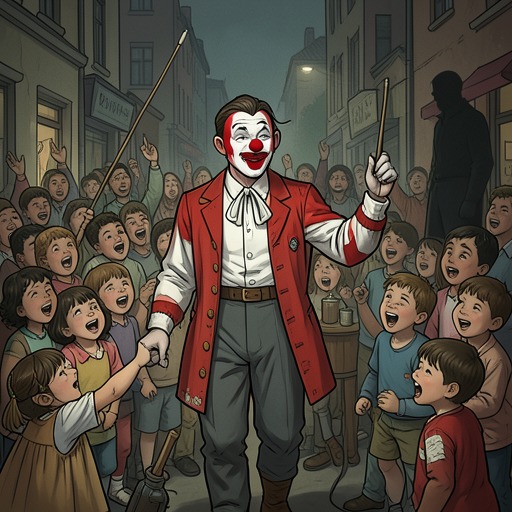
At Founder’s Day, Tucker appears in a clown costume and calls out to Quinn, promising that she will enjoy the show. Quinn recognizes his voice only after a moment: behind the mask, he is more high-energy than he had been in detention. His performance is not simply a disguise. The costume gives him room to amplify an exuberance already associated with him, while his failure to heed Mr. Vern’s ban shows that the school’s warning has not restrained his participation in the clown display.
Janet’s response underscores the social nature of this performance. Wearing a thin cardboard half mask shaped like Frendo, she remarks on Tucker’s enthusiasm in costume. Her comment treats his transformation as familiar enough to be amusing, even as the Founder’s Day setting makes the clown image part of a more unsettling public spectacle.
Fear and the Reversal of the Prank
Tucker’s confidence changes when he sees a clown on his laptop screen. The figure stands motionless on a welcome rug in the camera’s low-light image. Desaturation, the camera’s slight fisheye distortion, and the dark pom-pom buttons make Frendo appear ghostlike and grotesque; the mask’s painted smile catches a glossy glow. These details belong to Tucker’s mediated view of the image, not to a face he can read or a prank he can control.
The reversal is sharpened by the account of Tucker’s usual behavior: he loves pranking an unsuspecting person but hates being frightened himself. That contrast makes the laptop scene more than a generic scare. The prankster is now the watcher, held by an image that the camera distorts and that offers no explanation. His earlier ease in wearing Frendo’s likeness sits uneasily beside his fear when Frendo appears on the screen.
Death and Narrative Significance
In the attack, Tucker feels fingers pulling at his scalp, covered by bunchy white gloves. The gloves recall his own difficulty manipulating balloon animals while dressed as a clown: he could manage balloon swords, but little else. The remembered practical nuisance of the costume returns at the moment of violence, linking his clown performance to the physical details of his final scene without making the gloves a source of protection.
Tucker has his thumb poised over the green dial button on his phone when his head is jerked back and his skin pulled taut. A blade runs across his neck, and he dies. The account does not identify the attacker in this moment, so the scene’s significance rests on the abrupt reversal it confirms: the man who relished frightening others becomes helpless before a masked, gloved assailant. His death closes the gap between clowning as public performance and Frendo as a lethal presence.