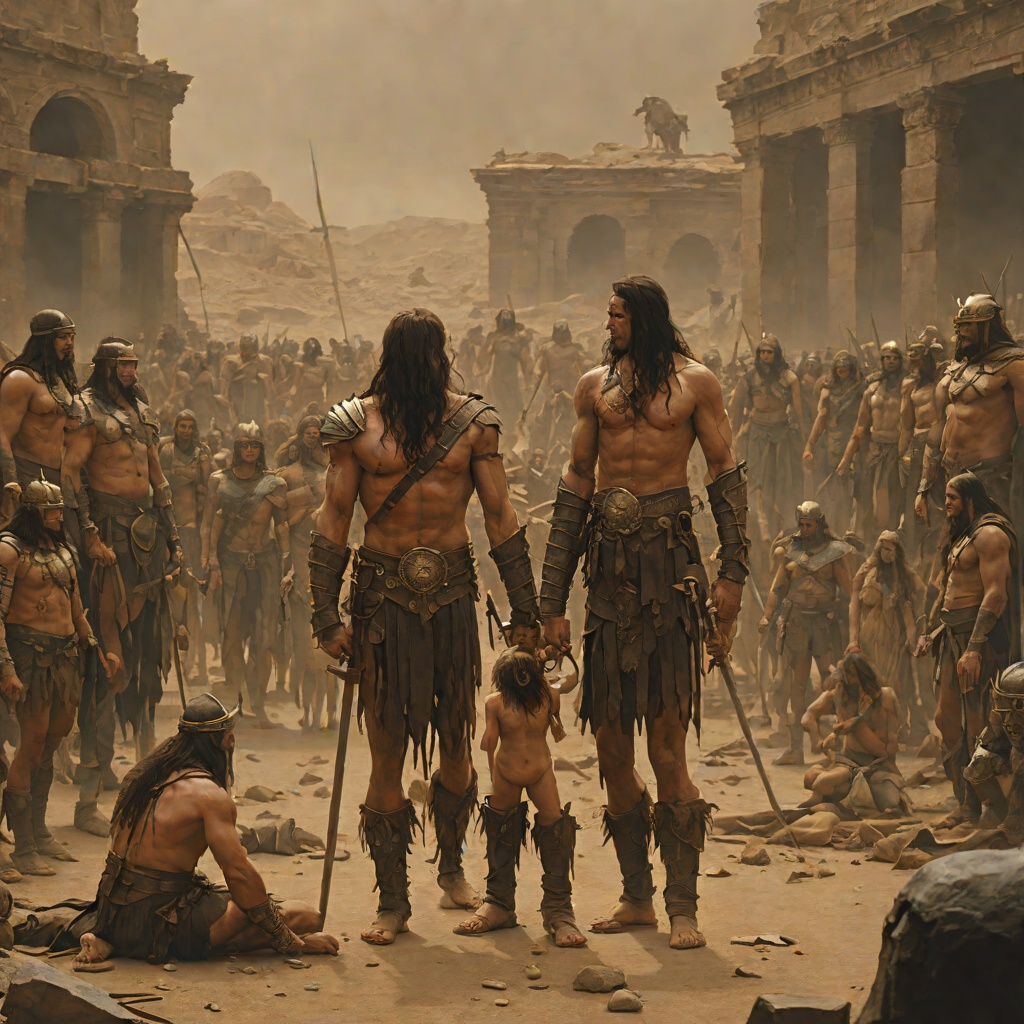
Blood and vengeance
Conan the BarbarianBlood and vengeance is the brief, stark funeral chant that Conan intones over the body of Valeria as he prepares to commit her to the flames on a funeral pyre beside the Vilayet Sea. The song, which the narrative identifies as a mournful Pit-fighter's song, runs only a few lines: "Blood and vengeance / My sword is singing / Through bone and flesh. / The way of the warrior / Is ever death." In these few words, the chant compresses the entire moral universe of the Cimmerian—a world in which blood is the currency of honor, vengeance the only response to loss, and death the inevitable terminus of every warrior's road. It is the book's most concentrated statement of its own ethos, spoken not as a battle cry but as a lament, and its placement at the moment of Valeria's cremation gives it the weight of a eulogy and a creed at once.
Origins in the Pit
The song's name and its imagery reach back to the earliest and most brutal phase of Conan's life. After the Vanir raiders swept down upon his Cimmerian village—iron-shod horses shattering the ice of the stream, lances thrust between the shoulders of fleeing mothers—the boy was herded with other captives through the palisaded gateway of Thrudvang and chained to the Wheel of Pain, a massive mill wheel turned by ragged, dull-eyed youths grinding grain beneath its ponderous weight. It was there, among slaves who had learned that suffering was the only constant, that the Pit-fighter's ethos was forged. The song's insistence that the way of the warrior is ever death is not abstract philosophy but the distilled lesson of a childhood spent pushing a groaning wheel in an eternal circle under the lash of the Master of the Wheel, who stood wrapped in greasy furs, hawk-like, watching for the laggard. The Pit-fighters who sang such songs were men who had learned, as Conan had, that life in the north lands is bleak, that the hand of every stranger is lifted in enmity, and that the only thing a man can count on is a blade of well-forged steel.
The Funeral Rite
The song is sung at the climax of Conan's grief, after Valeria has died and been carried to her pyre. The sun was a fiery ball low in the west when the last piece of driftwood was laid on the funeral pyre, which stood atop the largest mound amid the burial places of ancient warriors and kings, the slabs marking their resting places forming a guard of honor all around it. Thither Conan carried Valeria and gently laid her down; there in the rosy sunset, she looked very young, a child asleep. Subotai helped the old wizard up the slope with a lighted taper in his trembling hands, while Conan regarded his love with brooding eyes and slowly chanted the mournful Pit-fighter's song. The scene is deliberately composed as a ritual: the pyre atop the ancient burial mound, the guard of honor formed by the slabs of dead kings, the trembling taper, and the slow chant. Having bid Valeria a last adieu, the Cimmerian reached for the flaming torch and, stepping forward, touched the flame to the dry wood. The song is thus the bridge between the living and the dead, the words that carry Valeria into the fire even as they affirm that her death is not an aberration but the fulfillment of the warrior's contract.
The Warrior's Creed
The song's theology is one of acceptance rather than hope. Where the cult of Set promised its followers eternal life and bliss unutterable in the embrace of the Wise Serpent, and where Thulsa Doom taught that death was a boon to be conferred upon the infidel, the Pit-fighter's song offers no afterlife and no consolation. It simply states the terms of the trade: blood and vengeance are the warrior's elements, his sword sings through bone and flesh, and death is the way of the warrior. This is the creed that Conan carries from the Wheel of Pain to the throne of Aquilonia, and it stands in deliberate opposition to every doctrine he encounters. When the merchant in Shadizar warned him that the servants of Set worship Death, Conan was shocked—to him, Death was ever the enemy. Yet the Pit-fighter's song acknowledges death not as an enemy to be defeated but as a certainty to be met with a singing sword. It is the difference between the cult's necrophilic longing and the warrior's stoic embrace of his own mortality.
The Riddle Resolved
The song's final resonance comes at the moment of Conan's triumph over Thulsa Doom, when the severed serpent head of the cult leader rolls down the long flight of stairs to rest beside the fountain pool. Conan watched the gory object fall into the purple shadows of the dying day and spoke, half to himself: "My father was the light of day; Thulsa Doom, my night. Yet in one thing he spoke true. What matters is not the steel within the blade, but the steel within the man." The Pit-fighter's song is the earliest and most elemental form of that same insight—that the warrior's worth lies not in the weapon but in the will that wields it, and that the acceptance of death is the very thing that makes a man's steel true. Where Doom preached that steel was as naught compared to the hand that wields it, and that the hand was nothing without a mind to command it, Conan's song answers with a simpler and harder truth: the hand is nothing without a heart that has already made its peace with death. The song that began as a lament over Valeria's body ends as the unspoken creed that allows Conan to stand unshaken before the serpent-headed god and strike. In this sense, Blood and vengeance is not merely a funeral dirge but the book's answer to the Riddle of Steel—the recognition that the only thing harder than the blade is the man who has already accepted that he will die, and who sings of it as he swings.