Cimmeria
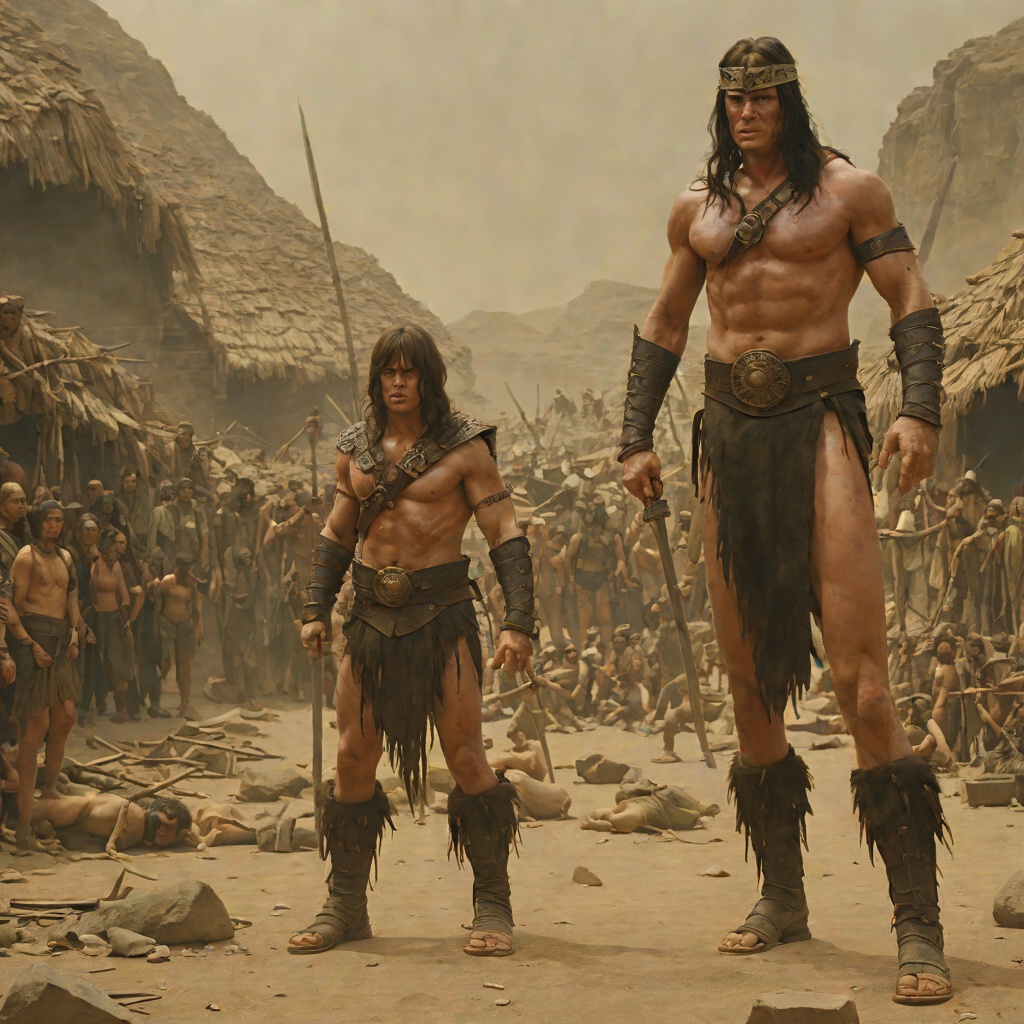
Conan the BarbarianCimmeria is the northern homeland of Conan, a bleak and unforgiving land whose very harshness forges the iron character of its people. It is a place of frozen dawns, leafless trees, and thin ice on streams, where life is harsh and the hand of every stranger is lifted in enmity against his fellows. The land itself is defined by its brutal climate and its isolation, a realm of snow and rock that produces a people as hard and unyielding as the iron they work. It is the starting point of Conan's journey and the source of the suffering that shapes his entire life, a homeland he leaves in chains and never sees again, yet which remains the moral and emotional foundation of his identity.
Geography and the Raid
Cimmeria is a land of stark, unforgiving beauty, described through the eyes of the young Conan as a place of gaunt crags of naked rock thrusting through mantles of wind-piled snow. The saw-toothed range of the Eiglophians looms before travelers like a row of white-robed giants against sapphire skies, a natural barrier between Cimmeria and the realms beyond. The land is crossed by streams that cut deep runnels in lingering snowdrifts, and its sparse soil supports only stunted trees that cling precariously to the rough land, their twisted forms looking to the boy like crooked gnomes. It is a land of tundra and reindeer herds, of marsh fowl and mournful cries, a place where survival itself is a constant struggle against the elements.
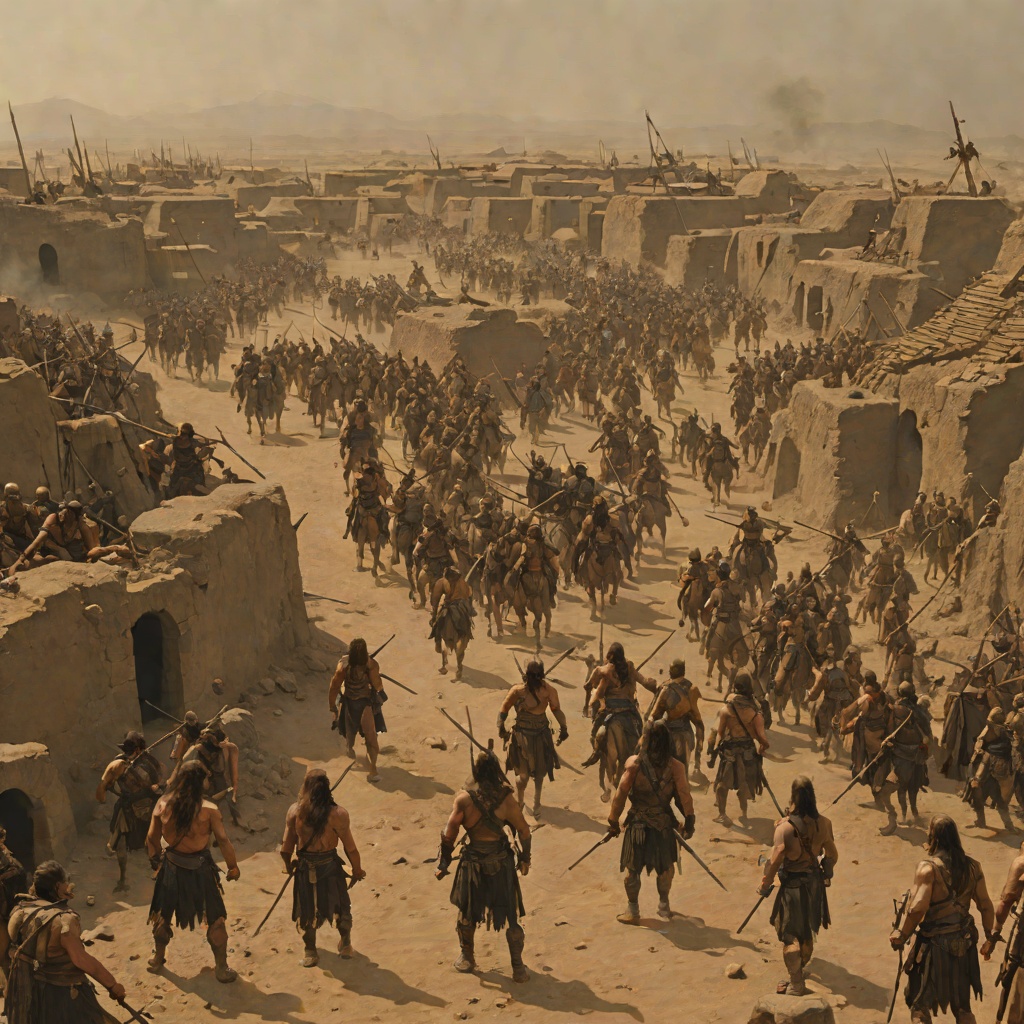
The defining event of Cimmeria's history in this tale is the dawn raid on Conan's village, a sudden and brutal assault that shatters the quiet of a frozen morning. Horsemen shod in iron crash through the bushes, their horses shattering the thin ice of the stream that parallels the village. Dark and grim, wearing leather armour scaled with iron, and holding axes, spears, and swords, the raiders sweep down upon the hamlet. The villagers, startled from their slumbers, emerge confused and disorganized, only to be met with slaughter. A woman shrieks as she snatches a toddler from beneath a horse's prancing hooves, only to be run through by a rider's lance, the spearhead bursting into view between her breasts before she is borne along like a rag doll. Corin the smith, Conan's father, roars "The Vanir!" as he plunges from his hut swinging his blacksmith's hammer, but the raid is overwhelming.
The raid is led not by the Vanir alone, but by two dark, towering men who are obviously not men of Vanaheim: the giant Rexor and his mysterious master, Thulsa Doom. Conan's mother Maeve falls without a cry, her severed head rolling in the mire at his feet, her pale face displaying neither fear nor shock nor pain, only a dreamy-eyed look of fascination. The boy, hate-filled, whips about and aims his knife at Doom's broad back, but the Vanir are upon him, dragging him into a snowdrift and wresting the knife from his grasp. The raid ends with the village plundered and put to the torch, the hot coals and ashes trampled under horses' hooves so that when spring thaws the earth, no evidence will remain that here had ever been a dwelling place of men.
The Road into Slavery
In the aftermath of the raid, the surviving Cimmerians are marched away as captives, a weary column chained one to another, trudging across an endless expanse of pristine snow shadowed by pines. The bedraggled line is a sad remnant of what had been a close-knit Cimmerian clan, the sole survivors of the dawn raid. Old men, women, and children, the ill-clad and the injured, slip and slide their way over ice-coated snows and rocky outcrops into slavery. The boy Conan staggers along, bent beneath the weight of his chain and chilled by the upland winds and the iron collar that clutches at his throat, his mind a turmoil of half-memories and uncomprehending dread. The journey into Vanaheim remains a dreamlike horror in his memory, a blurred montage of startling images: fur-clad riders whirling past, the grisly standard of tangled serpents and a black sun, an old man unchained from the line and speared with uncaring savagery, small red footprints left on the ice by the torn feet of barefoot children.
The captives are herded through the palisaded gateway of a Vanir town called Thrudvang, where the footsore thralls are driven like cattle through a clutter of stone houses half-buried in turf and roofed with thatch. The stronger and healthier among them are chained by rusty manacles to a massive wheel whose spokes are stout logs polished smooth by the pressure of human hands, a wheel that turns one enormous millstone upon another, grinding grain to powder. To this Wheel of Pain, as the slaves come to call it, Conan is chained beside other ragged, dull-eyed youths and men from lands unknown or rarely mentioned in Cimmeria. The captive women and girl-children of his village are led away to face a different, perhaps even uglier fate, and Conan never hears of them again. The Master of the Wheel, a burly, swarthy man who seems to the labouring children to be an ogre, stands on the incline above the shallow pit, watching hawk-like to detect the laggard or the indolent, and only springs into action when an exhausted boy falls to his knees, laying crimson welts on pitiful shoulders with a vicious rawhide whip until the whimpering wretch staggers to his feet to toil once more.
Language, Knowledge, and the Cimmerian Mind
Despite the crushing toil, Conan's mind remains free, free to soar like the marsh fowl on wings of hope. Nurtured by the fires of rage, a new-found pride, and the courage to endure, he grows into a man, his body gaining the strength and flexibility which soft iron gains when it is heated in the furnace and pounded by the hammer of the smith. Having an aptitude for languages, Conan learns to speak fluent, if accented, Vannish and picks up a smattering of Aquilonian and Nemedian from his fellow captives. Otherwise his mind sleeps, save when it gnaws like a hungry wolf on the thought of revenge. He might have learned more had he drawn out his shed-mates, but he is a taciturn youth who asks for no companionship and offers none. In the fullness of his years, King Conan reflects on this as an error, noting that his fellow captives might have taught him to write their tongues had he encouraged them, for he did not dream that some day he should need that skill, as they knew naught of letters in Cimmeria. "Knowledge should be grasped wherever it lies," he tells his scribe, "for it is a jewel beyond price."
The Cimmerian code is one of self-reliance and stoic endurance, a code that forbids weeping and demands that a man face his fate with grim resolve. Conan's prayer to Crom, the grim god of his people, reflects this ethos: Crom is a god who gives a man strength at birth and then abandons him to his own devices, caring nothing for his fate. This is a worldview shaped by the bleakness of Cimmeria itself, a land where suffering is the norm and strength is the only virtue that matters. The Cimmerian villagers do not steal from one another, although they freely raid the lands of clans with whom they are at feud, a distinction that shapes Conan's own moral code when he later encounters the thieves of Zamora.
Cimmeria's Absence and Conan's Identity
Cimmeria functions in the narrative less as a place Conan returns to than as an absence that defines him. After his enslavement, he is sold to Toghrul, a pit master from Hyrkania, and begins a life of wandering that takes him far from his homeland. He travels to Shadizar of Zamora, the crossroads of the world, a city of thieves and rogues that surpasses anything he has ever seen, and he marvels that so many could dwell crowded together without turning on one another to rend and slay like savage beasts. The contrast between Cimmeria's stark simplicity and Zamora's decadent complexity is a constant theme, with the barbarian's homeland representing a kind of natural authenticity against the corruption of civilization. Yet Cimmeria itself is never revisited; it exists only in memory, in the pain of its loss, and in the vengeance that loss demands.
Conan's identity is inseparable from his Cimmerian origins. He introduces himself as "Conan, a Cimmerian, a man-slayer by profession, a thief from necessity," and his people's code of blood and vengeance drives his entire quest against Thulsa Doom. When he finally confronts Doom at the Mountain of Power, he speaks of his father as "the light of day" and Doom as "his night," acknowledging that the man who destroyed his homeland also shaped him. The final beheading of Thulsa Doom is not a return to Cimmeria but a completion of the cycle that began there, a settling of the debt incurred on that frozen dawn. Cimmeria remains a place of origin and loss, a homeland that exists only in the memory of its last survivor and in the steel of the man it forged.