Crom
Conan the BarbarianCrom, the Father of Gods, is the supreme deity of the Cimmerians, a god of frosts, stars, and storms who rules over earth, heaven, and the broad and restless sea. Unlike the gods of other peoples, Crom is not a benevolent or intervening presence; he is aloof in his high heaven, indifferent to the needs and prayers of mortals. This distant, unyielding nature defines the Cimmerian worldview and shapes the life of Conan, the story's hero, from his earliest childhood to his final battle. Crom's significance lies not in his active involvement in human affairs, but in the philosophy he embodies—a philosophy of self-reliance, suffering, and the forging of strength through adversity, which becomes the moral and spiritual core of Conan's character.
The God of Frosts and Stars
Crom is introduced in a moment of profound ritual and teaching. On a rocky ridge swept clear of snow, during a violent storm, Conan's father, Corin the smith, draws an enormous two-handed sword and chants an ancient rune spell, thrusting the blade into the heart of the tempest. He proclaims that fire and wind are born in the womb of the heavens, the children of the sky gods, and that the mightiest of these is Father Crom, who rules earth and heaven and the sea. Corin explains that Crom is the master of many secrets, but the greatest of these is the secret of steel, a secret the gods did not teach to men but jealously guarded in their inmost hearts. This revelation establishes Crom not merely as a tribal god but as the keeper of a fundamental cosmic mystery, one that is intimately tied to the nature of humanity and the material world.
The god's character is further defined by his relationship to the natural world. He is a god of frosts and stars and storms, not of humankind. This description, given by Conan's mother Maeve during the Vanir raid on their village, underscores his elemental and impersonal nature. When the young Conan murmurs "Crom help us!" as the raiders approach, Maeve gives him an icy glance and corrects him: "Crom does not heed the prayers of men. He scarcely hears them." This moment is crucial, as it teaches Conan early that his god is not a protector or a source of comfort, but a distant, indifferent force of nature. The god's power is real, but it is not directed toward the salvation or aid of his worshippers.
The Riddle of Steel and the Cimmerian Code
Crom's most significant role is as the source of the "riddle of steel," a concept that permeates the entire narrative. Corin teaches his son that the secret of steel was stolen from Crom by the giants, who dwelt within the earth and were crafty and wise, the fashioners of stone and wood, the miners of gems and gold. By their wiles, they befooled even Crom and stole from him the most precious possession of the immortals: the secret of the silvery metal that, when bent, springs into shape again. This myth explains the origin of steel as a divine gift, wrested from the gods, and it elevates the metal to a sacred status. Corin warns Conan that men are not gods or giants, but mortals, weak and foolish, and that their days are numbered. He instructs his son to be wary of steel and to hold it in respect, for it carries within it a mystery and a power.
The lesson culminates in the central tenet of the Cimmerian code. Corin tells Conan that before a man is worthy to bear a sword of steel in battle, he must learn its riddle and understand the ways of steel. He imparts the crucial wisdom: "Know that in all the world you can trust no one, neither man nor woman nor beast, neither spirit nor demon nor god. But you can trust a blade of well-forged steel." This statement is a direct commentary on Crom's nature. Since Crom is indifferent and cannot be trusted to help, the only reliable thing in the world is the steel one forges and wields oneself. Corin further explains that the heart of a man is like a piece of unworked iron, which must be hammered by adversity and forged by suffering, purged and hardened in the fires of conflict, and purified and shaped on the anvil of despair and loss. Only when the heart has become as steel will a man be worthy to wield a keen-edged sword and win against his enemies. This philosophy, rooted in the nature of Crom, becomes the foundation of Conan's identity and his approach to life.
Conan's Prayer and the Rejection of Divine Aid
Conan's relationship with Crom is characterized by a profound and deliberate distance. He tells the Hyrkanian thief Subotai that his people seldom pray to Crom, and that he himself never does. He describes Crom as aloof in his high heaven, indifferent to the needs and prayers of mortals. When Subotai asks if Crom rewards sins with punishments, Conan chuckles and replies, "He cares not about the sins of puny men." This exchange reveals that Conan has fully internalized the lesson of his father and mother: Crom is not a moral arbiter, not a source of justice, and not a being who intervenes in the lives of individuals. He is a force of nature, as impersonal as the frost and the stars he commands.
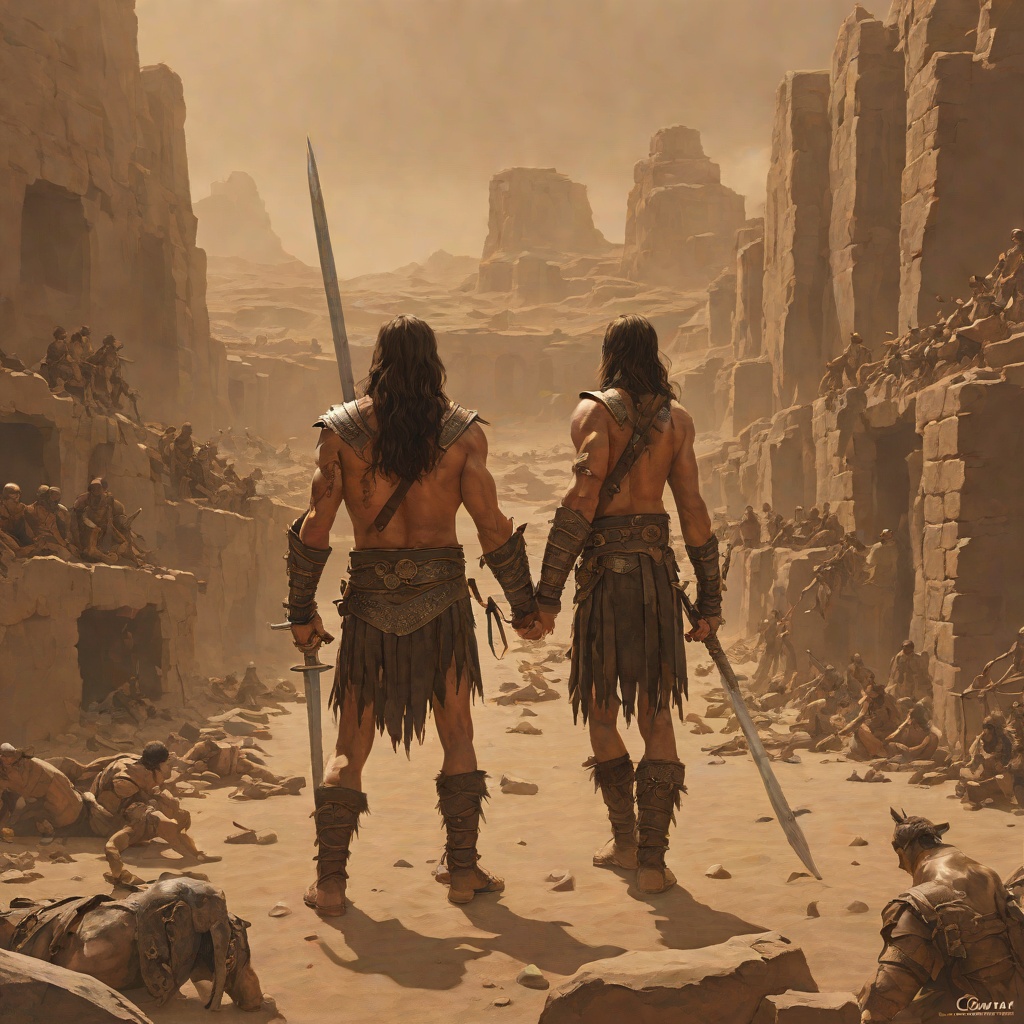
Despite this, Conan does turn to Crom in a moment of extreme crisis. On the eve of the final battle against Thulsa Doom's forces, facing almost certain death, Conan breathes a rare supplication. He acknowledges his lack of a tongue for prayer and states that the outcome of the battle does not matter to Crom, nor will Crom or any other remember why they fought or how they died. However, he appeals to Crom's nature: "But valour pleases you, Lord Crom, and to me it is important. This night three brave men stand against many—that you may remember." He asks for one thing alone: revenge before he dies. This prayer is not a plea for salvation or intervention, but a request for a personal quality—courage and the opportunity for vengeance. It is a prayer that aligns with Crom's character, asking not for the god to act, but for the god to witness and to value the valour of the men who fight. It is a final affirmation of the Cimmerian code: a man must rely on his own strength and steel, and the only thing he can offer his god is his courage.
The Triumph of the Man over the God
The ultimate significance of Crom is revealed in the story's climax, where the philosophy of steel and self-reliance triumphs over the false divinity of Thulsa Doom. Doom, the charismatic leader of the Cult of Set, presents himself as a god-like figure, demanding absolute obedience and demonstrating his power through horrific acts. In the garden demonstration, he commands a young girl to leap to her death to prove the strength of his will, declaring, "That is strength, boy—that is power! It is strength against which the hardness of steel or the resilience of human flesh are as naught. What is steel, compared to the hand that wields it; what is the hand, without a mind to command it?" This is a direct challenge to the Cimmerian philosophy of steel, arguing that the mind and will are superior to any material. Doom's power is charismatic and magical, a form of re-enchantment that offers his followers a false sense of purpose and belonging.
Conan's final victory over Doom is a vindication of Crom's philosophy. When Doom reveals his true nature, transforming into a serpent-headed monster, Conan's sword sweeps up in a great arc and cleaves the snake head from the human body. As the severed head rolls down the steps, Conan speaks his final judgment: "My father was the light of day; Thulsa Doom, my night. Yet in one thing he spoke true. What matters is not the steel within the blade, but the steel within the man." This statement reinterprets Doom's earlier taunt, affirming that the true power lies not in the material blade, but in the character, courage, and will of the man who wields it. This is the essence of the Cimmerian code, the lesson of Crom. The god does not intervene, does not grant victory, and does not reward faith. Instead, he represents the ideal of self-forged strength, the belief that a man must hammer his own heart into steel through suffering and adversity. Conan's victory is not a divine miracle but a testament to the strength he has built within himself, a strength that is the only true answer to the indifference of the gods. In this way, Crom, though absent and silent, is the ultimate spiritual force of the narrative, shaping the hero's journey and defining the meaning of his triumph.