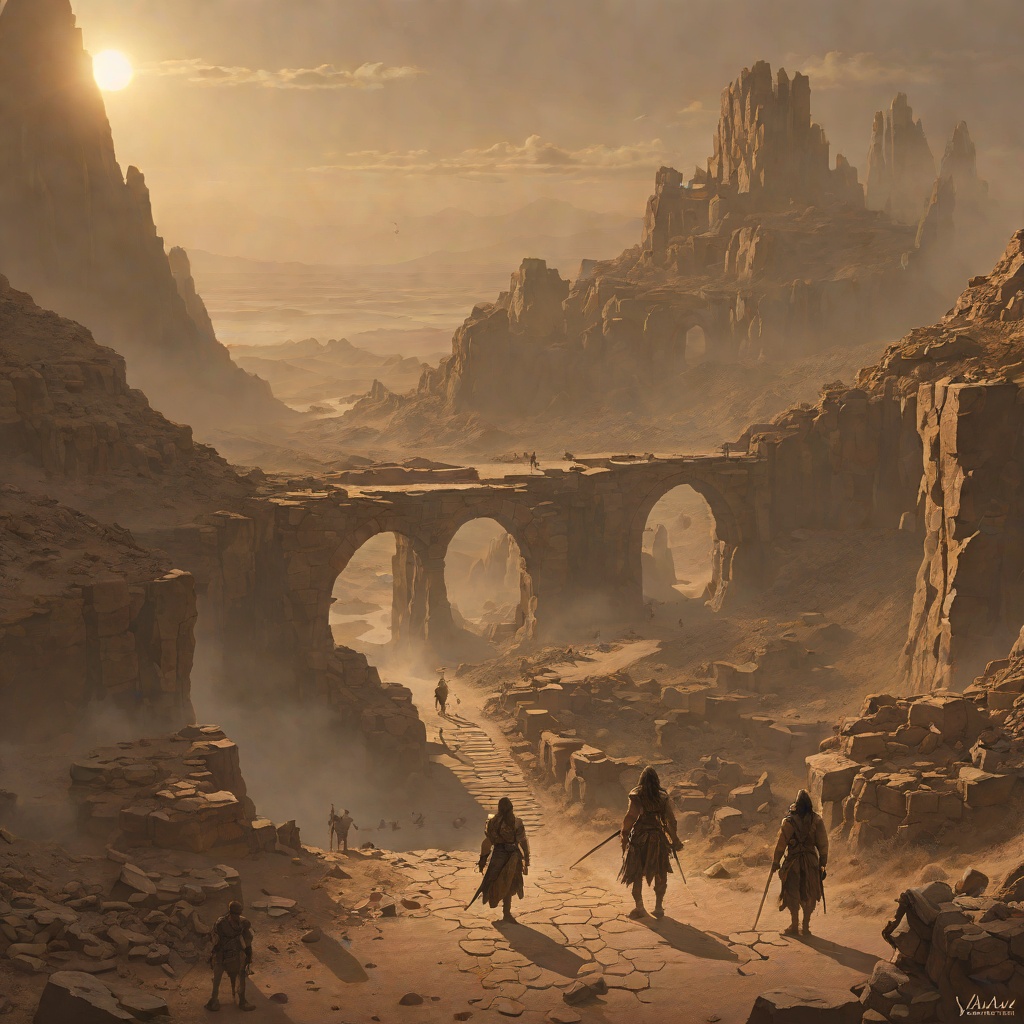
Do you want to live forever
Conan the Barbarian“Do you want to live forever?” is a question that haunts Conan's journey from the slave-pits of the Nordheimers to the final confrontation with Thulsa Doom. It is first spoken by Valeria, the thief and warrior who becomes Conan's lover, during their desperate climb up the Tower of the Black Serpent. The words are not merely a taunt but a challenge—a distillation of the Cimmerian worldview that values a single moment of fierce, meaningful combat over an eternity of cowering survival. The phrase recurs at the story's climax, when Valeria's ghost returns from the dead to fight beside Conan, and it ultimately becomes a measure of how deeply the barbarian has internalized the lesson his father taught him about steel, suffering, and the human heart.
Origins and the Father's Teaching
The question's philosophical roots lie in the night Conan's father, Corin, the Cimmerian smith, imparted the riddle of steel to his young son. On a lightning-riddled night, Corin curled the boy's fingers about the hilt of the great sword and told him that the heart of a man is like a piece of unworked iron—it must be hammered by adversity, forged by suffering, and hardened in the fires of conflict until it becomes as steel. Only then, he said, would Conan be worthy to wield a keen-edged sword in battle and win against his enemies, as the gods did when they conquered the dark giants. The father's words carried a stark corollary: in all the world, a man can trust no one—neither man nor woman nor beast, neither spirit nor demon nor god—but he can trust a blade of well-forged steel. This doctrine of self-reliance through suffering is the soil from which the question grows. When Valeria later asks Conan if he wants to live forever, she is not offering him immortality; she is reminding him that the only life worth living is one spent in the active, violent assertion of the will, even at the cost of death.
The First Utterance: The Tower of the Black Serpent
The phrase enters the story during the raid on the Tower of the Black Serpent, when Conan, Valeria, and Subotai are scaling the tower's sheer wall in darkness. Conan begins the ascent with a grunt, and Valeria clambered after him, her slender body moving up the wall with effortless agility. Laughing, she looked over her shoulder at the labouring Hyrkanian and asked, “Do you want to live forever?” The question is delivered with a mocking, almost flirtatious energy, contrasting her catlike grace with Subotai's laboured climb. The Hyrkanian, burdened by his quiver and bow case, mutters that the woman climbs like a cat and spits like one, too. The moment captures Valeria's character—fearless, taunting, and utterly at home in mortal danger—and it establishes the phrase as her signature challenge to Conan's own recklessness. The question is not an invitation to seek eternal life but a dare to embrace the present danger fully, to live so intensely that the fear of death becomes irrelevant.
The Echo: Valeria's Ghost at the Battle of the Burial Mounds
The question returns at the Battle of the Burial Mounds, when Conan, wounded and disarmed, faces the giant lieutenant Rexor. As Rexor charges for the killing blow, a radiant Valeria appears beside her helpless lover, arrayed in shimmering armour with lustrous blonde hair floating beneath a winged helmet of unearthly metal. Her well-muscled limbs shine in the moonlight, and the tulwar she uplifts flashes with blue lightning. She stays Rexor's arm with her fiery sword and whips her blinding blade across his unguarded eyes, leaving him transfixed. Conan gapes at the shining figure, his nape-hairs bristling with superstitious awe, and in his mind he hears her say, “Cimmerian, do you want to live forever?” The question is now spoken not in mockery but as a summons—a call to rise, to fight, to refuse the easy surrender of death. The apparition fades, leaving only a ghostlike glory glimmering against the sky, but the memory of Valeria's whispered words—"My love is stronger than death... Were I dead and you in peril, I would return from Hell itself to fight beside you"—gives the wounded barbarian a generous measure of pride. He painfully makes his way to Rexor's horse, slips the giant's foot from the stirrup, and forces him from the saddle, slapping the horse's rump so it careens away into the darkness.
The Cimmerian Ethos and the Rejection of Death
The question also illuminates Conan's fundamental stance toward death, which he has always regarded as the enemy. When a merchant warns him that the servants of Set worship Death, Conan is shocked—to him, death is ever the foe. This instinctive rejection of death as a thing to be courted or worshipped stands in direct opposition to the Cult of Set and its doctrine, which treats death as a boon to be conferred even upon one's own parents. The question “Do you want to live forever?” thus carries a double edge: it mocks the coward who clings to life, but it also rejects the death-cultist who embraces oblivion. The true answer, in Conan's code, is neither—one lives fully, fights fiercely, and accepts death when it comes, without seeking it and without fearing it. This is the same spirit that made the Pit fighter's life bearable: to face an adversary and kill him was to enjoy, for a fleeting moment, the illusion of freedom, to be a whole man again after the dehumanizing torment of the Wheel of Pain.
The Question as a Bond of Love and Grief
Finally, the phrase becomes a private language between Conan and Valeria, a bond that survives even her death. When Valeria falls, Subotai weeps for her, explaining to the shaman that she was a friend to him but everything to Conan—and because Conan is a Cimmerian and must not weep, Subotai weeps in his stead. The question Valeria asked in life and repeated in death is thus woven into the fabric of their love, a love that Conan's father's teaching said he could never trust. Yet Valeria's return from Hell itself to fight beside him proves that some bonds transcend even the riddle of steel. The question, in the end, is not about literal immortality but about the kind of love and courage that makes a man willing to die—and, more importantly, willing to live—for something greater than himself. It is the Cimmerian answer to the cult of death: a defiant affirmation of life, fought for at the point of a sword.