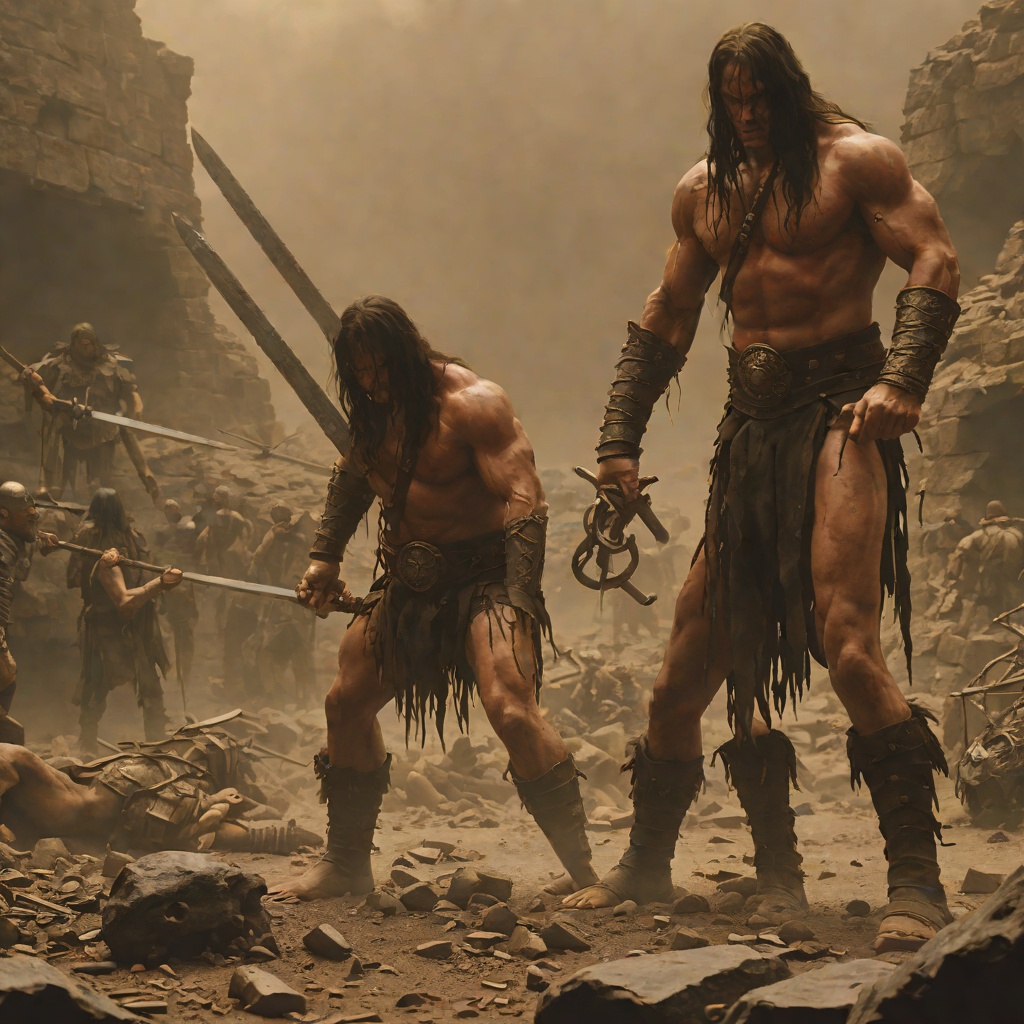
Out of suffering is born strength
Conan the BarbarianOut of suffering is born strength is the philosophical cornerstone of the Conan saga, a doctrine first spoken by Corin the smith to his young son on a night of storm and incantation. It is the principle that a human heart, like a piece of unworked iron, must be hammered by adversity, forged by suffering, and hardened in the fires of conflict before it can become worthy of wielding a keen-edged sword. This belief, passed from father to son, becomes the lens through which Conan interprets every trial of his life, from the brutal enslavement of his youth to the final, climactic confrontation with his father's murderer. The phrase is not merely a motto but a lived reality, a creed that transforms pain into power and loss into strength, and it ultimately finds its fullest expression in Conan's own words after he beheads Thulsa Doom: what matters is not the steel within the blade, but the steel within the man.
The Forging of the Doctrine
The doctrine is first articulated in the forge of Corin the smith, on a night when lightning riddled the sky and the boy Conan watched, open-mouthed, from the doorway. His father, a blacksmith who drove the bellows tirelessly and hammered white-hot iron on his anvil, cupped his son's small hands within his own and curled the boy's fingers about the hilt of a great sword. He spoke of the heart of a man as a piece of unworked iron, which must be hammered by adversity and forged by suffering and the challenges flung by the thoughtless gods, nigh unto the point of breaking. It must be purged and hardened in the fires of conflict, purified and shaped on the anvil of despair and loss. Only when the heart has become as steel, he said, would Conan be worthy to wield a keen-edged sword in battle and win against his enemies, as did the gods when they conquered the dark giants. The father also warned his son that in all the world he could trust no one, neither man nor woman nor beast, neither spirit nor demon nor god, but that he could trust a blade of well-forged steel. All his life, Conan remembered those words, spoken by his sire on that lightning-riddled night, and in time he began to comprehend the cryptic phrases, understanding that out of suffering is born strength and that only through pain and deprivation does a human heart become as strong as steel. But many and long were the years that passed before this wisdom became fully his.
The First Lessons in Suffering
Even upon the heels of that wild night of storm and incantation, Conan came to learn his first lesson in suffering, a lesson that was cruel and far too early for so young a child. The north lands are bleak, life therein is harsh, and the hand of every stranger is lifted in enmity against his fellows. The quiet of a frozen dawn was fractured by the clamour of horsemen who crashed through the bushes, their horses shod in iron shattering the thin ice of the stream that paralleled the village. Dark and grim, wearing leather armour scaled with iron, and holding axes, spears, and swords, the raiders swept down upon the hamlet. Corin the smith roared "The Vanir!" as he swung his blacksmith's hammer and plunged from the mouth of his hut. The boy Conan witnessed his mother Maeve fall without a cry, her severed head rolling in the mire at his feet, her pale face displaying neither fear nor shock nor pain, only a dreamy-eyed look of fascination. As the day faded, a weary column of captives, chained one to another, trudged across an endless expanse of pristine snow, the sole survivors of the dawn raid. Far behind them, smoke stained the sky as the Vanir put all buildings to the torch, trampling the hot coals and ashes under their horses' hooves so that when spring thawed the earth, there would exist no evidence that here had ever been a dwelling place of men. The boy Conan staggered along, bent beneath the weight of his chain, chilled by the upland winds and the iron collar that clutched at his throat, his mind a turmoil of half-memories and uncomprehending dread.
The Wheel of Pain and the Pit
The captives were herded through the palisaded gateway of a Vanir town called Thrudvang, where the stronger and healthier among them were chained by rusty manacles to a massive wheel whose spokes were stout logs, polished smooth by the pressure of human hands. This wheel turned one enormous millstone upon another, grinding grain to powder, and to this Wheel of Pain, as the slaves came to call it, Conan was chained beside other ragged, dull-eyed youths and men from lands unknown. The Master of the Wheel, a burly, swarthy man who seemed to the labouring children to be an ogre, stood on the incline above the shallow pit, wrapped in his greasy furs, watching hawk-like to detect the laggard or the indolent. Only when an exhausted boy fell to his knees did he spring into action, his vicious rawhide whip laying crimson welts on pitiful shoulders until the whimpering wretch staggered to his feet to toil once more. The gruelling torment of the Wheel dehumanized Conan, but it was followed by a new ordeal that paradoxically restored something of his manhood. Sold to Toghrul, a pit master from Hyrkania who travelled with his troupe staging fights for the amusement of local chieftains, Conan became a Pit fighter, a man-slayer battling for his life to feed the blood lust of the Nordheimers. The life of a Pit fighter was not quite the worst of lives, Conan grimly discovered, for to face an adversary and kill him was to enjoy, for a fleeting moment at least, the illusion of freedom, to be a whole man again. The fierce battles of the Pit restored something of manhood and self-love, and even more intoxicating than the strong ale and generous portions of food were the frenzy of the audience and the adulation of the crowd. When a Hyrkanian general asked the young barbarian what was the best of life, Conan's mouth twitched in a shadow of a smile as he replied that it was to confront your enemy face to face, to see his hot blood spill upon the earth, and to hear the lamentations of his women. The general approved, warning Toghrul that the Pit had not broken the spirit of his champion, and that he should beware lest this young tiger some day turn and rend him.
The Journey and the Woman
After years of toil, Conan's path led him to a woman whose passion and cryptic message set him on a new course. In a moment of intense desire, she whispered to him that in Shadizar of Zamora, the crossroads of the world, he would find that which he sought, but that he would be a fool to go, for only fools seek their own death. The journey to Shadizar was long and weary, across the vast emptiness of the firmament and the seldom-travelled track that snaked across the flat prairie and the rondure of patient hills. Conan strode through this empty land with a measured pace that devoured the leagues, often running with the Hyrkanian Subotai pounding at his side. In Shadizar, he met Valeria, a woman who became his lover, and together they shared a bed of passion. But when dawn tiptoed into Shadizar, turning the spires of the royal palace into rose and gold, Valeria awoke to find that Conan was gone, leaving behind only a handful of glittering stones, his share of the king's advance payment. A tear rolled down her cheek and was instantly wiped away, for pit fighters don't cry. Far to the east, a lone rider picked his way through a pass in the Kezankian Mountains, clad in fine raiment with a tunic of mesh-mail, a steel cap on his head, and the ancient sword he had taken from the cave of the grinning skeleton, now whetted to a razor edge and thrust into a splendid scabbard of reptile skin. Remembering the past, he rubbed the coarse black beard that shadowed his scarred face, for Toghrul had compelled his fighters to shave, but now, eager to come to grips with Doom, he had ignored the practice. He remembered, too, the lovely woman from whose encircling arms he had departed, knowing that Valeria would never understand, for her gods were not the northern gods. He turned east, but bowed his head to Valhalla, knowing that Crom awaited his vengeance upon his enemies with calm indifference, and that his life hung on a slender thread.
The Culmination of the Doctrine
The doctrine of suffering-born strength reaches its ultimate expression in the final confrontation with Thulsa Doom. Before the frozen faces of the faithful, Doom's neck lengthened, his jaws elongated, his nose shrank and disappeared, his forehead retreated, his lips thinned and vanished, and his dark eyes rounded into lidless orbs as a purple tongue flicked out to test the air. Thulsa Doom bore the scaly serpent head of the ancient snake-men, those timeless enemies of all mankind. As one, the congregation gasped, and the princess, watching from the shadows, uttered a half-choked cry as tears of pity, mixed with horror and relief, coursed down her cheeks. Conan's sword sighed as it swept up in a great arc and clove the swaying snake head from the human body. The body fell backward and lay, writhing, like a trampled serpent, at the top of the wide steps, while the severed head rolled slowly down the long flight of stairs and came to rest beside the fountain pool. Conan watched the gory object fall into the purple shadows of the dying day, and then, half to himself, he spoke: "My father was the light of day; Thulsa Doom, my night. Yet in one thing he spoke true. What matters is not the steel within the blade, but the steel within the man." In this moment, the doctrine that began as a cryptic lesson in a forge is fully realized: the suffering of a lifetime, the loss of his parents, the years of slavery, and the battles of the Pit have all forged Conan's heart into steel, making him worthy to wield the sword and to triumph over the serpent-headed sorcerer. The strength born of suffering is not merely physical prowess but a spiritual and moral hardening that allows Conan to face the ultimate evil and prevail, fulfilling the prophecy of his father that only when his heart had become as steel would he be worthy to win against his enemies. The doctrine thus stands as the philosophical backbone of Conan's entire journey, transforming a tale of revenge into a meditation on the nature of strength, suffering, and the human soul.