Raid on the Cimmerian village
Conan the BarbarianRaid on the Cimmerian village is the decisive catastrophe at the beginning of Conan’s life. A disciplined Vanir force descends on a northern Cimmerian settlement at dawn, overwhelms its poorly equipped defenders through cavalry, hounds, and archery, and turns a close-knit community into a field of corpses. Conan witnesses the deaths of his mother Maeve and father Corin, survives only because the raiders seize him, and is carried into slavery. The raid therefore functions not merely as an isolated massacre but as the violent threshold through which his childhood, family, homeland, and freedom are all taken from him.
The Vanir Assault
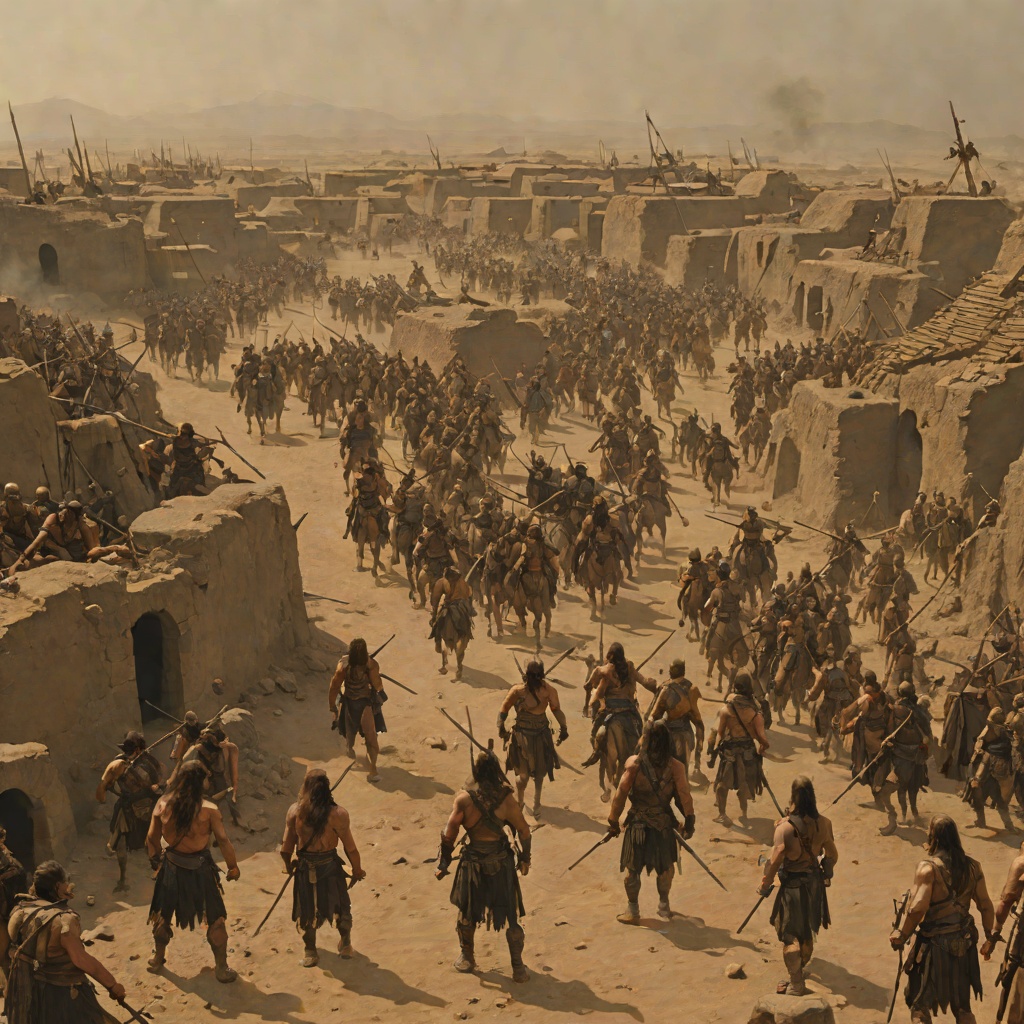
The attack begins after a night of storm and incantation, when frozen dawn has barely displaced the darkness. Horsemen crash through the bushes and shatter the thin ice of the stream beside the village. Wearing leather armor scaled with iron and carrying axes, spears, and swords, the raiders sweep into the hamlet with the advantages of surprise, mounts, armor, and organization. The villagers awaken confused and disordered, emerging from their huts in coarse woolens and clutching whatever weapons or tools they can find.
The assault immediately becomes indiscriminate slaughter. A woman trying to pull a toddler away from a prancing horse is speared from behind, and the rider drags the lance free only after carrying her forward on it. A terrified young girl is pulled down by a black hound and has her throat torn out before Conan’s eyes. These scenes establish that the raid is aimed at the destruction and subjugation of the settlement rather than at a formal contest between equal military forces. The villagers’ cries, the horses’ hooves, and the clank of iron merge into a single landscape of panic.
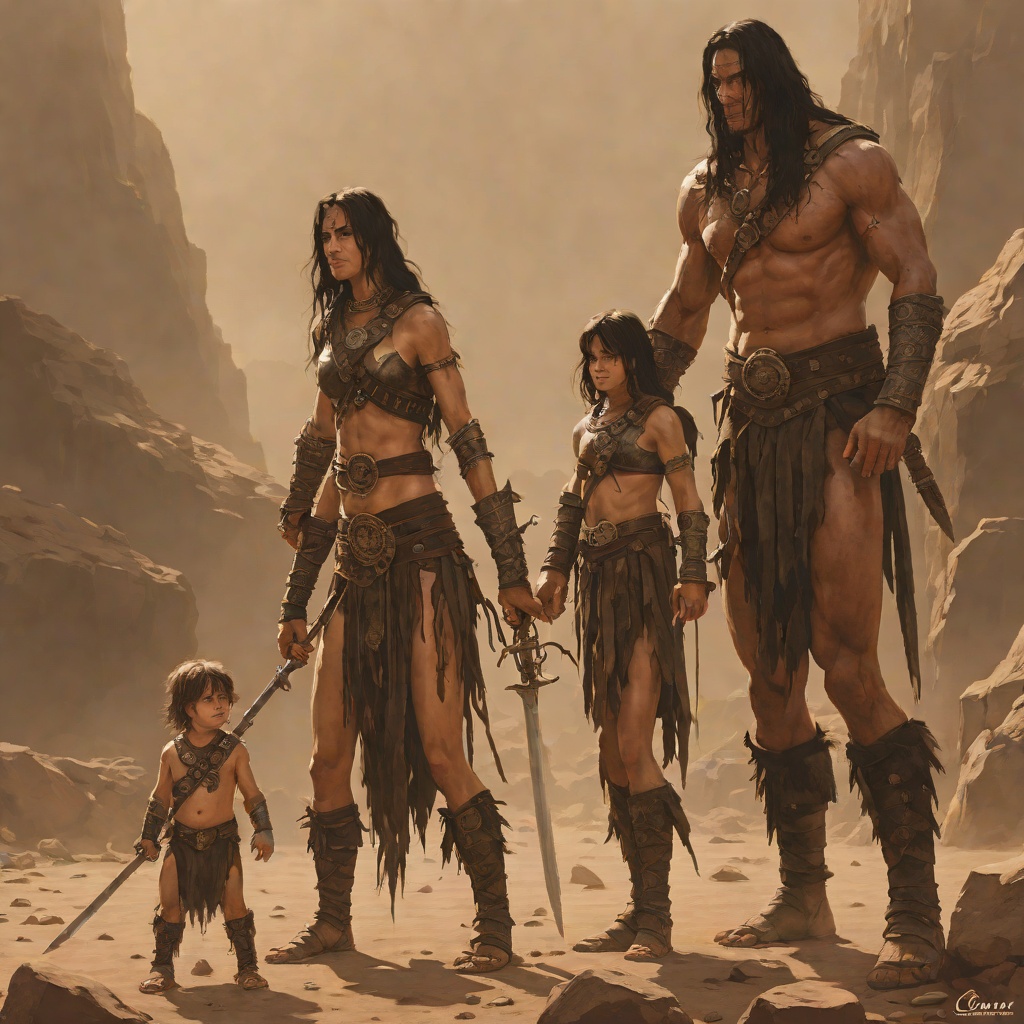
Corin the smith attempts to impose resistance on the chaos. He emerges from his hut with his blacksmith’s hammer and fights the mounted invaders, while a naked Cimmerian hunter enters the struggle with a huge axe and cuts a raider’s leg away. Other Cimmerians gather around Corin, but their defense is desperately unequal. Some possess retrieved weapons; others carry hoes and rakes. Their shields are made from boiled hides stretched over wooden frames and provide little protection against the weight and reach of Vanir iron. The contrast between improvised village resistance and trained mounted violence determines the battle before it is fully joined.
Collapse of the Defenders
Corin’s great sword briefly gives the defenders a terrifying advantage. The ensorcelled blade flashes like frozen lightning and cuts through the Vanir line, sending armored raiders from their mounts with their entrails spilling across the muddy snow. Conan, shaking off his first paralysis of fear, seizes a fallen knife and tries to fight beside his father. Though the press of men is too thick for him to cut his way through, he hamstrings a towering warrior, who then stumbles into Corin’s sweeping stroke. The man’s head is severed and lands in the mud at Conan’s feet, making the child a direct witness to killing even before the battle has ended.
The invaders regain control through coordinated weapons rather than individual heroics. Their arrows strike huts, shields, and unprotected bodies until the Cimmerian shield-wall sags and crumbles. The Vanir commander, a gigantic dark figure on a hillock, orders the hounds released and then commands another volley from the archers. The dogs break the defenders’ formation by forcing men to turn from the horsemen and arrows, while the second rain of shafts finishes the surviving resistance.
Corin’s death is presented as the destruction of the village’s last center of defiance. Standing alone, his shield bristling with arrows, he is struck in the upper thigh and falls into the frozen slush. One hand crawls toward the great sword, but an arrow pins it to the ground before the dogs reach him. The battle is then over almost as quickly as it began. The brief resistance has not saved the village; it has only made the scale of its defeat visible.
Maeve, Doom, and Conan’s Loss
The raid’s personal climax occurs when Thulsa Doom approaches the surviving Cimmerians. The Vanir chant his name as a portent and a threat, while Doom moves among armed men in serpentine mail, studying Corin’s splendid sword with apparent fascination. His attention turns to Maeve, who raises her broadsword and prepares to attack. Yet Doom’s presence arrests her action. He removes his jeweled helm, reveals a lean, darkly handsome face, and fixes her with a gaze that combines admiration, menace, and supernatural domination.
Doom walks within the range of Maeve’s weapon as though danger cannot touch him. Maeve remains motionless, fascinated and repelled, while the raiders continue to call his name. Once past her, Doom raises the great sword with effortless-looking skill and strength. The stroke severs her head without a cry. Conan watches her head roll into the mire, her face retaining an expression of fascination rather than fear or pain.
Maeve’s murder transforms the raid from a communal disaster into Conan’s defining personal wound. Filled with hatred, he turns and aims his knife at Doom’s back, but the Vanir seize him and drag him into a snowdrift. The child’s first impulse after witnessing his mother’s death is immediate vengeance, yet the same military force that destroyed the village also prevents him from acting. His capture fixes the central pattern of his later life: survival is inseparable from resistance, and resistance repeatedly takes the form of violence against those who have imposed power upon him.
Captivity and the Wheel of Pain
At day’s end, the survivors are no longer a village but a weary column of captives chained together across the snow. Old men, women, and children, ill-clad and injured, move through the frozen landscape as the remnants of a once close-knit Cimmerian clan. The raid thus continues beyond the battlefield. Its true conclusion is the conversion of free people into property and the removal of the survivors from their homeland.
The captives are eventually driven through the palisaded gateway of Thrudvang and confined in a slave pen. At dawn they receive only bread and thin soup before the stronger prisoners are chained to a massive wheel. Its spokes are stout logs polished smooth by the pressure of human hands, and its turning drives millstones that grind grain. Conan is placed among ragged youths and men from unfamiliar lands, while the captive women and girl-children are taken away to an unknown fate and never heard from again.
This forced labor gives the raid its long-term physical consequence. The Wheel of Pain replaces the village road, the smithy, and the family with an endless circle governed by exhaustion and the overseer’s rawhide whip. For Conan, slavery is not a temporary aftermath but the environment in which suffering is converted into endurance. The community is erased socially before his body is remade by labor, and the child who entered the Wheel as a captive begins the process by which he will become capable of surviving every later trial.
Narrative Significance
The raid establishes the book’s governing opposition between imposed authority and personal strength. The Vanir possess armor, horses, archers, hounds, and a commander whose name inspires collective fear; the Cimmerians possess courage and isolated weapons but lack the means to match that organization. The massacre therefore shows that bravery alone cannot protect a community when power is coordinated against it, while also preserving Corin’s sword as an image of resistance that survives its owner.
Its consequences reverberate through the later story. Conan’s captivity, his hardening through labor, his encounters with cults and rulers, and his eventual confrontation with Thulsa Doom all originate in this morning’s destruction. Doom’s later doctrine of death and cleansing finds an earlier practical counterpart in the Vanir method: terror, separation, bodily destruction, and the reduction of survivors to instruments. Against that logic, Conan’s later survival represents not the restoration of the lost village but the persistence of an individual will after family, place, and inherited security have been annihilated.
The raid also gives Conan’s later identity its emotional foundation. He begins as a bewildered boy searching for order in chaos, yet the attack teaches him that the world offers no protection simply because a person is innocent, young, or at home. Maeve’s death gives him an enemy, Corin’s death gives him a memory of defiant strength, and enslavement gives him the prolonged ordeal through which endurance becomes power. The event is consequently both massacre and origin: the end of Conan’s childhood and the beginning of the violent journey that will define him.