Skaun
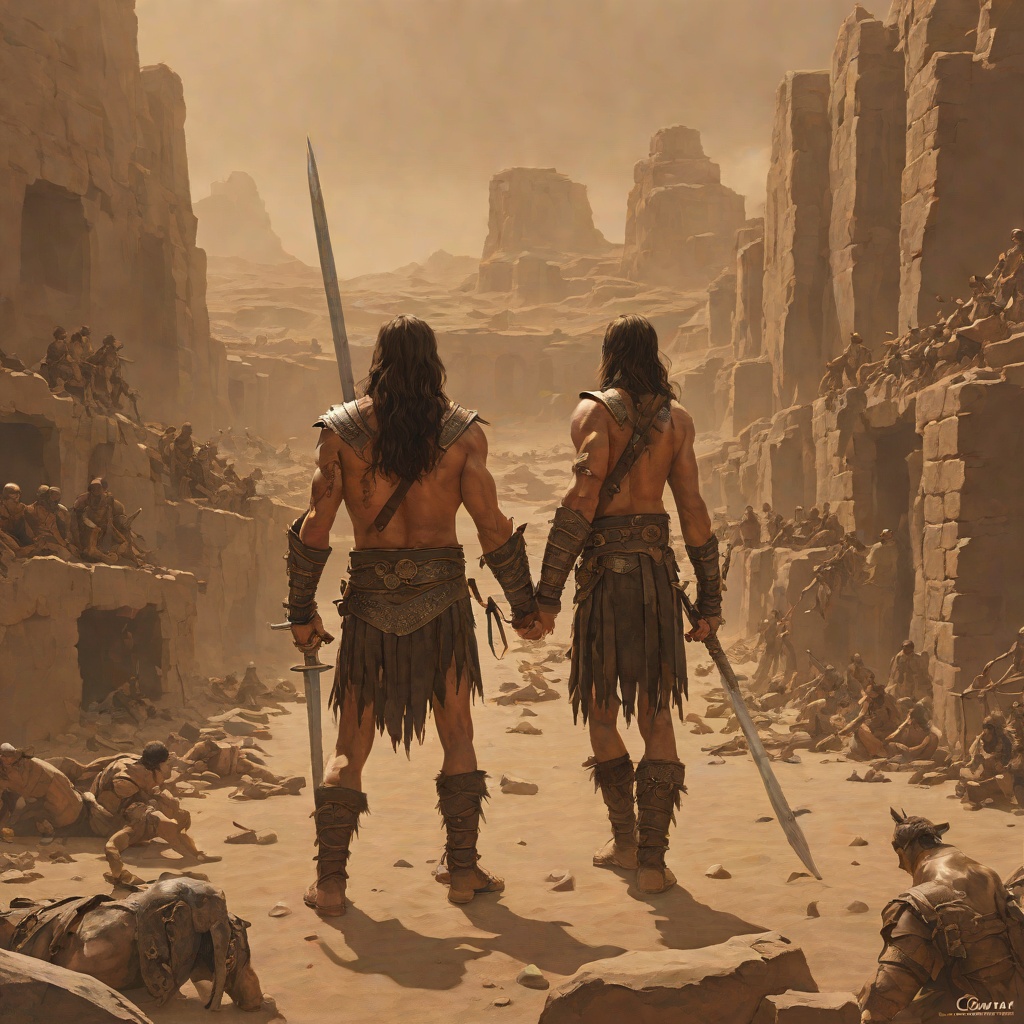
Conan the BarbarianSkaun is a town of the Vanir, a grim northern settlement that serves as the stage for some of the most brutal and formative episodes in Conan's early life. It is here that the young Cimmerian, still a slave in Toghrul's troupe, is first dropped into the Pit to fight for his life against a drugged Kushite warrior. The town is not merely a backdrop; it is a place where death is sport, where chieftains gamble on blood, and where the cult of Set later conducts its grisly ceremonies. Skaun thus stands as a monument to the cruelty of the Hyborian world and the harsh education that forged Conan into a man-slayer.
The Pit and Conan's First Fight
Conan's introduction to Skaun comes in chains. With others of Toghrul's troupe, he is taken to the town, where the fighters are herded into a high-roofed, barn-like structure. Inside, fires smoulder in beds of charcoal to lessen the biting chill of early autumn, and the air is thick with smoke, the reek of ill-tanned hides, and the stench of baggy woollens stiff with dirt and rancid sweat. The Pit itself is ten paces long, five wide, and as deep as the height of a man, its edges hung with crudely-figured shields and standards of hide painted in cranberry red, cerulean blue, and raw earth tones.
Looking up from the enclosure, Conan sees a ring of Vanir chieftains sitting on crude benches, guzzling ale from cups of horn and thrusting the horn points into the soft earth at their feet when they tire of handling them. Torches set in brackets encircle the upper reaches of the Pit, their fitful light gleaming on the red manes and ruddy faces of the men and glinting on their bracelets and pectorals of gold and silver, embellished with uncut gemstones. The chieftains laugh, hoot, drink heavily, and bawl obscene jests, but they eye the fighters shrewdly before placing bets, displaying bars of gold, precious jewels, and fine weapons as earnest of their wagers.
Half a dozen fighters stand against the far wall of the Pit, powerful men naked save for dirty clouts, their deep chests, broad backs, and muscled limbs smeared with grease to afford scant hold to their opponents. Conan recognizes none of them. Having heard muttered talk among Toghrul's people of a rival Pit master, an Asa from Asgard named Ivar, the Cimmerian infers that the strange fighters might be of Ivar's troupe. His own opponent is a man of a kind he has never seen before: a Negro with skin of ebon hue, from the land of Kush, a thousand leagues or more to the south, where his father had told him such men were said to live. The Negro's bullet head is shaven smooth, and deep in the shining mask of his heavy-featured face, his eyes burn with feral fires. His jaws move rhythmically as he chews on a handful of leaves, and as the potent narcotic enters his bloodstream and ascends to his brain, the look in his eyes becomes inhuman, the eyes of a beast of prey.
Pretending to be feckless and bewildered, the young barbarian studies his opponent. The black is a magnificent specimen of savage manhood, his oiled body gleaming in the firelight like a statue carved from obsidian, terrific strength sleeping in those massive shoulders and arms, muscles like writhing pythons tensing and relaxing beneath the skin of torso and legs. When the drug has taken full charge of the Negro's brain, he springs upon Conan like a charging tiger. In an instant his huge hands close about the novice's throat and clamp tight, sinking into the flesh and stifling the warning growl that rises from Conan's chest. The Cimmerian's hands lock on the wrists of the black, and the two struggle together in a dance of death, swaying back and forth in an embrace as intimate as that of lovers, while the Vanir chieftains howl with excitement.
Conan fights desperately for breath, tensing the corded muscles of his throat. His lungs are afire; a red haze thickens before his eyes. The Negro leans close, his thick lips spread in a lurid grimace that exposes yellow teeth filed to fang-like points, his hot breath, sickly-sweet with the effluvium of the drug, fanning Conan's brow. The black's face comes closer still, and the combatants sway cheek to cheek as the Kushite strives to reach Conan's jugular vein with his fangs. This is the first time Conan is dropped into the Pit, and it is a place of death or triumph, a lesson in the brutal arithmetic of survival that will define his life.
The Cult of Set in Skaun
Skaun is also a place where the servants of Set operate in the shadows. A merchant, standing at the doorway of his shop, warns Conan in a low tone: "Stranger, beware. The servants of Set are deceivers. They worship Death." Conan is shocked; to him, Death is ever the enemy. The merchant nods and adds that they would murder their own parents, thinking to confer a boon by relieving them of the burden of life. This warning reveals the cult's death-worshipping doctrine, a stark contrast to Conan's own reverence for life and his Cimmerian code.
Within the town, the cult conducts its ceremonies in a vaulted chamber lit feebly through a round opening in the ceiling. The floor beneath the circular opening is littered with corpses, male and female; some appear fresh, others are far gone in decay, still others have been reduced to skeletal remains. As Conan and Subotai edge closer to the mass of putrescence, rats flee squeaking before them, their eyes aglow with hostility when, upon reaching safety, the rodents turn briefly to watch the intruders. The cultists seem to be young persons of both sexes, their hoods shadowing their rapt faces and their long robes hiding their bodies.
As Conan watches, one of the group steps forward, discarding its hooded robe. Revealed in the emerald light is a beautiful young woman, whose slender body is scarcely shielded by a gauzy wisp of fabric. With resolute step, the maiden mounts a stone corbel that juts out like a spar from the side of the aperture, and as she moves, the solemn chanting swells in volume. The ceremony nears its climax when the black priest, Yaro, rises to his full height. At his commanding gesture, the mesmerized girl poised on the jutting corbel raises her arms and falls or throws herself into the corpse-filled pit. A chorus of cries of surprise and superstitious terror fills the darkened chamber when none hears the expected thud of a fallen body or scream of a dying victim. Yaro leans forward, peering into the dim depths below, and instead of a broken body atop the pile of corpses, he sees the girl lowered unharmed to the floor by the arms of a giant who has caught her as she fell. He hears her shriek, "Our god is dead, is dead!" as she stares through the archway wherein the headless serpent lies.
The Mountain of Power and the Pleasure Pavilion
Beyond the town itself, the influence of Skaun extends to the Mountain of Power, where the cult's darker appetites are made manifest. In the caverns beneath the mountain, Conan, Valeria, and Subotai discover a huge cauldron upheld by four massive posts of blackened stone, flames roaring up from fire pits cut out of the rocky floor. All around the cauldron, huge, sweat-covered beast-men work to feed the flames, while great chunks of boiling meat float in the bubbling bowl and apelike butchers cut up other carcasses to add to the aromatic stew. Hung from meat hooks to one side of the great cauldron, half-hidden by the steam and the flickering firelight, are human bodies, drawn and bloodless, like those of beef sides or plucked fowl. From the delicate, almost translucent flesh that covers the pallid faces and immobile limbs, it is clear that the victims had once been pilgrims to the Mountain of Power, followers of the serpent god. As the three adventurers watch in horror, a pair of beast-men hack up one body with their cleavers and, hotteting over to the cauldron, toss the pieces into the boiling liquid. Valeria turns pale and buries her face against Conan's shoulder; the Cimmerian swears an oath beneath his breath; Subotai retches.
Nearby, within the confines of the cave, lies a chamber draped in filmy gauze to form a pavilion through which green light pulses. Around it, half-hidden by the translucent curtains, are graceful pits and beds of delicate-hued flowers, planted in soil-filled hollows to re-create a garden within the cave. The floor of polished blue-black marble gleams like the still waters of a lake, and from silver vessels incense curls upward through the motionless air. Above the distant throbbing of the drums, a flute sings like a nightingale to weave a sense-seducing spell. Behind the draperies of the pavilion, dozens of young people of both sexes lie in slumber, languidly make love, or sit in a deathlike trance, their backs propped up against the slender columns of malachite. So slowly do the pleasure-seekers move that Conan looks at his companions and wordlessly forms the word, "Drugged!" Even the leopards, chained to a column, have been affected by the potent narcotic that wafts upward with the incense, laying their slumberous heads between their paws and closing their eyes of molten gold.
The Doctrine of Doom and the Great Cleansing
Skaun and its surrounding cult sites are the proving ground for Thulsa Doom's apocalyptic doctrine. In the great temple, the Faithful of Set gather to hear the exhortation of their master. Hundreds of candles, nursed by loving hands, throw a dim radiance over the chamber and reflect the eager faces of the congregation. All become silent as Thulsa Doom, resplendent in his reptilian armour, mounts the dais and faces his followers. His eyes are dark and filled with sorcery, but there is no humanity in them. He fixes his gaze beyond the uplifted faces massed before him, as if he saw some vision of the future that he alone could see, and intones: "The day of doom is here. The purging is at last at hand. All who stand against us in high places, all who have lied to you and tried to turn you from me—parents, teachers, judges—all shall depart in a night of blood and fire. Then shall the earth be cleansed and ready to receive the god we worship." The listeners moan in ecstasy, "Set!" and Doom continues, "You, my children, are the pure water that will cleanse the world. You shall destroy all who stand against us. In your hands you hold the eternal light that burns in the eyes of Set!"
This doctrine of the Great Cleansing is the ideological engine of the cult's violence, and Skaun is one of its strongholds. The town's brutal Pit, its corpse-filled ceremonial chambers, and its cannibalistic feasts are all expressions of a worldview in which death is not an enemy but a gift, and in which the faithful are urged to "slip the silken noose over the heads of Set's enemies" and to "spill the heart's blood of the infidels, to give them the infinite benison of eternal peace." It is against this backdrop that Conan's own philosophy of steel and survival takes shape, and it is in Skaun that he first learns the terrible cost of the cult's embrace of death.
Narrative Significance
Skaun functions as a crucible for Conan's character. It is where he learns to fight for his life in the Pit, where fight or die is the only law, and where he first encounters the death-worshipping cult of Set. The town's brutal spectacles and its hidden chambers of sacrifice establish the stakes of the larger conflict between Conan and Thulsa Doom. Skaun is also a place of stark contrasts: the raw, honest brutality of the Pit, where men gamble on blood and strength, stands against the seductive, drugged decadence of the cult's pleasure pavilion, where young people are lulled into deathlike trances. Both are faces of the same coin, expressions of a world that has made death its master. For Conan, Skaun is a school of hard lessons, a place where he learns that steel and the hand that wields it are the only things a man can count on, and where he first glimpses the enemy he will spend his life hunting.