Thrudvang
Conan the BarbarianThrudvang is a palisaded Vanir town in the northern lands, a place of stone houses half-buried in turf and roofed with thatch, where the boy Conan is first brought as a captive after the Vanir raid on his Cimmerian village. It is here that he is chained to the Wheel of Pain, a massive millstone turned by slaves, and here that he survives a plague that kills all his fellow captives, leaving him alone at the wheel. Thrudvang is thus the crucible of Conan's youth, the place where he learns his first lessons in suffering, endurance, and the riddle of steel, and where the seeds of his lifelong vendetta against Thulsa Doom are planted.
The Slave Town and Its Captives
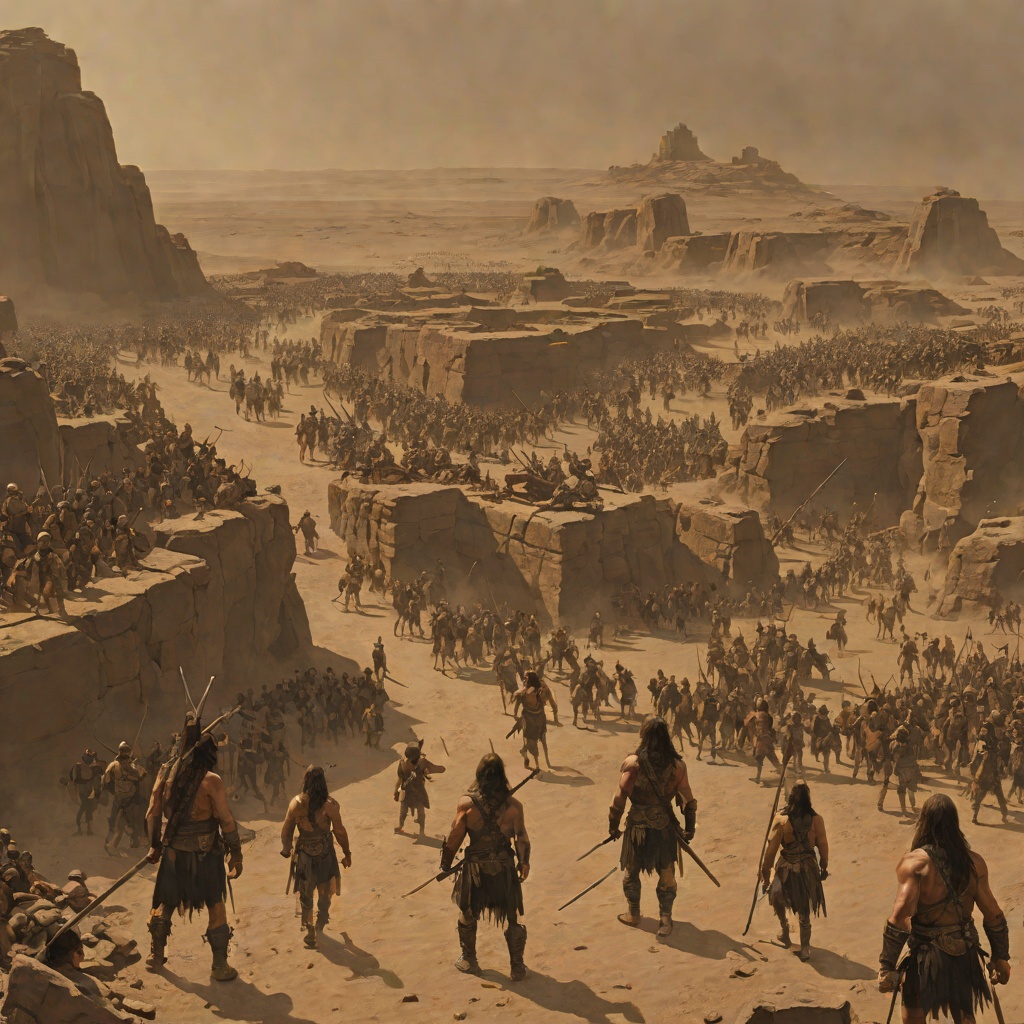
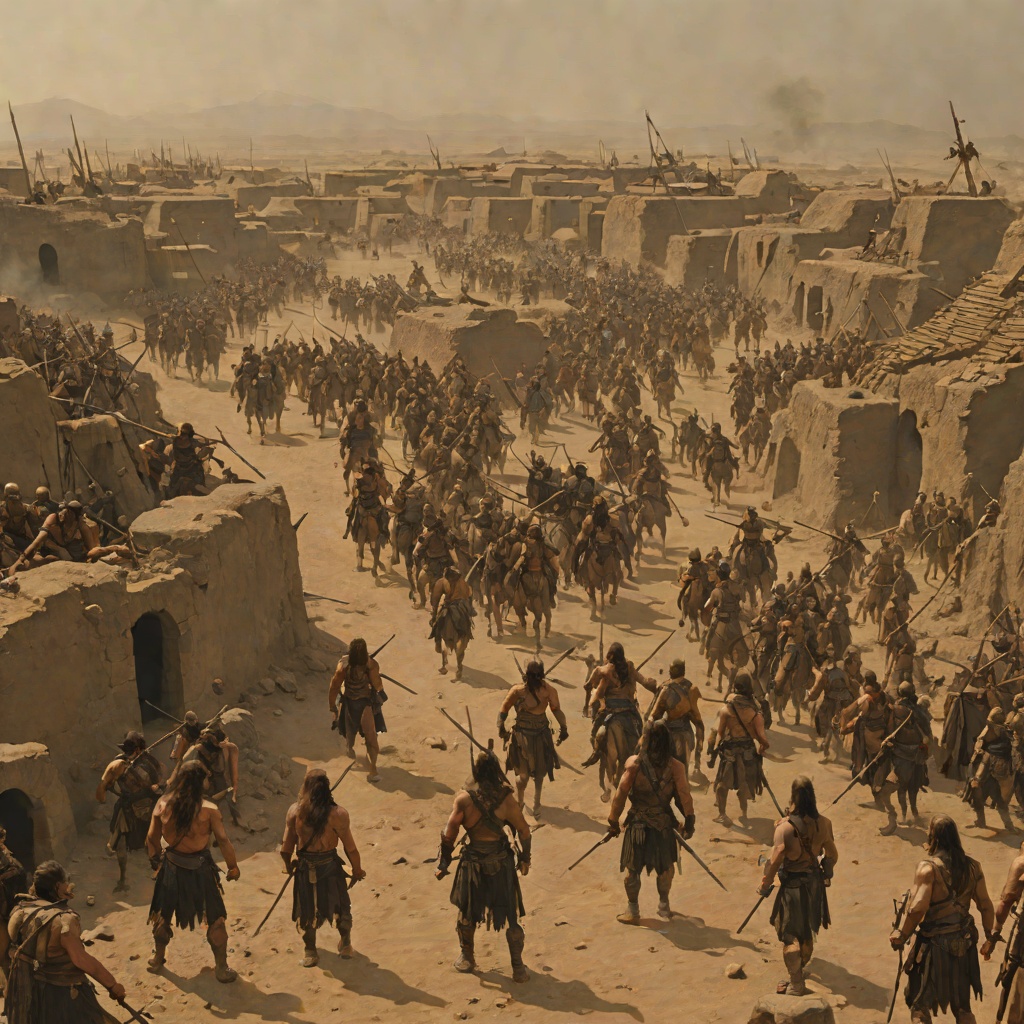
Thrudvang is introduced as a sizeable community, a Vanir town reached at dusk after a long and weary march across marshes where the first timid flowers of spring emerge from ice-scummed water. The captives, footsore and driven like cattle, are herded through the palisaded gateway into a clutter of stone houses, half-buried in turf and roofed with thatch. They are then hustled into a walled enclosure containing several sheds, one of which serves as a slave pen offering scant protection from the elements. Here the newcomers spend a lonely night sleeping on hard clay sparsely strewn with dirty straw. At dawn, after receiving a small ration of bread and thin soup, the stronger and healthier among them are chained by rusty manacles to a massive wheel whose spokes are stout logs, polished smooth by the pressure of human hands. This wheel turns one enormous millstone upon another, grinding grain to powder beneath its ponderous weight. To this Wheel of Pain, as the slaves come to call it, Conan is chained beside other ragged, dull-eyed youths and men from lands unknown or rarely mentioned in Cimmeria. The captive women and girl-children of his village are led away to face a different, perhaps even uglier fate, and Conan never hears of them again.
The Plague and the Lone Wheel-Turner
During one famine, a plague descends on Thrudvang, and many die despite the drumming and chanting of the shaman. The pestilence spreads to the mill, where underfed and overworked slaves prove easy prey. One by one, they take to coughing, suffer bloody fluxes, and succumb. At last the day comes when Conan stands alone at the Wheel of Pain. The Master, descending to the walkway to drag out the final corpse, expresses honest perplexity: "I do not know what to do with you, Cimmerian. We must have flour ere we starve; but one man cannot turn the mill alone." Conan replies with a grunt, "Hah! Think you so? Place me at the outer end of the boom, and I'll show you that I can." The Master grants him the chance, saying, "Well, you shall have your chance. May your Cimmerian gods be with you!" This moment marks Conan's first triumph over the crushing labor that defines Thrudvang, and it is here that he learns the value of sheer will and physical strength, lessons that will serve him throughout his life.
The Riddle of Steel and the Cimmerian Code
Thrudvang is also the place where Conan's understanding of steel and the Cimmerian code is forged, though the lessons themselves are imparted earlier, on a rocky ridge swept clear of snow, when his father Corin the smith teaches him the secret of steel. Corin tells the boy that the mightiest of the gods is Father Crom, who rules earth and heaven and the broad and restless sea, and that the greatest of Crom's secrets is the secret of steel, a secret the gods taught not to men but jealously guarded in their inmost hearts. He explains that giants once dwelt within the earth, crafty and wise, and that they stole from Crom the secret of the silvery metal that, when bent, springs into shape again. Corin warns Conan that men are but mortals, weak and foolish, and that he must be wary of steel and hold it in respect, for it carries within it a mystery and a power. He tells the boy that before a man is worthy to bear a sword of steel in battle, he must learn its riddle, and that in all the world he can trust no one, neither man nor woman nor beast, neither spirit nor demon nor god, but only a blade of well-forged steel. He also teaches that the heart of a man is like a piece of unworked iron, which must be hammered by adversity and forged by suffering and the challenges flung by the thoughtless gods, nigh unto the point of breaking, and that only when the heart has become as steel will a man be worthy to wield a keen-edged sword in battle. These lessons, though taught before Thrudvang, are put into practice in the slave town, where Conan's heart is hammered and forged by the suffering of the wheel and the plague. His taciturn nature, his refusal to seek companionship, and his gnawing thought of revenge all take root here, as he learns to speak fluent, if accented, Vannish and picks up a smattering of Aquilonian and Nemedian from his fellow captives, though he does not encourage them to teach him to write, a regret he later voices to King Conan in the fullness of his years.
The Cult of Set and the Shadow of Doom
Though Thrudvang itself is not the seat of the Cult of Set, the town's harshness and the suffering it inflicts on Conan are part of the larger world that the cult's ideology seeks to cleanse. The cult's teachings, as later revealed in the temple of Set, glorify death and the Great Cleansing, a doctrine that would see all who stand against the cult—parents, teachers, judges—depart in a night of blood and fire. Thulsa Doom, the cult's leader, preaches that his followers are the pure water that will cleanse the world, and that they shall destroy all who stand against them. This ideology of sacrificial violence, which finds its ultimate expression in the crucifixion on the Tree of Woe and the Battle of the Burial Mounds, stands in stark contrast to the Cimmerian code of steel and self-reliance that Conan learns in his youth. Thrudvang, as the place where Conan first experiences the brutality of the world and the indifference of the gods, is thus the foundation upon which his later conflict with Doom is built. The town's name, though not directly linked to the cult in the evidence, resonates with the themes of doom and cleansing that pervade the narrative, and Conan's survival there is a testament to the strength that will eventually allow him to confront and behead Thulsa Doom.
Narrative Significance
Thrudvang serves as the first major station in Conan's picaresque journey, a place of lowly origin from which he rises through a series of episodic adventures. It is here that he learns the value of endurance, the meaning of suffering, and the importance of steel, lessons that define his character and his worldview. The town's harshness and the plague that nearly kills him are early tests of the Cimmerian code, and his solitary turning of the Wheel of Pain is a foreshadowing of his later solitary battles against overwhelming odds. Thrudvang also introduces the theme of slavery and captivity that recurs throughout the narrative, from the Wheel of Pain to the Pit fights to the Mountain of Power, and it is the place where Conan's vow of revenge against the Vanir and, by extension, against all who would enslave and oppress, is born. The town's bleakness and the suffering it inflicts are a stark contrast to the later scenes of cultic splendor and ritual violence, and they ground Conan's story in the harsh realities of the Hyborian Age, where life is cheap and only the strong survive.