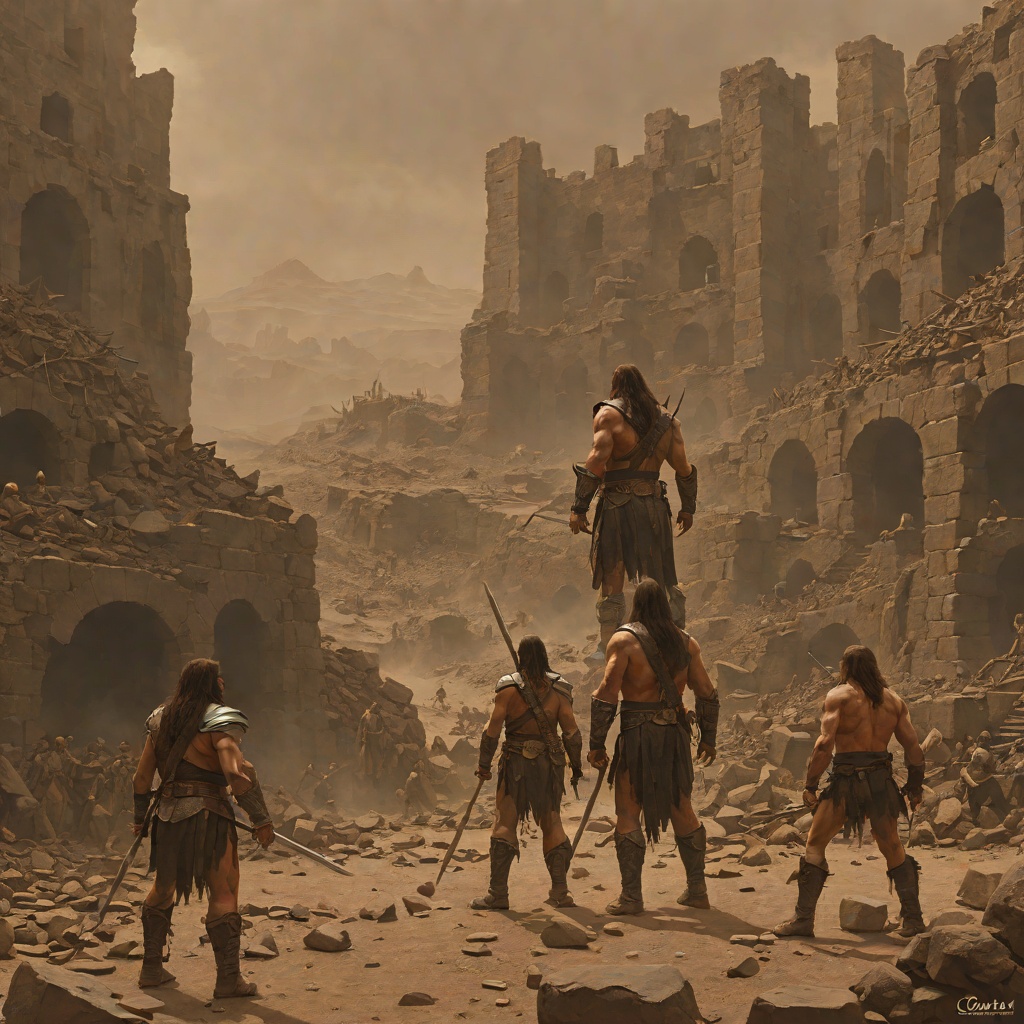
What is steel compared to the hand that wields it
Conan the BarbarianWhat is steel compared to the hand that wields it? is the central philosophical challenge of the conflict between Conan and Thulsa Doom, spoken in the garden of the Mountain of Power as Doom attempts to shatter the Cimmerian's most deeply held belief. The question is Doom's deliberate inversion of the Riddle of Steel, the secret that Conan's father imparted to him as a boy on a lightning-riddled ridge: that a blade of well-forged steel is the only thing a man can count on in all the world. Where the father taught that steel carries within it a mystery and a power that must be respected, Doom dismisses the metal itself as nothing, insisting that the true secret of strength lies not in the weapon but in the mind that commands it. The utterance marks the moment when the two opposing creeds of the story collide directly, each man claiming to possess the real secret of power.
The Garden Demonstration
The question arises from a brutal demonstration of power. In the garden of the Mountain of Power, Doom draws Conan's attention to a beautiful young girl and her lover standing on a high wall, and asks the chained barbarian whether he knows what it is to love a girl or to be truly loved by one. Remembering Valeria, from whom he had parted with such pain many days earlier, Conan's lips tighten and he growls an assent deep within his throat. Doom, with the ghost of a smile, tells him that perhaps he thinks love conquers all, but that he will show him a force stronger than steel, or even than love. Fixing his hypnotic eyes upon the girl's sweet face, Doom hisses a single command: "Come to me, child." The childish face becomes suffused with joy; she poises for a moment at the edge of the embankment, then, without a glance at the youth beside her, leaps from the wall and falls with a heavy thud on the tiles of the garden walk below. Conan averts his eyes from the doll-like broken body near their feet, while Doom laughs, the music of his laughter spun through with a note of triumph.
The Doctrine of the Hand
Standing over the broken body, Doom delivers the doctrine that the question crystallizes. "That is strength, boy—that is power!" he declares, calling it strength against which the hardness of steel or the resilience of human flesh are as naught. He then poses the rhetorical question that gives the expression its name: "What is steel, compared to the hand that wields it; what is the hand, without a mind to command it?" For Doom, this is the secret of strength, and he dismisses the metal itself with a contemptuous "Steel, bah!" The doctrine is the culmination of his entire philosophy of power, the same philosophy he preaches to his followers in the great temple when he tells them that the day of doom is here and that all who stand against them—parents, teachers, judges—shall depart in a night of blood and fire. His power is not physical but mental, exercised through hypnotic command and the willing obedience of his votaries, who moan "Doom! Doom!" in ecstasy and clutch the hilts of their daggers to spill the heart's blood of the infidels.
The Inversion of the Riddle of Steel
The question stands in direct opposition to the teaching Conan received from his father. On that storm-racked ridge, the father had told the nine-year-old boy that the mightiest of the gods is Father Crom, who rules earth and heaven and the broad and restless sea, and that the greatest of Crom's secrets is the secret of steel, a secret the gods taught not to men but jealously guarded in their inmost hearts. The father had further taught that before a man is worthy to bear a sword of steel in battle, he must learn its riddle and understand the ways of steel, and that in all the world a man can trust no one—neither man nor woman nor beast, neither spirit nor demon nor god—but can trust a blade of well-forged steel. Where the father's creed makes the blade the one reliable thing in an untrustworthy world, Doom's doctrine makes the blade a mere instrument of the commanding mind. The two teachings are mirror images: the father exalts the steel, Doom exalts the hand that wields it.
The Challenge to Conan's Creed
Doom's question is also a direct challenge to Conan's identity and his claim to have been made by suffering. When Conan dismisses Doom's power as power over fools and weaklings, insisting that the cult leader has never met a real man on equal terms and fought him face to face or hand to hand, Doom responds proudly that he has made Conan what he is. "Aye! And see what I have made of you, how life has toughened your flesh and hardened your spirit!" he declares, claiming that through pain and suffering he has made Conan a champion, a hero, a veritable demigod, and that Conan wishes to waste this gift on mere revenge. The argument echoes the father's teaching that the heart of a man is like a piece of unworked iron that must be hammered by adversity and forged by suffering nigh unto the point of breaking, and that only when the heart has become as steel will a man be worthy to wield a keen-edged sword. Doom claims the role of the forger, the one who hammered Conan's heart into steel, and the question "What is steel compared to the hand that wields it?" becomes his assertion that he, not the blade, is the source of Conan's strength.
The Unanswered Challenge
The question is never directly answered by Conan in the garden. The barbarian's closed countenance and the set of his bruised shoulders seem to diminish Doom's power, to offer an unspoken insult to one unused to insults, and Doom makes one more attempt to reassert his authority over the stubborn youth whose body is in chains but whose soul remains free. The challenge hangs in the air, unresolved, and the story's later events constitute Conan's answer in action rather than in words. His entire life has been a testament to the father's creed: he trusts his blade, he confronts his enemies face to face, he spills their hot blood upon the earth and hears the lamentations of their women. The question "What is steel compared to the hand that wields it?" thus becomes the central philosophical opposition of the tale, the moment when the sorcerer's doctrine of the commanding mind confronts the barbarian's creed of the trusted blade, and the story's resolution—Conan's eventual triumph—vindicates the father's teaching over Doom's doctrine, even as the question itself remains one of the most memorable utterances in the narrative.