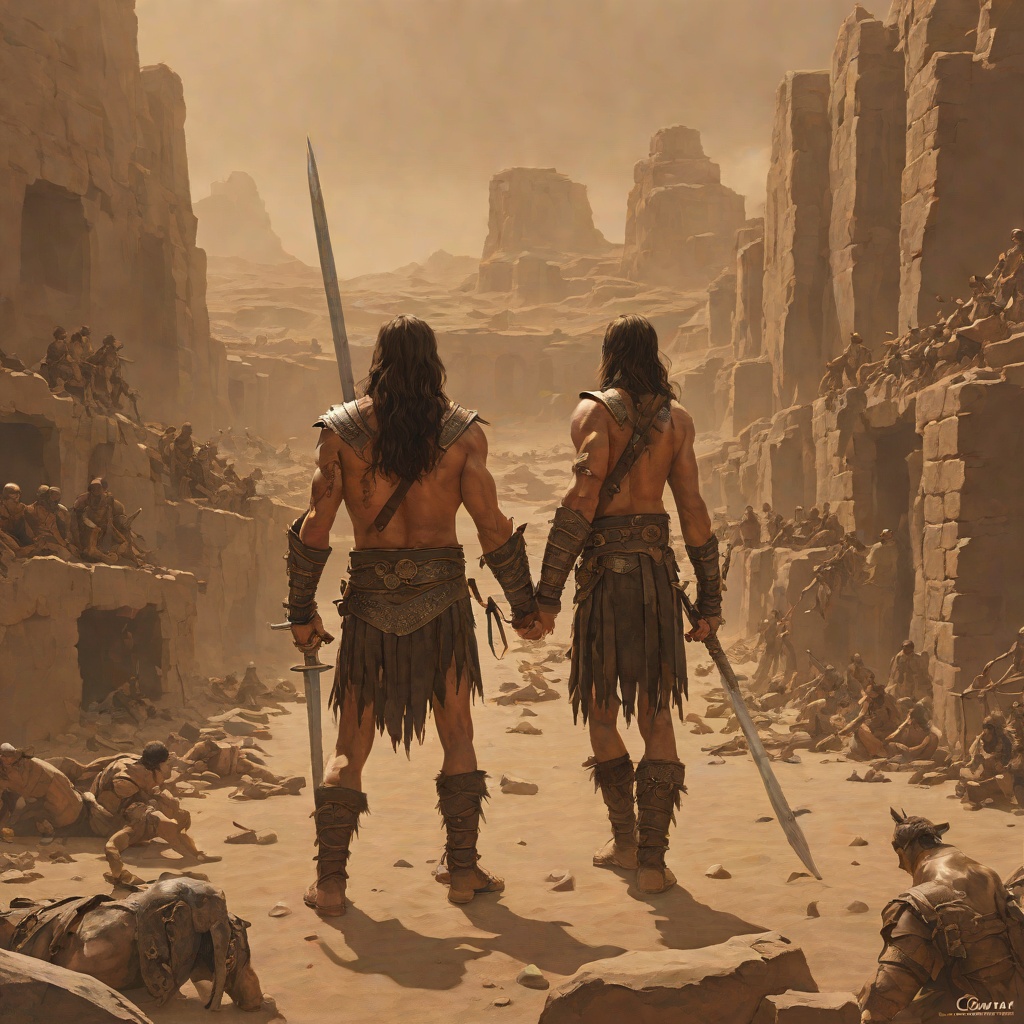
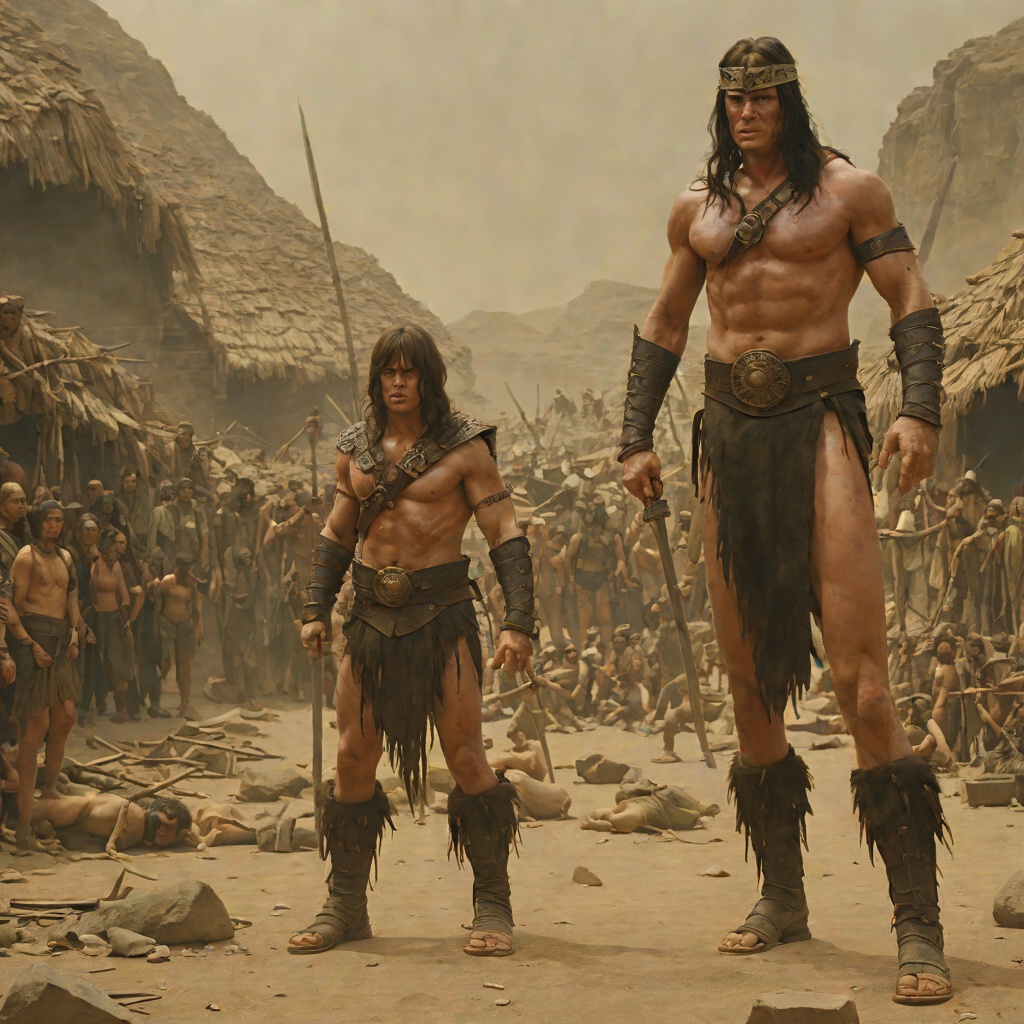
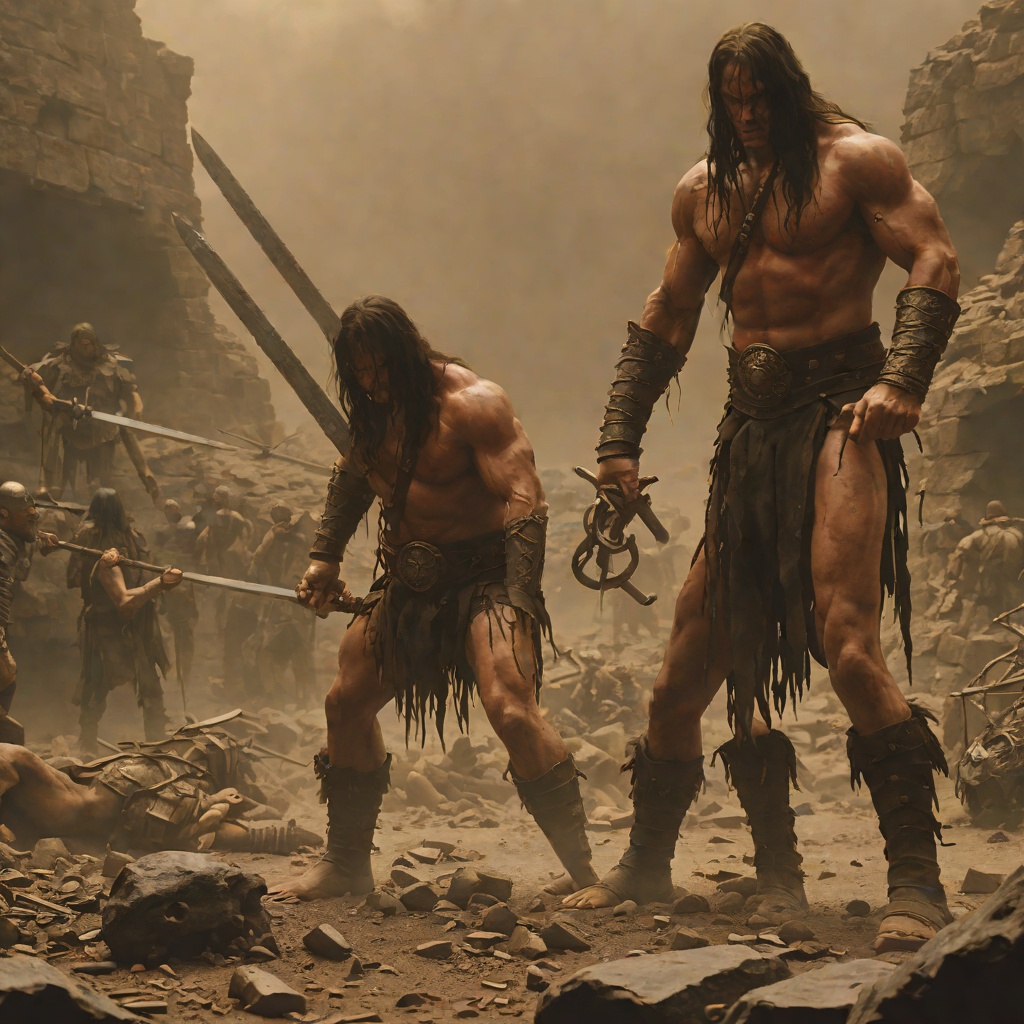
When I wear a crown, it will be won by my own sword
Conan the BarbarianWhen I wear a crown, it will be won by my own sword is the Cimmerian warrior Conan's terse, unshakeable statement of personal honor and self-determination. Uttered in conversation with his comrade Subotai after he has turned down a princess's offer of a kingdom as a dowry, the line distills the philosophy that has driven him from slavery to kingship: that true power is never inherited, gifted, or seized through another's favor, but must be forged through one's own suffering, struggle, and steel. It is the verbal culmination of the 'riddle of steel' his father taught him as a boy, and it marks the moral boundary between Conan and the decadent, corrupt civilizations he moves through—a boundary that ultimately carries him to the throne of Aquilonia as Conan the Great, the mightiest lord of his day, as recorded in the Nemedian Chronicles.
The Riddle of Steel and the Father's Teaching
The declaration's roots lie in a lightning-riddled night in Cimmeria, when Conan's father, Corin the smith, cupped his son's small hands within his own and curled the boy's fingers about the hilt of a great sword. "The heart of a man is like a piece of unworked iron," the smith said. "It must be hammered by adversity and forged by suffering and the challenges flung by the thoughtless gods, nigh unto the point of breaking. It must be purged and hardened in the fires of conflict. It must be purified and shaped on the anvil of despair and loss." Only when the heart has become as steel, Corin taught, would Conan be worthy to wield a keen-edged sword in battle and win against his enemies, as the gods did when they conquered the dark giants. "When you have mastered the mysteries of steel, my son, your sword will be your very soul." All his life Conan remembered those words, and in time he came to comprehend the cryptic message: out of suffering is born strength; only through pain and deprivation does a human heart become as strong as steel. The smith himself was something of a godling to his neighbours, having come out of the south lands bearing the arcane art of steel—that precious inheritance from the ancient Atlanteans, believed lost and forgotten in the darkling age. When Conan later declares that his crown must be won by his own sword, he is not merely refusing a gift; he is affirming that the crown itself is worthless unless it has been hammered, purged, and shaped on the anvil of his own life.
The Refusal of the Dowry and the Declaration
The line is spoken in a moment of quiet aftermath, after the fall of Thulsa Doom. Subotai, ever curious about the strange ways of Cimmerians, asks Conan how he disposed of Yaro, the hostile priest who had opposed King Osric. Conan shrugs and explains that the fighting came to little: when the folk of Shadizar heard that Doom was dead, the black priest's followers turned on him, and before Conan had a chance to sword him, his own people tore him limb from limb. Then Subotai, with a sigh, remarks on the strangeness of Cimmerians and asks how Conan disposed of the lady's offer—for Conan had turned down a princess's hand and kingdom before leaving the city. Conan grunts his reply: "When I wear a crown, it will be won by my own sword, not given as a dowry." The brevity of the statement, its gruff matter-of-factness, is itself a measure of how deeply the principle is ingrained. There is no boasting, no elaboration, no self-congratulation—only the flat, unarguable assertion of a man who has spent his life earning everything he has, from his freedom to his very survival.
The Pit, the Wheel, and the Forging of the Will
The declaration carries the weight of Conan's entire history of suffering. As a boy, he was captured in the Vanir raid on his Cimmerian village, when horsemen shod in iron shattered the thin ice of the stream and swept down upon the hamlet, their lances thrusting through fleeing mothers. He was herded into the slave pens of Thrudvang, and at dawn the stronger and healthier captives were chained by rusty manacles to the Wheel of Pain—a massive wheel whose spokes were stout logs, polished smooth by the pressure of human hands, turning one enormous millstone upon another to grind grain to powder. There, under the hawk-like eye of the Master of the Wheel, Conan learned his first lessons in suffering, driven by a vicious rawhide whip that sang its sibilant song and laid crimson welts on pitiful shoulders. Later, in the Pit, he fought for his life day after day, wondering whether each day would be his last. When a Hyrkanian general asked the young barbarian what was best in life, Conan's mouth twitched in a shadow of a smile as he replied: "The best of life is to confront your enemy face to face, to see his hot blood spill upon the earth, and to hear the lamentations of his women!" The general warned Toghrul, his pit master, that the Pit had not broken the spirit of his champion, nor sapped his will—that the young tiger might some day turn and rend him. Conan's refusal of a dowry-crown is the same spirit speaking in a different key: the man who has earned his strength through the Wheel and the Pit will not accept a throne as a gift, because a throne so received would be as hollow as a blade never forged.
The Contrast with Thulsa Doom and the Corruptions of Power
The declaration also stands in stark opposition to the philosophy of Thulsa Doom, the cult leader who slaughtered Conan's people and chained him to the Wheel. Doom's power was built on manipulation, deception, and the willing submission of fools and weaklings. In his garden, he demonstrated his strength by commanding a young girl to leap to her death, and as her doll-like broken body lay at their feet, he laughed and said: "That is strength, boy—that is power! It is strength against which the hardness of steel or the resilience of human flesh are as naught. What is steel, compared to the hand that wields it; what is the hand, without a mind to command it?" Doom claimed to have made Conan a champion, a hero, a veritable demigod through pain and suffering, and he urged the Cimmerian to waste his strength on revenge rather than on the greater glory Doom offered. But Conan, unimpressed, stared at him dourly and answered: "What is it to me that you have power over fools and weaklings? You have never met a real man on equal terms and fought him face to face or hand to hand." Where Doom's power is exercised over the weak and the credulous, Conan's is proven only against equals, in open combat. Where Doom's authority is inherited from the serpent-men and maintained by terror, Conan's must be won by his own sword. The declaration is thus a rejection not merely of a dowry, but of an entire model of power—the model of the cult, the priest, and the tyrant who rules through fear rather than through earned strength.
The Fulfillment and the Meaning of the Crown
The line finds its ultimate vindication in the final confrontation with Thulsa Doom. When Doom revealed his true nature before the frozen faces of the faithful—his neck lengthening, his jaws elongating, his nose shrinking and disappearing, his dark eyes rounding into lidless orbs, a purple tongue flicking out to test the air—he bore the scaly serpent head of the ancient snake-men, those timeless enemies of all mankind. Conan's sword sighed as it swept up in a great arc and clove the swaying snake head from the human body. The body fell backward and lay, writhing, like a trampled serpent, at the top of the wide steps, while the severed head rolled slowly down the long flight of stairs and came to rest beside the fountain pool. Watching the gory object fall into the purple shadows of the dying day, Conan spoke half to himself: "My father was the light of day; Thulsa Doom, my night. Yet in one thing he spoke true. What matters is not the steel within the blade, but the steel within the man." The crown Conan will one day wear is the crown of a man who has proven his steel against the serpent-headed tyrant, who has refused every gift and every shortcut, who has earned his place through the Wheel, the Pit, and the sword. When the Nemedian Chronicles record that Conan ruled from the throne of Aquilonia as Conan the Great, the mightiest lord of his day, they record the fulfillment of the boy's vow—a vow that was never about the crown itself, but about the hand that would win it. The declaration is thus not a boast but a creed: the crown is only as worthy as the sword that wins it, and the sword is only as worthy as the man who wields it.