Balang
Crazy Mama: 9 Steps to a Not-So-Normal LifeBalaam is presented as a prophet with real spiritual authority and a genuine heart for God, yet also as a man vulnerable to the seductions of wealth, status, and worldly influence. His journey toward Moab becomes an extended warning about compromise: a person may know God’s instruction, affirm it sincerely, and still begin moving away from it when attractive rewards remain in view. The speaking donkey at the center of his story reverses the expected hierarchy, showing that obedient integrity can matter more than religious reputation and that God can use and defend even the most unlikely servant.
Identity and Spiritual Authority
Balaam is described as one of God’s notable prophetic figures. His blessing carried force, and his curse was regarded as equally powerful; Balak therefore treated him as the decisive instrument in a political and military crisis. Balaam’s authority was not merely ceremonial. Balak believed that whoever Balaam blessed would be blessed and whoever he cursed would be cursed, making the prophet valuable to a king who feared the growing strength of the Israelites.
Yet Balaam is not introduced as a simple villain. He had a heart for God and understood that his words and actions were subject to the word of the Lord. That combination—genuine devotion joined to desire for worldly gain—creates the central tension of his character. His danger does not begin with open rejection of God. It begins when spiritual knowledge and worldly appetite are allowed to occupy the same decision.
Balak’s Request and the First Refusal
Balak ruled Moab when the Israelites settled near his territory. Their victories and expansion frightened him, and he sought a supernatural solution: he sent for Balaam and asked him to curse the people so that Moab might defeat and drive them away. Balak’s messengers arrived with gifts and inducements, but Balaam did not answer immediately. He asked them to remain overnight while he consulted God, a response the narrative treats as wise. The book also draws from this moment a practical rule: major decisions should not be made impulsively, but should be brought before God.
God’s answer was explicit. Balaam was told not to go with the men and not to curse the Israelites because they were blessed. Balaam therefore sent the first delegation away. At this point his conduct appears firm. He has heard a clear prohibition and has communicated it, and the story briefly seems to have reached its proper conclusion.
The Seduction of Wealth and Honor
Balak refused to accept the first answer. He sent more numerous and more honorable princes, accompanied by a stronger promise: Balaam would receive very great honor and whatever he asked for. Balaam correctly declared that even a house full of silver and gold could not authorize him to go beyond the word of the Lord. His statement recognizes that no reward can legitimately revise divine instruction.
His failure comes immediately afterward. Instead of dismissing the second delegation, Balaam allowed the princes to stay another night while he consulted God again. The repeated consultation does not arise from uncertainty in the original command; the book emphasizes that God had already spoken clearly. The additional delay gives wealth and prestige time to work upon Balaam’s imagination. The promises of riches and power become a kind of spiritual advertisement, and the longer he remains near them, the more plausible compromise begins to feel.
That night God permits Balaam to go only on the condition that he do nothing beyond God’s command. Balaam nevertheless saddles his donkey and sets out with the men of Moab without God’s permission. The movement from refusal to departure is therefore gradual rather than dramatic. Balaam does not announce rebellion or declare that he intends to curse the Israelites. He appears to rationalize the journey as an opportunity to inspect the situation, but the book treats that rationalization as the beginning of a destructive spiral. A small concession has placed him on a road he already knows he should not be traveling.
The Donkey, the Angel, and the Narrow Road
God’s anger is kindled because Balaam went, and the Angel of the Lord stands in the way as an adversary. The obstacle is not random misfortune. It is divine resistance to a compromised choice. The book’s interpretation is direct: when a person attempts to work around God’s direction, adversity may appear—not because God desires destruction, but because He may use opposition to prevent a worse outcome.
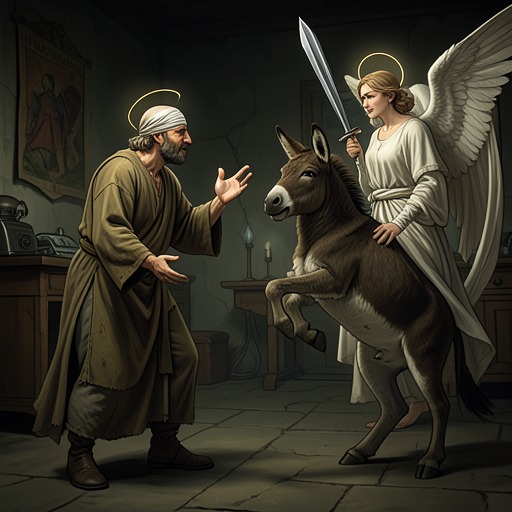
Balaam’s donkey sees the Angel before Balaam does. Three times the animal attempts to avoid the danger, while Balaam, unable to perceive what is happening, responds with anger. The donkey’s repeated resistance contrasts with the prophet’s blindness. Balaam possesses spiritual status, but the animal possesses the practical discernment required for the moment. The narrative consequently turns the expected order upside down: the supposedly inferior creature is acting with greater integrity than the prophet who is riding her.
The Angel eventually stands in a narrow place with no room for the donkey to turn either right or left. The donkey falls beneath Balaam, and Balaam strikes her with his staff. His violence reveals how thoroughly he has misread the situation. He interprets obedience to an unseen danger as stubbornness and punishes the creature that is trying to save him. The narrow passage becomes an image of moral pressure: once compromise has carried Balaam far enough, escape routes disappear, and the only remaining movement is surrender.
Speech, Defense, and Deliverance
God then opens the donkey’s mouth, and she asks Balaam why he has struck her three times. Her speech is the story’s decisive reversal. Earlier, Balaam’s prophetic words were sought by a king; now the truth comes through an animal he has treated as an obstacle. The donkey’s voice does not merely create wonder. It interrupts the pattern of violence and forces Balaam to confront the fact that his own perception has failed.
The Angel explains that the donkey had seen Him and turned aside three times. Had she not done so, Balaam would have been killed while the donkey was spared. The animal’s apparent disobedience was therefore obedience in action, and her suffering was the cost of protecting the man who was beating her. Balaam depended on her even while misunderstanding and punishing her.
The book places special weight on God’s defense of the donkey. God not only permits the animal to speak but also explains why her resistance was right. This demonstrates that divine usefulness does not require human perfection or social prestige; it requires obedience. The donkey becomes an example of integrity under pressure, suffering three times for doing what was right and finally receiving a voice through which the truth could be proclaimed.
Character, Consequences, and Meaning
Balaam’s story is used to distinguish sincere religious identity from uncompromising obedience. He has a heart for God, knows the divine word, and can articulate the limits of his authority, but he still allows promises of riches and honor to shape his conduct. His conflict is therefore ethical before it is dramatic: duty demands that he remain within God’s command, while consequence-oriented desire tempts him with the benefits that compromise might produce. The book resolves the conflict in favor of steadfast obedience rather than negotiation.
The narrative also frames Balaam’s experience as a warning against gradual moral erosion. Compromise rarely announces itself as a total reversal. It begins with entertaining the offer, postponing a clear answer, permitting temptation to remain nearby, and treating disobedience as a temporary investigation. Balaam’s journey to Moab shows how a person can preserve the language of obedience while already moving in the opposite direction.
His donkey supplies the story’s lasting contrast. Balaam is the recognized prophet, yet the donkey sees what he cannot see, acts when he will not act, suffers when he should have been grateful, and speaks when ordinary resistance has failed. The book later uses this structure to emphasize the power of words: kicking, bucking, squirming, and stopping do not change the situation, but speech does. The donkey’s opened mouth turns the plot because it makes hidden danger and misplaced anger visible.
Balaam’s ending in the supplied account is not a triumphant rise but a forced exposure and deliverance. He is stopped before the destructive purpose of his compromise can proceed, and the donkey’s obedience protects his life. The episode leaves him as a cautionary figure: spiritual gifts do not cancel the need for discipline, and divine favor cannot be used to bless disobedience. At the same time, his survival demonstrates the protective dimension of obedience. God’s intervention preserves Balaam through the integrity of a creature he had undervalued, making the prophet’s humiliation the means of his rescue.