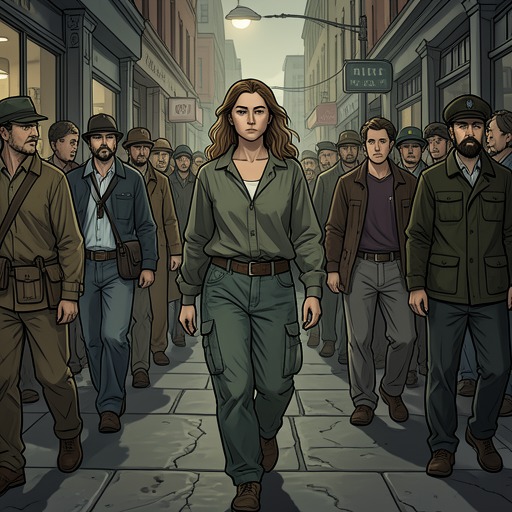
Conformity
Crazy Mama: 9 Steps to a Not-So-Normal LifeConformity is the pressure to adapt one’s conduct and standards to the crowd, a condition the book treats as both a personal diminishment and a perilous way of life. It can feel safe because it offers company and shields people from appearing eccentric, yet that comfort may conceal a surrender of individual gifts and a drift toward the lowest common denominator. The alternative is not rebellion for its own sake, but a distinctive life shaped by renewed judgment, faith, and deliberate choices.
Identity and the Loss of Originality
The book introduces conformity through a comic difference in perception: one daughter sees a pair of pants as genie pants, while Katie identifies them as M.C. Hammer pants. The same object prompts different associations, making the children’s variety a small demonstration of a larger claim. People, like the children, are not interchangeable. Each person is an original, and the book argues that imitation can keep that person from using what is distinctive in them.
That loss is described as more than private dissatisfaction. When someone conforms to the masses, the world is denied the particular gift that person carries. The book connects individuality to purpose: a person was made as they are for a reason, and the world needs what they have to offer. Its appeal to be oneself therefore rests on a religious account of human difference, not simply on personal preference. Conformity is costly because it replaces a particular life with a copy and withholds its contribution from others.
Comfort, Culture, and the Cost of Fitting In
The attraction of conformity is its promise of safety. In the crowd, a person is not alone, and others are less likely to look at them as though they have lost their minds. The book sets that reassurance against its claim that many people live far below their capabilities. Following the majority can make low expectations seem normal, as though what is common must also be an adequate standard. Against that assumption, the text describes divine possibility as extravagant and abundant, and insists that people can become agents of wonders rather than settle for what the crowd regards as ordinary.
A personal furniture-shopping episode gives the cost of that pull a concrete setting. Hannah Keeley accompanies a friend to a store to look at a dining table, entering from a home furnished with cast-offs and charity-store finds. The contrast between the polished showroom and her rickety, peeling dining table is sharp; at home, a mattress stands against a wall with an old quilt pinned up as a makeshift headboard. She becomes captivated by a solid-pine extended headboard equipped with drawers, lights, and mirrors. A salesperson then secures approval for the entire amount, with nothing due upfront and delivery available that day. She signs, only later recognizing how expensive the decision was. In the book’s account, the easy approval and immediate gratification show how a choice that appears to offer entry into a more desirable norm can carry consequences hidden at the moment of purchase.
The book also portrays the surrounding culture as unstable in its moral judgments: standards of right and wrong are treated as subjective, as casual as choosing a pasta sauce. It says that the standards it finds in scripture are compromised and that people who speak for what they regard as right may be dismissed as lunatics or fanatics. On this account, effortless social acceptance is not proof that a person is living well; fitting in without challenging anyone may instead indicate conformity. The passage does not, however, equate resistance with condemnation of other people. It distinguishes accepting people from accepting every action, and frames the pursuit of righteousness as a response to grace rather than a license for self-righteousness.
The Wide Road and Its Reversal
The book’s central image for conformity is the wide road, contrasted with the narrow way leading to life. It invokes Matthew 7:13 to associate the broad route with destruction and treats the sense that everyone is doing something as a warning that the crowd may be following that route. The majority’s direction, rather than serving as a reliable guide, becomes a reason to examine where a choice leads.
The argument is given a social scale through figures the book cites: approximately 70 percent of women are said to take some form of anti-anxiety medication, the average American household is said to carry more than $54,000 in debt, and over a third of Americans are described as obese. The text adds that this last figure excludes people who are out of shape or suffering from poor health. These statistics support its claim that the masses are not on a prosperous path; they are not offered as isolated personal failings, but as signs that widely shared habits can still produce distress and diminished well-being.
The wide road’s danger lies partly in how easy it is to enter. Taking on debt may require only checking a box or clicking a button; becoming inactive requires no effort beyond doing nothing; neglecting a marriage can begin by ignoring it. Such choices initially seem smooth and spacious because they ask little of the person making them. Over time, however, the road grows difficult: people crowd one another, the way ahead becomes harder to see, and vines and tangled limbs impede progress. The route that began as convenience ends in entanglement and destruction. This reversal echoes the furniture episode, where easy access and immediate delivery conceal a later cost.
The narrow road demands the opposite kind of response. Its entrance is so constricted that pride and ego must be left behind to pass through. The contrast is therefore not simply between a crowded and an uncrowded route. It is between unexamined ease and a more demanding path that requires humility, attention, and choices the majority may not make.
Resistance Without Contempt
The book’s advice to determine what everyone else is doing and then do the opposite condenses its strategy for resisting conformity. It first portrays the common direction as a pattern of stress, debt, poor physical condition, and repetitive habits that leave people without a sense of abundant life. The recommendation is to recognize that pattern and refuse to treat its prevalence as evidence of its wisdom. It is a deliberate counter-habit, aimed at escaping ruts rather than at opposing others merely to appear different.
That resistance has a moral boundary. The book rejects a judgmental posture that points fingers at sinful people, acknowledging that all people are sinful and that grace makes freedom and forgiveness possible. Its proposed alternative is to pursue righteousness in response to mercy, while loving and accepting people without endorsing what it regards as sin. In that distinction, nonconformity is not permission for superiority or hostility. It is the effort to live by a considered standard even when the surrounding culture prizes something else.
Conformity thus links intimate choices to a broader account of purpose and consequence. It can silence originality, make compromised standards appear ordinary, and draw people onto a route whose initial ease conceals its destination. Against it, the book sets the original person, the renewed mind, and the narrow road: a life that may look unusual to the crowd, but does not mistake popularity or convenience for the measure of what is good.