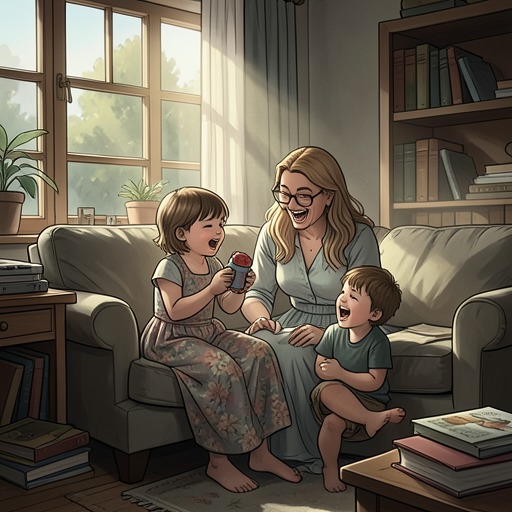
Hannah Keeley–Korben Keeley mother-son relationship
Crazy Mama: 9 Steps to a Not-So-Normal LifeHannah Keeley–Korben Keeley mother-son relationship is presented through scenes of play, conversation, and practical help. Hannah listens as Korben insists that Five is his superhero name, makes him a costume to match it, and later recalls how he tackled a large Lego spaceship by following its instructions. Across these episodes, her account sets parental assumptions beside Korben’s own declarations and actions: she may not immediately understand his idea or expect his success, but the story gives his choices and competence the last word.
Family Life and Superhero Play
Korben is the youngest of Hannah’s three sons, positioned between two older sisters and two younger sisters. Hannah describes the boys as able to withstand the pressure of sisters who love to boss them around, and locates their shared play in the woods around the family home. There they climbed trees, ran at super speed, and pretended to lift cars. Her account makes superhero play a regular family activity rather than a single performance: the boys’ talents seemed boundless as they played together.
The brothers gradually settled on distinct characters. The oldest, Kyler Keeley, became Mighty Man, with super strength; the middle son, Karis Keeley, became Rubber Boy, able to stretch to extraordinary lengths. Korben’s turn to choose a character brings Hannah into the play more directly. The other boys are outside; Korben runs into the living room while she folds clothes, carrying the energy of their game into an ordinary household task. His rosy face, dirt-caked shoes, and sweat-stuck hair establish the physical circumstances of the interruption without displacing its purpose: he has come to tell his mother what his superhero will be called.
The Name Five
Korben announces that he wants to be Five. Hannah takes the word literally and tells him that he is five years old; he explains that Five is his superhero name. When she later asks what his name means, he says that he simply likes five, then clarifies again that it is the name. The exchange loops back on itself: Hannah tries to connect a superhero’s name to a special ability, while Korben holds to the preference he has already expressed.
Hannah recognizes that the conversation has become a circular argument, and frames the impasse with a parent’s wry observation that children become especially skilled at this sort of arguing as teenagers. But the scene does not end with her persuading Korben to choose a more explanatory name. Instead, she asks what he can do, and he answers without hesitation that he can do everything. His declaration supplies the talent that the name itself did not explain. In the relationship’s small comic reversal, Hannah’s practical question gives Korben a chance to define his own character on his own terms.
Costumes and Shared Imagination
The next day, Hannah goes to a fabric store for brightly colored cloth and iron-on backing, then makes costumes for all three boys. Kyler’s blue shirt carries a large red M, Karis’s red shirt a large blue R, and Korben’s yellow shirt a green number 5. The costumes turn the boys’ invented identities into something they can wear, while preserving the different names and colors they had chosen. Hannah’s response is not to replace Korben’s unusual idea with a conventional superhero identity; she makes a shirt that represents it.
Her account also follows the shirts into the repetitive logistics of family life. As soon as the costumes come out of the wash, the boys put them back on. Hannah eventually cuts corners and stops laundering them, joking about little-boy body odor and the competing smells in a nine-person household. The detail keeps her participation grounded in domestic work: making the costumes is followed by the less glamorous task of dealing with how often the boys wear them. In the neighborhood, the three homemade shirts make the brothers recognizable as a trio, with Korben’s numeral placed beside his brothers’ initials.
Instructions, Confidence, and Parental Assumptions
A later memory shows Hannah describing Korben’s first large Lego kit, given to him for his eighth birthday by Blair’s parents. Seeing the picture on the box, she doubts that a child his age can build the enormous spaceship. Korben is not deterred: he empties the pieces, takes up the instruction booklet, and works through the steps until the finished spaceship stands on the dining-room table a couple of hours later. The scene gives concrete form to a contrast already present in the superhero episode. Hannah can underestimate what Korben will manage, while his response is to proceed with the task in front of him.
Hannah uses the Lego story to explain her belief that people need God’s Word as an instruction manual, rather than trying to assemble a difficult undertaking without guidance. In that argument, Korben’s achievement becomes an example of patient, directed work: he follows the booklet, step by step, and completes the spaceship. The comparison does not erase the mother-son scene beneath the religious lesson. Hannah’s initial doubt, Korben’s untroubled attention to the instructions, and the completed model remain the facts that make her illustration persuasive. Together with the costume episode, the memory portrays a mother who tells stories about her son through the gap between what she expects and what he shows he can do.